
Suastus gremius, the Indian palm bob or palm bob, is a butterfly belonging to the family Hesperiidae. It is found in the Indomalayan realm.

Taractrocera ceramas, commonly known as the Tamil grass dart, is a butterfly belonging to the family Hesperiidae. It is found from the Western Ghats to Mumbai, in the hills of southern India, in northeast India to northern Burma and in south-eastern China.

Miletus symethus, the great brownie, is a small butterfly found in India that belongs to the lycaenids or blues family. The species was first described by Pieter Cramer in 1777.

Setina irrorella, the dew moth, is a moth of the family Erebidae. The species was first described by Carl Linnaeus in his 1758 10th edition of Systema Naturae. It is found in the Palearctic from Ireland, then through Europe and east to northern and central Asia to the Pacific Ocean. It is missing in the high north and parts of the Mediterranean region. It is found also in the limestone Alps up to 2,000 meters above sea level.
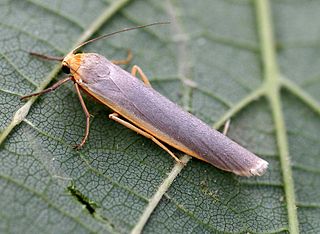
Manulea complana, the scarce footman, is a moth of the family Erebidae. The species was first described by Carl Linnaeus in his 1758 10th edition of Systema Naturae. It is found throughout the Palearctic region.

Ophthalmitis is a genus of geometer moths in the Boarmiini tribe.

Dicallomera fascelina, the dark tussock, is a moth in the family Erebidae. It is found in most of Europe, through the Palearctic to Central Asia to Korea.

Catocala nymphagoga, the oak yellow underwing, is a moth of the family Erebidae. It is found in Southern Europe, from Bulgaria up to the Iberian Peninsula and sometimes further north as a migrant. It is also found in North Africa and Asia Minor.

Thumatha senex, the round-winged muslin, is a moth of the family Erebidae. It is found in northern and central Europe, the Alps, northern Asia Minor, the Crimea and south-western Siberia.
Anarsia amalleuta is a moth of the family Gelechiidae. It was described by Meyrick in 1913. It is found in South Africa and Zimbabwe.
Anarsia antisaris is a moth of the family Gelechiidae. It was described by Meyrick in 1913. It is found in South Africa.
Anarsia mitescens is a moth of the family Gelechiidae. It was described by Meyrick in 1913. It is found in South Africa.
Anarsia pensilis is a moth of the family Gelechiidae. It was described by Meyrick in 1913. It is found in Sri Lanka.
Dichomeris thyrsicola is a moth in the family Gelechiidae. It was described by Meyrick in 1913. It is found in India (Assam).
Hypatima dissidens is a moth in the family Gelechiidae. It was described by Meyrick in 1913. It is found in South Africa (Mpumalanga).
Palintropa hippica is a moth in the family Gelechiidae. It was described by Meyrick in 1913. It is found in Sri Lanka.
Gonioterma aesiocopia is a moth in the family Depressariidae. It was described by Lord Walsingham in 1913. It is found in Mexico and Panama.
Gonioterma diatriba is a moth in the family Depressariidae. It was described by Lord Walsingham in 1913. It is found in Guatemala.
Gonioterma compressa is a moth in the family Depressariidae. It was described by Lord Walsingham in 1913. It is found in Venezuela and Mexico (Tabasco).
Eucosmophyes icelitodes is a moth of the family Tortricidae first described by Edward Meyrick in 1913. It is found in Sri Lanka.
