
Udea fulvalis is a species of moth of the family Crambidae. It was first described by Jacob Hübner in 1809.

Udea lutealis is a species of moth of the family Crambidae described by Jacob Hübner in 1809.

Udea prunalis is a moth of the family Crambidae. It is found in Europe and China. The species was first described by Michael Denis and Ignaz Schiffermüller in 1775. In the Butterfly Conservation's Microlepidoptera Report 2011 this species was classified as common in the UK.

Udea is a genus of snout moths in the subfamily Spilomelinae of the family Crambidae. The genus was erected by Achille Guenée in 1845. The currently known 214 species are present on all continents except Antarctica. About 41 species are native to Hawaii.

Thinopteryx is a genus of moths in the family Geometridae erected by Arthur Gardiner Butler in 1883.
Udea monticolens is a moth of the family Crambidae described by Arthur Gardiner Butler in 1882. It is endemic to the Hawaiian islands of Kauai, Oahu and Hawaii.
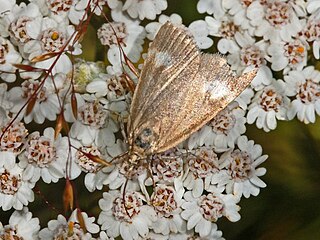
Udea alpinalis is a moth of the family Crambidae. The species was first described by Michael Denis and Ignaz Schiffermüller in 1775. It is an alpine species found in Europe.
Udea alaskalis is a moth in the family Crambidae. It was described by Arthur Gibson in 1920. It is a high Arctic species found in North America, where it has been recorded from Alaska. It is also found in Greenland and northern European Russia.
Udea cinerea is a moth in the family Crambidae. It was described by Arthur Gardiner Butler in 1883. It is found in Chile.
Udea indistincta is a moth in the family Crambidae. It was described by Arthur Gardiner Butler in 1883. It is found in Chile.
Udea melanosticta is a moth in the family Crambidae. It was described by Arthur Gardiner Butler in 1883. It is found in Chile.
Mnesictena notata is a moth in the family Crambidae. It was described by Arthur Gardiner Butler in 1879. It is endemic to New Zealand.
Udea ragonotii is a moth in the family Crambidae. It was described by Arthur Gardiner Butler in 1883. It is found in Chile.
Holcopogon robustus is a moth in the family Autostichidae. It was described by Arthur Gardiner Butler in 1883. It is found in Sri Lanka.
Cryptolechia hecate is a moth in the family Depressariidae. It was described by Arthur Gardiner Butler in 1883. It is found in Chile.
Doina edmondsii is a moth in the family Depressariidae. It was described by Arthur Gardiner Butler in 1883. It is found in Chile.
Doina increta is a moth in the family Depressariidae. It was described by Arthur Gardiner Butler in 1883. It is found in Chile.
Odites swinhoei is a moth in the family Depressariidae. It was described by Arthur Gardiner Butler in 1883. It is found in India.
Pisinidea viridis is a moth in the family Depressariidae. It was described by Arthur Gardiner Butler in 1883. It is found in Chile.

