
Colotis danae, the crimson tip or scarlet tip, is a small butterfly of the family Pieridae, that is, the yellows and whites. It is found in Asia and Africa.

Graphium aurivilliusi is a species of butterfly in the family Papilionidae (swallowtails). It is endemic to the Democratic Republic of the Congo. It is only known from the type series of males.
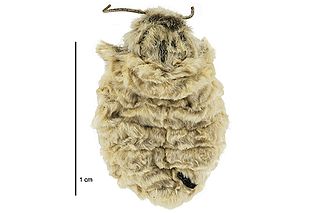
Metacrias huttoni is a species of moth in the family Erebidae. This species is endemic to New Zealand where it is known from the eastern areas of the South Island. The female of the species is flightless and buff coloured where as the male is brightly coloured and flies during the day.

Graphium agamedes, the Westwood's white lady, is a butterfly in the family Papilionidae (swallowtails). It is found in Ivory Coast, Ghana, Togo, Benin, Nigeria, Cameroon, the Central African Republic and the Democratic Republic of the Congo. The habitat consists of the forest/savanna transition zone.

Graphium fulleri is a butterfly in the family Papilionidae (swallowtails). It is found in Cameroon, Equatorial Guinea, Gabon, the Republic of the Congo, Angola, the Democratic Republic of the Congo and Chad.

Episcepsis venata is a moth of the family Erebidae. It was described by Arthur Gardiner Butler in 1877. It is found in Mexico and the Amazon region.

Ichneutica morosa is a moth of the family Noctuidae. It is endemic to New Zealand and is found in the southern parts of the North Island and throughout the South Island. I. morosa is common in the eastern parts of both those islands and also in Fiordland. I. morosa can be found from altitudes ranging from lowlands to the alpine zone. I. morosa is absent from the range of its closely related species I. mustulenta, that is from the northern North Island. The larvae of I. morosa are known to feed on Poa astonii and also on other Poa species including introduced species. As well as its standard form the adult moths have a grey colour morph with the head and thorax being a grey and mottled brown, and the forewing being a pale greyish ochreous to a deep brown, suffused with grey. I. morosa can be confused with I. mustulenta and I. lignana. Adults are on the wing from November to April.
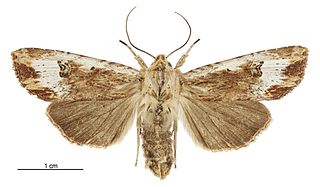
Ichneutica rubescens is a moth of the family Noctuidae. It is endemic to New Zealand. This species can be found locally in the North Island but is widespread throughout the South Island and is present on both Stewart Island and the Auckland Islands. I. rubescens has a round or oval mark near the centre of the forewing that encloses a dot. This is diagnostic of this species. I. rubescens inhabits tussock grasslands, beech as well as podocarp forests. Larval hosts are likely herbaceous plants such as grasses and herbs and larvae have been reared on Gunnera prorepens. Adults of this species are on the wing from December to April and are attracted to light.
Udea cinerea is a moth in the family Crambidae. It was described by Arthur Gardiner Butler in 1883. It is found in Chile.
Udea indistincta is a moth in the family Crambidae. It was described by Arthur Gardiner Butler in 1883. It is found in Chile.
Mnesictena notata is a moth in the family Crambidae. It was described by Arthur Gardiner Butler in 1879. It is endemic to New Zealand.
Udea ragonotii is a moth in the family Crambidae. It was described by Arthur Gardiner Butler in 1883. It is found in Chile.
Neoploca is a genus of moths belonging to the subfamily Thyatirinae of the Drepanidae. It was first described by Shōnen Matsumura in 1927. It contains only one species, Neoploca arctipennis, first described by Arthur Gardiner Butler in 1878, which is found in Japan, Korea, the Russian Far East and China.
Phiala cunina is a moth in the family Eupterotidae. It was described by Pieter Cramer in 1780. It is found in Cameroon, Nigeria and Sierra Leone.

Hibrildes crawshayi is a moth in the family Eupterotidae. It was described by Arthur Gardiner Butler in 1896. It is found in the Democratic Republic of the Congo (Katanga), Malawi, South Africa, Tanzania, Zambia and Zimbabwe.
Doina edmondsii is a moth in the family Depressariidae. It was described by Arthur Gardiner Butler in 1883. It is found in Chile.
Doina increta is a moth in the family Depressariidae. It was described by Arthur Gardiner Butler in 1883. It is found in Chile.
Odites swinhoei is a moth in the family Depressariidae. It was described by Arthur Gardiner Butler in 1883. It is found in India.
Stenoma fallax is a moth in the family Depressariidae. It was described by Arthur Gardiner Butler in 1877. It is found in the Amazon region of Brazil.

Arctesthes catapyrrha is a moth of the family Geometridae. It is endemic to New Zealand.

