
Cataclysta lemnata, the small china-mark, is a moth species of the family Crambidae. It is found in Europe, Morocco and Iran.

Elophila nymphaeata, the brown china mark, is a species of moth of the family Crambidae. It was described by Carl Linnaeus in his 1758 10th edition of Systema Naturae. It is found in Europe and across the Palearctic to the Russian Far East and China. The moth is notable as its larva, like most members of the crambid subfamily Acentropinae, is aquatic and has tracheal gills.
Loxmaionia is a genus of moths of the family Crambidae. It contains only one species, Loxmaionia megale, which is found in Costa Rica.
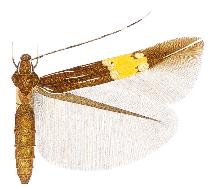
Cosmopterix astrapias is a moth of the family Cosmopterigidae. It is known from the United States, Argentina, Costa Rica, Jamaica, Mexico (Tabasco) and Puerto Rico.
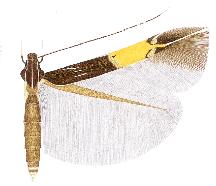
Cosmopterix teligera is a moth of the family Cosmopterigidae. It is known from the United States, Brazil, Colombia, Costa Rica, Cuba, Jamaica and Mexico (Tamaulipas).
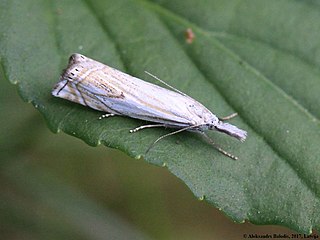
Crambus uliginosellus is a species of moth in the family Crambidae. It was first described by Zeller in 1850 and is currently found in most of Europe, except Portugal, Slovenia, Croatia and Ukraine.
Cnaphalocrocis cochrusalis, the marasmia moth, is a moth in the family Crambidae. It is found in the West Indies, Costa Rica, Honduras and the United States, where it has been recorded from Florida, Louisiana, Mississippi, Oklahoma, South Carolina and Texas.
Samea sylvialis is a moth in the family Crambidae. It is found in Brazil, Venezuela and Costa Rica.
Stenorista fortunata is a moth in the family Crambidae. It was described by Schaus in 1912. It is found in Costa Rica.
Sufetula polystrialis is a moth in the family Crambidae. It was described by George Hampson in 1912. It is found on the Louisiade Islands.
Sufetula sunidesalis is a moth in the family Crambidae. It was described by Francis Walker in 1859. It is found on Borneo and in India, Sri Lanka and Malaysia.
Syllepte microstictalis is a moth in the family Crambidae. It was described by George Hampson in 1918. It is found in Cameroon.
Syllepte agraphalis is a moth in the family Crambidae. It was described by George Hampson in 1912. It is found in Bhutan and Assam, India.
Syntrita nimalis is a moth in the family Crambidae. It was described by William Schaus in 1924. It is found in Bolivia.
Udea ferrealis is a moth in the family Crambidae. It was described by George Hampson in 1900. It is found in Amur in the Russian Far East.
Mnesictena pantheropa is a moth in the family Crambidae. It was described by Edward Meyrick in 1884. It is endemic to New Zealand, where it has been recorded from the Chatham Islands.
Udea umbriferalis is a moth in the family Crambidae. It was described by George Hampson in 1918. It is found in Peru and Bolivia.
Antaeotricha modulata is a species of moth of the family Depressariidae. It is found in Brazil, Guyana and French Guiana.
Stenoma comma is a moth of the family Depressariidae. It is found in Cuba, Mexico, El Salvador, Costa Rica, Panama, Venezuela, French Guiana and Guyana.
Rhodanassa io is a moth of the family Depressariidae and the only species in the genus Rhodanassa. It is found in French Guiana.

