
Lygephila pastinum, the blackneck, is a moth of the family Erebidae. The species was first described by Georg Friedrich Treitschke in 1826. It is found in Europe and across the Palearctic Siberia, the Russian Far East, Japan and China.
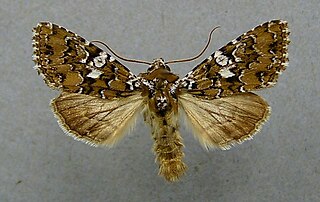
Hadena albimacula, the white spot, is a species of moth of the family Noctuidae. It is found in Europe.

Euxoa obelisca, the square-spot dart, is a moth of the family Noctuidae. It is found in the Palearctic realm.
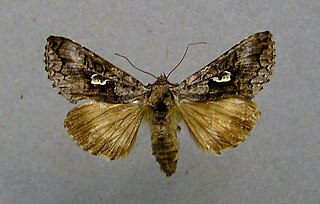
Syngrapha interrogationis, the scarce silver Y, is a moth of the family Noctuidae. It is found in the northern areas of the world, from Alaska, through Canada, Iceland, Europe, Siberia up to Northeast Asia including Japan.

Catocala nymphagoga, the oak yellow underwing, is a moth of the family Erebidae. It is found in Southern Europe, from Bulgaria up to the Iberian Peninsula and sometimes further north as a migrant. It is also found in North Africa and Asia Minor.

The green-brindled dot is a species of moth of the family Noctuidae. It is found in Southern Europe and the Middle East, then east up to Iran and Ukraine. In Germany it is found up to the Eifel and Ahr.

Schrankia taenialis, the white-line snout, is a species of moth of the family Erebidae. It is found from Central Europe to Sardinia, Sicily, North Turkey and Azerbaijan.

Apona caschmirensis is a moth of the family Eupterotidae first described by Vincenz Kollar in 1844. It is found in Nepal, Pakistan and India.
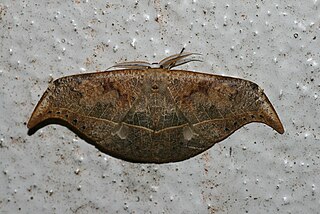
Canucha specularis is a moth of the family Drepanidae described by Frederic Moore in 1879. It is found in Hong Kong, India, southern China, Sundaland and Sulawesi.

Apamea lateritia, the scarce brindle, is a moth of the family Noctuidae. It is found in much of the Palearctic. It is a sporadic migrant in Great Britain, where it is recorded from the east and south-east coasts.

Apamea anceps, the large nutmeg, is a moth of the family Noctuidae. The species was first described by Michael Denis and Ignaz Schiffermüller in 1775.

Athetis pallustris, the marsh moth, is a moth of the family Noctuidae. It is found in most of Europe, the southern Urals, southern Russia, Ukraine, eastern Turkey, Siberia, the Amur region, the Russian Far East, Mongolia and northern China.
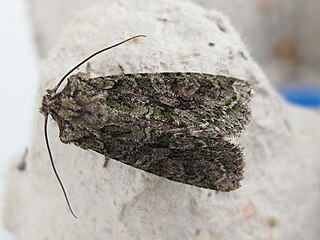
Dryobotodes eremita, the brindled green, is a moth of the family Noctuidae. The species was first described by Johan Christian Fabricius in 1775. It is found in most of Europe, east to Turkey.
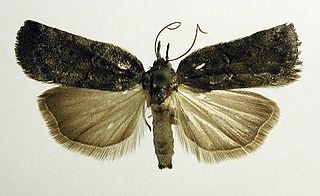
Nycteola revayana, the oak nycteoline, is a moth of the family Nolidae. The species was first described by Giovanni Antonio Scopoli in 1772. It is found from Europe and east across the Palearctic to Japan and India.

Elaphria venustula is a moth of the family Noctuidae. It is found in most of Europe, except the north. In the east, the range extends through the Palearctic to the Pacific Ocean.
Prionopaltis sericea is a moth in the family Crambidae. It was described by William Warren in 1892. It is found in Himachal Pradesh, India.
Pygospila cuprealis is a moth in the family Crambidae. It was described by Charles Swinhoe in 1892. It is found in Meghalaya, India and in Myanmar.
Udea indistinctalis is a moth in the family Crambidae. It was described by William Warren in 1892. It is found in North America, where it has been recorded from Alberta, Saskatchewan, Washington and California.
Canucha sublignata is a moth in the family Drepanidae. It was described by Warren in 1902. It is found in New Guinea and on the Moluccas.

Eriopygodes imbecilla, the Silurian, is a moth of the family Noctuidae first described by Johan Christian Fabricius in 1794.
