
Hebomoia glaucippe, the great orange-tip, is a butterfly belonging to the family Pieridae, that is the yellows and whites. It is found in the Indomalayan realm and Wallacea.
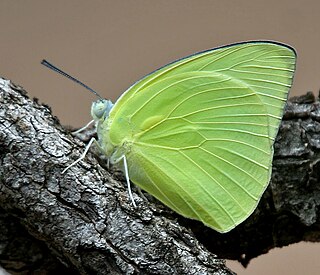
Catopsilia pomona, the common emigrant or lemon emigrant, is a medium-sized pierid butterfly found in Asia, Cambodia and parts of Australia. The species gets its name from its habit of migration. Some early authors considered them as two distinct species Catopsilia crocale and Catopsilia pomona.

Acrapex atriceps is a species of moth of the family Noctuidae first described by George Hampson in 1910. It is found in India.

Acrapex brunnea is a species of moth of the family Noctuidae first described by George Hampson in 1910. It is found in Africa, including Angola, Kenya and South Africa.

Acrapex carnea is a species of moth of the family Noctuidae first described by George Hampson in 1905. It is found in Africa, including South Africa.

Acrapex leucophlebia is a species of moth of the family Noctuidae first described by George Hampson in 1894. It is found in the Nilgiri Mountains of India.

Acrapex roseotincta is a species of moth of the family Noctuidae first described by George Hampson in 1910. It is found in Sri Lanka.

Acrapex spoliata is a species of moth of the family Noctuidae first described by Francis Walker in 1863. It is found in Africa, including Sierra Leone and South Africa.

Amolita irrorata is a species of moth in the family Erebidae first described by George Hampson in 1910. The species is found in South America, including Paraguay and Brazil. Its wingspan is 26–32 mm (1.0–1.3 in).

Amolita perstriata is a species of moth in the family Erebidae first described by George Hampson in 1910. The species is found on the Bahamas. Its wingspan is about 22 mm.

Acylita distincta is a species of moth of the family Noctuidae first described by E. Dukinfield Jones in 1908. It is found in Brazil. Its wingspan is about 26 mm.
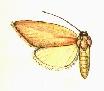
Acylita elongata is a species of moth of the family Noctuidae first described by William Schaus in 1906. It is found in Brazil. Its wingspan is about 34 mm.

Spilosoma batesi is a moth of the family Erebidae. It was described by Walter Rothschild in 1910. It is found in Nigeria, Cameroon, Congo and Zaire.
Scoparia atricuprea is a moth in the family Crambidae. It was described by George Hampson in 1917. It is found in South America and on the Antilles.
Blepharomastix fusalis is a moth in the family Crambidae. It was described by George Hampson in 1917. It is found in Colombia.
Pycnarmon syleptalis is a moth in the family Crambidae. It was described by George Hampson in 1899. It is found in Loja Province, Ecuador.
Salbia pachyceralis is a moth in the family Crambidae. It was described by George Hampson in 1917. It is found in Panama.
Udea melanephra is a moth in the family Crambidae. It was described by George Hampson in 1913. It is found in Colombia and Bolivia.
Udea melanostictalis is a moth in the family Crambidae. It was described by George Hampson in 1916. It is found in Kenya.
Udea poasalis is a moth in the family Crambidae. It was described by Schaus in 1912. It is found in Costa Rica.
