
Halpe porus, or Moore's ace, is a butterfly belonging to the family Hesperiidae, found in India.
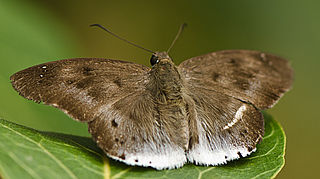
Tagiades japetus, commonly known as the pied flat or the common snow flat, is a species of spread-winged skipper butterfly belonging to the family Hesperiidae. It is widely distributed, being found from India, the Himalayas, Southeast Asia, to Australia. It contains twenty-four recognized subspecies.

Colotis danae, the crimson tip or scarlet tip, is a small butterfly of the family Pieridae, that is, the yellows and whites. It is found in Asia and Africa.

Appias lalage, the spot puffin, is a small butterfly of the family Pieridae, that is, the yellows and whites, which is found in India, Indochina and Hainan.

Appias indra, the plain puffin, is a small butterfly of the family Pieridae, that is, the yellows and whites, which is found in south and southeast Asia.

Melanitis phedima, the dark evening brown, is a species of butterfly found flying at dusk. The flight of this species is erratic. They are found in south and southeast Asia.
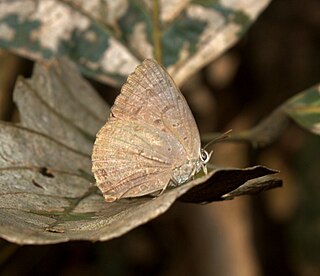
Arhopala atrax, the dark broken-band oakblue or Indian oakblue, is a species of lycaenid or blue butterfly found in the Indomalayan realm.

Zesius chrysomallus, the redspot, is a species of lycaenid or blue butterfly found in Sri Lanka and India.

Ichneutica morosa is a moth of the family Noctuidae. It is endemic to New Zealand and is found in the southern parts of the North Island and throughout the South Island. I. morosa is common in the eastern parts of both those islands and also in Fiordland. I. morosa can be found from altitudes ranging from lowlands to the alpine zone. I. morosa is absent from the range of its closely related species I. mustulenta, that is from the northern North Island. The larvae of I. morosa are known to feed on Poa astonii and also on other Poa species including introduced species. As well as its standard form the adult moths have a grey colour morph with the head and thorax being a grey and mottled brown, and the forewing being a pale greyish ochreous to a deep brown, suffused with grey. I. morosa can be confused with I. mustulenta and I. lignana. Adults are on the wing from November to April.
Udea indistincta is a moth in the family Crambidae. It was described by Arthur Gardiner Butler in 1883. It is found in Chile.
Udea melanosticta is a moth in the family Crambidae. It was described by Arthur Gardiner Butler in 1883. It is found in Chile.
Mnesictena notata is a moth in the family Crambidae. It was described by Arthur Gardiner Butler in 1879. It is endemic to New Zealand.
Euphalacra nigridorsata is a moth in the family Drepanidae. It was described by Warren in 1897. It is found in the north-eastern Himalayas.
Neoploca is a genus of moths belonging to the subfamily Thyatirinae of the Drepanidae. It was first described by Shōnen Matsumura in 1927. It contains only one species, Neoploca arctipennis, first described by Arthur Gardiner Butler in 1878, which is found in Japan, Korea, the Russian Far East and China.
Kurama mirabilis is a moth in the family Drepanidae. It was described by Arthur Gardiner Butler in 1879. It is found in Japan.
Odites swinhoei is a moth in the family Depressariidae. It was described by Arthur Gardiner Butler in 1883. It is found in India.
Cerconota nitens is a moth in the family Depressariidae. It was described by Arthur Gardiner Butler in 1877. It is found in Brazil (Amazonas).
Stenoma fallax is a moth in the family Depressariidae. It was described by Arthur Gardiner Butler in 1877. It is found in the Amazon region of Brazil.

Austramathes purpurea is a species of moth in the family Noctuidae. It is endemic to New Zealand and can be found throughout the North and South Islands but has yet to be recorded at Stewart Island. It inhabits native forest. This species might possibly be confused with A. pessota, however this latter species does not have the purple hue to the forewings. The larvae of A. purpurea feed primarily on māhoe but have been recorded as feeding on, and have been reared on, narrow-leaved māhoe. The larvae pupate in a silken cocoon on moss covered ground. Adults can be found on the wing during the months of March to January but mainly occur during New Zealand's late autumn, winter, and spring. Light trapping may not be the most efficient technique for collecting this species.

Samana acutata is a species of moth in the family Geometridae This species is endemic to New Zealand. It is classified as "At Risk, Relict" by the Department of Conservation.
