
Sikkim is a state in northeastern India. It borders the Tibet Autonomous Region of China in the north and northeast, Bhutan in the east, Nepal in the west, and West Bengal in the south. Sikkim is also close to India's Siliguri Corridor near Bangladesh. Sikkim is the least populous and second smallest among the Indian states. A part of the Eastern Himalaya, Sikkim is notable for its biodiversity, including alpine and subtropical climates, as well as being a host to Kangchenjunga, the highest peak in India and third highest on Earth. Sikkim's capital and largest city is Gangtok. Almost 35% of the state is covered by the Khangchendzonga National Park – a UNESCO World Heritage Site.

Gangtok is a city, municipality, the capital and the largest town of the Indian state of Sikkim. It is also the headquarters of the East Sikkim district. Gangtok is in the eastern Himalayan range, at an elevation of 1,650 m (5,410 ft). The town's population of 100,000 are from different ethnicities such as Bhutia, Lepchas and Indian Gorkhas. Within the higher peaks of the Himalaya and with a year-round mild temperate climate, Gangtok is at the centre of Sikkim's tourism industry.

The history of Sikkim, an area in present-day North-East India, began in 1642 as a kingdom established when India and Nepal were still many princely states with many rulers at that time and had not unified to the present Union of India and present country of Nepal. At that time Sikkim had already solidified into country then with a king known as a Chogyal or dharma king, and till 16 May 1975 was an independent country ruled by the monarchs. Sikkim had twelve kings; Palden Thondup Namgyal was the last king of Independent Sikkim. There was contacts between ancient Hindus and Tibetans, followed by the establishment of a Buddhist kingdom or Chogyal in the 17th century. Sikkim emerged as a polity in its own right against a backdrop of incursions from Tibet and Bhutan, during which the kingdom enjoyed varying degrees of independence. In the early 18th century, the British Empire sought to establish trade routes with Tibet, leading Sikkim to fall under British suzerainty until independence in 1947. Initially, Sikkim remained an independent country, until it merged with India in 1975 after a decisive referendum. Many provisions of the Indian constitution had to be altered to accommodate the international treaties and between Sikkim and India.

Sikkim Democratic Front (SDF) is a regional political party in the Indian state of Sikkim. It was the ruling party in Sikkim from 12 December 1994 to 23 May 2019.
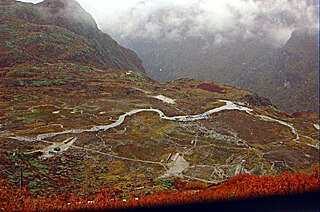
Yadong County, also transliterated from Tibetan as Chomo County, is a frontier county and trade-market of Tibet Autonomous Region, China, situated in the mouth of the Chumbi valley near the China-India and China-Bhutan border. It lies in the middle part of Himalayas and the south of Tibet Autonomous Region, covering about 4,306 square kilometers with a population of 10,000. It is under the jurisdiction of Xigazê.

Charles Lionel Augustus de Nicéville was a curator at the Indian Museum in Calcutta. He studied the butterflies of the Indian Subcontinent and wrote a three volume monograph on the butterflies of India, Bangladesh, Nepal, Burma and Sri Lanka.

Chumbi Valley is a valley in Yadong County, Tibet Autonomous Region, China. The valley is on the south side of the Himalayan drainage divide, near the Chinese border with Sikkim state of India and with Bhutan. The Chumbi Valley is connected to Sikkim to the southwest via the mountain passes of Nathu La and Jelep La.

Sikkimese cuisine is the cuisine of the state of Sikkim, located in northeastern India. Rice is a staple food, and fermented foods traditionally constitute a significant portion of the cuisine. Nepalese cuisine is popular, as Sikkim is the only state of India with an ethnic Nepali majority. Many restaurants in Sikkim serve various types of Nepalese cuisine, such as the Newa and Thakali cuisines. Tibetan cuisine has also influenced Sikkimese cuisine.

The Kingdom of Sikkim, earlier known as Dremoshong, was a hereditary monarchy from 1642 to 16 May 1975 in the Eastern Himalayas. It was ruled by Chogyals of the Namgyal dynasty.
The indigenous peoples of Sikkim include the Lepchas, Limbus, Nepalis and Bhutias.

The Sikkim Legislative Assembly is the unicameral state legislature of Sikkim state in north-eastern India. The seat of the Legislative Assembly is at Gangtok, the capital of the Sikkim state.

The Sikkim expedition was an 1888 British military expedition to expel Tibetan forces from Sikkim in present-day north east India. The roots of the conflict lay in British-Tibetan competition for sovereignty over Sikkim.

Sikkim Krantikari Morcha is a political party in the Indian state of Sikkim which was the ruling party of Sikkim in 2020.
The Convention of Calcutta was a late 19th-century treaty between the United Kingdom of Great Britain and Ireland and the ruling Chinese Qing dynasty relating to Tibet and the north Indian Kingdom of Sikkim. It was signed by Viceroy of India Lord Lansdowne and the Chinese Amban or resident in Tibet, Sheng Tai on 17 March 1890 in Calcutta, India.
Gadul Singh Lama, popularly known as Sanu Lama, is an Indian fiction writer, poet and translator of Nepali literature. An engineer by profession, he has published three short story anthologies and his stories have been translated into English, Hindi, Urdu, Assamese and Oriya languages. He is a recipient of Sahitya Akademi Award (1993), apart from other awards such as Sikkim Bhanu Puraskar, Dr. Shova Kanti Thegim Smrithi Puraskar and Madan Byakhanmala Puraskar. The Government of India awarded him the fourth highest civilian honour of the Padma Shri, in 2005, for his contributions to literature.

Doklam, Zhoglam, or Donglang, is an area with a plateau and a valley, lying between China's Chumbi Valley to the north, Bhutan's Ha Valley to the east and India's Sikkim state's Nathang Valley to the west. It has been depicted as part of Bhutan in the Bhutanese maps since 1961, but it is also claimed by China. To date, the dispute has not been resolved despite several rounds of border negotiations between Bhutan and China. The area is of strategic importance to all three countries.
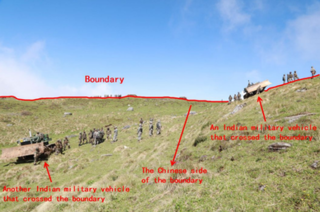
The 2017 China India border standoff or Doklam standoff refers to the military border standoff between the Indian Armed Forces and the People's Liberation Army of China over Chinese construction of a road in Doklam near a trijunction border area, known as Donglang, or Donglang Caochang, in Chinese. On 16 June 2017 Chinese troops with construction vehicles and road-building equipment began extending an existing road southward in Doklam, a territory which is claimed by both China as well as India's ally Bhutan. On 18 June 2017, as part of Operation Juniper, about 270 Indian troops armed with weapons and two bulldozers crossed the Sikkim border into Doklam to stop the Chinese troops from constructing the road. On 28 August, both India and China announced that they had withdrawn all their troops from the face-off site in Doklam.
The Sikkim Premier Division League is an association football league in Sikkim, India organised by Sikkim Football Association. It started with 8 teams in 2018. United Sikkim F.C. won the two consecutive S-league title for the session of 2017 and 2018.
The first case of the COVID-19 pandemic in India was reported on 30 January 2020, originating from China. Slowly, the pandemic spread to various states and union territories including the state of Sikkim.
