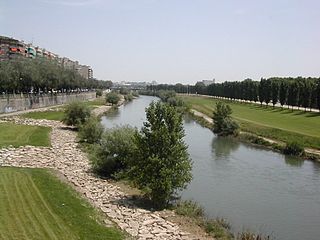
The Segre is a river tributary to the Ebro with a basin comprising territories across three states: France, Andorra and Spain.

Tremp is a municipality in Catalonia, Spain, the capital of the comarca of the Pallars Jussà. It is the largest municipality in Catalonia in terms of area, accounting for nearly a quarter of the total area of the comarca.

Hadrosaurids, or duck-billed dinosaurs, are members of the ornithischian family Hadrosauridae. This group is known as the duck-billed dinosaurs for the flat duck-bill appearance of the bones in their snouts. The ornithopod family, which includes genera such as Edmontosaurus and Parasaurolophus, was a common group of herbivores during the Late Cretaceous Period. Hadrosaurids are descendants of the Late Jurassic/Early Cretaceous iguanodontian dinosaurs and had a similar body layout. Hadrosaurs were among the most dominant herbivores during the Late Cretaceous in Asia and North America, and during the close of the Cretaceous several lineages dispersed into Europe, Africa, and South America.
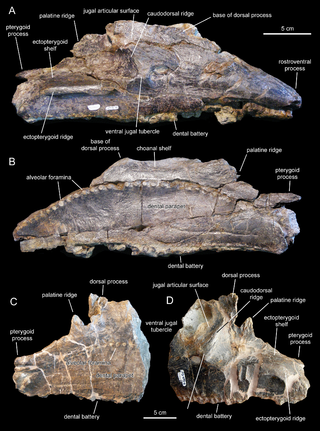
Pararhabdodon is a genus of tsintaosaurin hadrosaurid dinosaur, from the Maastrichtian-age Upper Cretaceous Tremp Group of Spain. The first remains were discovered from the Sant Romà d’Abella fossil locality and assigned to the genus Rhabdodon, and later named as the distinct species Pararhabdodon isonensis in 1993. Known material includes assorted postcranial remains, mostly vertebrae, as well as maxillae from the skull. Specimens from other sites, including remains from France, a maxilla previously considered the distinct taxon Koutalisaurus kohlerorum, an additional maxilla from another locality, the material assigned to the genera Blasisaurus and Arenysaurus, and the extensive Basturs Poble bonebed have been considered at different times to belong to the species, but all of these assignments have more recently been questioned. It was one of the last non-avian dinosaurs known from the fossil record that went extinct during the Cretaceous-Paleogene extinction event.

Anglès is a catalan municipality, in the comarca of Selva, in the province of Girona, Catalonia. It has an area of 16.30 km² and a population of 5,446 people (2008).

Koutalisaurus is a potentially dubious genus of extinct hadrosaurid dinosaur from the Arenysaurini. It is based on a mostly complete dentary from the Maastrichtian-age Upper Cretaceous Tremp Formation near the town of Abella de la Conca, Lleida, Spain.
The Arén Formation or Arén Sandstone is a geological formation in the Tremp-Graus Basin around Arén, Catalonia, Spain whose strata date back to the Late Cretaceous. Dinosaur remains are among the fossils that have been recovered from the formation. The formation dates to the Campanian to Maastrichtian and underlies the Tremp Group.

The Tremp Formation, alternatively described as Tremp Group, is a geological formation in the comarca Pallars Jussà, Lleida, Spain. The formation is restricted to the Tremp or Tremp-Graus Basin, a piggyback foreland basin in the Catalonian Pre-Pyrenees. The formation dates to the Maastrichtian to Thanetian, thus the formation includes the Cretaceous-Paleogene boundary that has been well studied in the area, using paleomagnetism and carbon and oxygen isotopes. The formation comprises several lithologies, from sandstone, conglomerates and shales to marls, siltstones, limestones and lignite and gypsum beds and ranges between 250 and 800 metres in thickness. The Tremp Formation was deposited in a continental to marginally marine fluvial-lacustrine environment characterized by estuarine to deltaic settings.

Rail transport in Catalonia operates on three rail gauges and services are operated by a variety of public operators:

Amer is a municipality in the comarca of la Selva in the province of Girona, Catalonia, Spain.
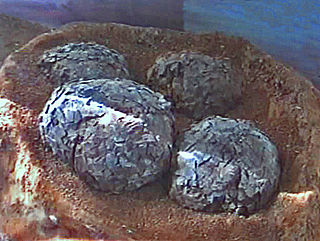
Megaloolithus is an oogenus of dinosaur egg. They are thought to have been laid by sauropod dinosaurs. They are known for having thick eggshells, at least 1.5 millimetres (0.059 in) thick, and the nearly spherical shape of the eggs. They are primarily found in India and Europe, but some specimens have been found in South America.
Ageroolithus is an oogenus of dinosaur egg. It may have been laid by a theropod.
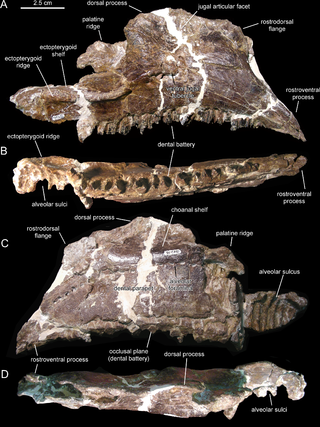
Canardia is an extinct genus of lambeosaurine dinosaur known from the Late Cretaceous Marnes d'Auzas Formation of Haute-Garonne department, in Occitanie region, southwestern France. The type species Canardia garonnensis was first described and named by Albert Prieto-Márquez, Fabio M. Dalla Vecchia, Rodrigo Gaete and Àngel Galobart in 2013. It is only known from juvenile specimens. The name of the genus comes from “canard”, the French word for “duck”, an allusion to the fact that this animal belongs to the hadrosaurids which are also known as duck-billed dinosaurs. The specific epithet garonnensis refers to the Haute-Garonne department where this dinosaur has been found. Although universally recognized as a lambeosaurine, its precise position within them is debated. Some authors consider it as a close relative of the genus Aralosaurus from Central Asia with which it would form the tribe Aralosaurini, while others include it in a more derived clade, the Arenysaurini in which all lambeosaurines from Europe and North Africa are placed. Canardia was one of the last non-avian dinosaurs and lived between 67,5 and 66 my on the former Ibero-Armorican Island, which included much of France and Spain.

Roca dels Bous is an archaeological site located in Sant Llorenç de Montgai, in the Catalan Pyrenees, Spain. Since 1988 the Autonomous University of Barcelona and the UCL Institute of Archaeology study and record the fossil sequence of southern European Neanderthals who inhabited the area during the Middle Paleolithic approximately 50,000 years ago. The excavation team utilizes a worldwide unique digital system and various innovative technologies that significantly improve the quality of the classification of the recovered objects. Roca dels Bous has as one of the first Paleolithic excavation sites in Spain established a visitor centre, that focuses on displaying the Prehistory research of the prepyrenees area.

Adynomosaurus is a genus of lambeosaurine dinosaur from the Late Cretaceous of what is now Catalonia, Spain. First discovered in 2012, it was named in 2019 with the type and only species being Adynomosaurus arcanus. It is only known from scant material, but is distinguished from other hadrosaurs by its weakly developed shoulder blade which would have had underdeveloped musculature, which lends it its scientific name, partially from the Greek word for "weak". Its exact relationships with other hadrosaurs remain unresolved, with it not consistently being recovered as a relative of any other specific genera, though some studies have allied it with Tsintaosaurini or even found it outside of Hadrosauridae. It would have lived as part of a diverse coastal estuary ecosystem, made up of meandering rivers and mud flats. The discovery of Adynomosaurus adds to the very incomplete fossil record of hadrosaurid dinosaurs in the Late Cretaceous of Europe, and it fits into a picture of major ecological turnover that was occurring during the Maastrichtian stage in the region.

The Basturs Poble bonebed is a mega-bonebed of hadrosaur dinosaur fossils, discovered in Catalonia, Spain. Hundreds of hadrosaur fossils have been found at the site, which would have been on a large island during the Late Cretaceous when the animals preserved were alive. Despite the enormous amount of specimens, taxonomically informative material has been scarce at the site, leading to extensive debate as to its nature. The number of species present, age of the individuals present in the sample, and taxonomic identity of the remains have been the primary matters of debate. Previously considered to represent Koutalisaurus, Pararhabdodon, or multiple, perhaps dwarf species, it is currently thought that a single, indeterminate species of lambeosaurine was present at the site, and that individuals of many different ages were present.
Los Llanos Formation is a geological formation in the La Rioja Province, northwestern Argentina whose strata date back to the Campanian stage of the Late Cretaceous.

The "Leva del Biberón" was the name given to the levies of 1938 and 1939 throughout the territory that republican Spain still controlled during the last years of the Spanish Civil War, with boys aged from 14 to 18. Mobilized by order of the President of the Second Spanish Republic, Manuel Azaña, at the end of April 1938. At that time, Franco's troops had attacked Lleida, Gandesa, Balaguer, Tremp and Camarasa and were taking control of the last points of republican resistance.

Fylax is a genus of hadrosauroid ornithopod from the Late Cretaceous Figuerola Formation of Spain. The genus contains a single species, Fylax thyrakolasus, known from a nearly complete left dentary.

Abditosaurus is an extinct genus of titanosaurian sauropod dinosaur from the Late Cretaceous (Maastrichtian) Tremp Group of Catalonia, Spain. The type and only species is Abditosaurus kuehnei. Phylogenetic analyses recover it within a clade of South American and African saltasaurines, distinct from other insular dwarf sauropods from the European archipelago. Abditosaurus inhabited the Ibero-Armorican Island, a prehistoric island made up of what is now Spain, Portugal, and southern France, and would have been the largest titanosaur species in its environment.

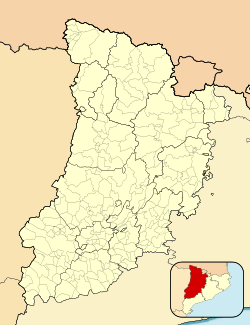


 Spain
Spain  Catalonia
