| Birth name | Walter Garland Argus | ||||||||||||||||||||||||||||||||||||||||||||
|---|---|---|---|---|---|---|---|---|---|---|---|---|---|---|---|---|---|---|---|---|---|---|---|---|---|---|---|---|---|---|---|---|---|---|---|---|---|---|---|---|---|---|---|---|---|
| Date of birth | 29 May 1921 | ||||||||||||||||||||||||||||||||||||||||||||
| Place of birth | Auckland, New Zealand | ||||||||||||||||||||||||||||||||||||||||||||
| Date of death | 21 October 2016 (aged 95) | ||||||||||||||||||||||||||||||||||||||||||||
| Place of death | Christchurch, New Zealand | ||||||||||||||||||||||||||||||||||||||||||||
| Height | 1.85 m (6 ft 1 in) | ||||||||||||||||||||||||||||||||||||||||||||
| Weight | 85 kg (187 lb) | ||||||||||||||||||||||||||||||||||||||||||||
| School | Pleasant Point District High School | ||||||||||||||||||||||||||||||||||||||||||||
| Rugby union career | |||||||||||||||||||||||||||||||||||||||||||||
| |||||||||||||||||||||||||||||||||||||||||||||
Walter Garland "Wally" Argus (29 May 1921 – 21 October 2016) was a New Zealand rugby union player who played 10 matches including four tests for the national team. From 16 November 2012 until his death he was the oldest living All Black.
Rugby union, commonly known in most of the world simply as rugby, is a contact team sport which originated in England in the first half of the 19th century. One of the two codes of rugby football, it is based on running with the ball in hand. In its most common form, a game is between two teams of 15 players using an oval-shaped ball on a rectangular field with H-shaped goalposts at each end.
The New Zealand national rugby union team, called the All Blacks, represents New Zealand in men's rugby union, which is known as the country's national sport. The team has won the last two Rugby World Cups, in 2011 and 2015 as well as the inaugural tournament in 1987.
Argus was born in Auckland on 29 May 1921, [1] [2] the son of Ernest Edward Argus, a railway worker, and his second wife, Margaret Elizabeth Argus (née Olsen). [3] [4] He was educated at Albury School [4] and Pleasant Point District High School in South Canterbury. [2]
Auckland is a city in the North Island of New Zealand. Auckland is the largest urban area in the country, with an urban population of around 1,628,900. It is located in the Auckland Region—the area governed by Auckland Council—which includes outlying rural areas and the islands of the Hauraki Gulf, resulting in a total population of 1,695,900. A diverse and multicultural city, Auckland is home to the largest Polynesian population in the world. The Māori-language name for Auckland is Tāmaki or Tāmaki-makau-rau, meaning "Tāmaki with a hundred lovers", in reference to the desirability of its fertile land at the hub of waterways in all directions.
Albury is a small village in the southern part of the Canterbury region of the South Island of New Zealand. It is inland from Timaru and located on State Highway 8 between Pleasant Point and Fairlie. It is in the Mackenzie Country.
Pleasant Point is a small country town in southern Canterbury, New Zealand, some 19 km inland from Timaru, on State Highway 8. It is a service town for the surrounding farming district. One of its main attractions is the heritage railway, the Pleasant Point Museum and Railway, which operates steam locomotives and one of only two Model T Ford railcar replicas in the world. It attracts about 10,000 people a year. For almost one hundred years, the Fairlie branch line railway passed through the town. It closed on 2 March 1968, and the heritage line utilises 2.5 km of track along the branch's old route.
A wing three-quarter, Argus began playing senior club rugby for the Southern Football Club in 1938, and the same year made his representative debut for the Mackenzie sub-union. Following the outbreak of World War II, he moved to Christchurch, where he played for the Linwood club, and made the Canterbury provincial team in 1941 and 1942. From 1942, Argus served with the 2nd New Zealand Expeditionary Force (2NZEF) in North Africa and Italy. [4]
World War II, also known as the Second World War, was a global war that lasted from 1939 to 1945. The vast majority of the world's countries—including all the great powers—eventually formed two opposing military alliances: the Allies and the Axis. A state of total war emerged, directly involving more than 100 million people from over 30 countries. The major participants threw their entire economic, industrial, and scientific capabilities behind the war effort, blurring the distinction between civilian and military resources. World War II was the deadliest conflict in human history, marked by 50 to 85 million fatalities, most of whom were civilians in the Soviet Union and China. It included massacres, the genocide of the Holocaust, strategic bombing, premeditated death from starvation and disease, and the only use of nuclear weapons in war.
Christchurch is the largest city in the South Island of New Zealand and the seat of the Canterbury Region. The Christchurch urban area lies on the South Island's east coast, just north of Banks Peninsula. It is home to 404,500 residents, making it New Zealand's third-most populous city behind Auckland and Wellington. The Avon River flows through the centre of the city, with an urban park located along its banks.

The Canterbury Rugby Football Union is the governing body for rugby union in a portion of the Canterbury Region of New Zealand. Its colours are red and black in a hooped design. The CRFU govern the running of the Canterbury representative team which have won New Zealand's first-tier domestic competition National Provincial Championship 14 times including a "six-peat" from 2008 to 2013 – with five in the National Provincial Championship, two in the Air New Zealand Cup, five in the ITM Cup and one in the Mitre 10 Cup. Their most recent victory was the 2017 Mitre 10 Cup. Canterbury also acts as a primary feeder to the Crusaders, who play in the Super Rugby competition.
After the end of the war, Argus was selected for the 2NZEF rugby team, known as the "Kiwis", that toured Britain and France. [4] In his 12 matches for the team he scored 17 tries. [2]
Back in New Zealand, Argus continued to play for Canterbury, and in 1946 he was selected for the New Zealand national side, the All Blacks. He made his international debut against the touring Australian side in the first test at Carisbrook in Dunedin. Argus scored two tries in the 31–8 win, and appeared again two weeks later in the second test at Eden Park, Auckland. The following year, Argus toured Australia with the national side, playing in eight of the nine matches on tour, including both of the test matches. [2]
The 1946 Australia rugby union tour of New Zealand was a collection of rugby union games undertaken by the Australia team in New Zealand against invitational and national teams of New Zealand. It was the first rugby union international tour after the Second World War.
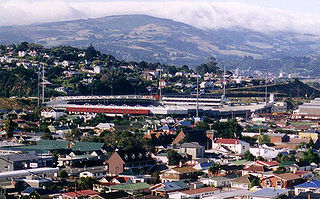
Carisbrook was a major sporting venue in Dunedin, New Zealand. The city's main domestic and international rugby union venue, it was also used for other sports such as cricket, football, rugby league and motocross. Carisbrook also hosted a Joe Cocker concert and frequently hosted pre-game concerts before rugby matches in the 1990s. In 2011 Carisbrook was closed, and was replaced as a rugby ground by Forsyth Barr Stadium at University Plaza in North Dunedin, and as a cricket ground by University Oval in Logan Park.
Dunedin is the second-largest city in the South Island of New Zealand, and the principal city of the Otago region. Its name comes from Dùn Èideann, the Scottish Gaelic name for Edinburgh, the capital of Scotland.
He was also selected for the 1949 tour to South Africa, but withdrew for business reasons and did not tour; he had just bought a market garden in Heathcote Valley, Christchurch. He also missed the opportunity to play Australia at home in 1949 because of injury. [4] [5] In all, Argus played 10 matches for the All Blacks, and scored 14 tries, [2] including tries in three of the four test matches that he played in. [5]
1949 saw the second full tour of South Africa by a representative New Zealand rugby union team. The All Blacks achieved a record of 13 wins, 7 losses and 4 draws, and they lost the test series 4–0.
Heathcote Valley is a suburb of Christchurch, New Zealand. It is named after Sir William Heathcote, who was secretary of the Canterbury Association.
Argus lived in retirement in Christchurch. After the death of Bob Scott in 2012, he was the oldest living All Black. [4]
Argus died in Christchurch on 21 October 2016 after battling a short illness. [6] [7]
The Crusaders are a New Zealand professional rugby union team based in Christchurch, who compete in the Super Rugby competition. They have won 9 titles.
Richard Hugh McCaw is a retired New Zealand rugby union player. He captained the national team, the All Blacks, in 110 out of his 148 test matches, and won two Rugby World Cups. He is the most capped test rugby player of all time, and has won the World Rugby player of the year award a joint record three times.
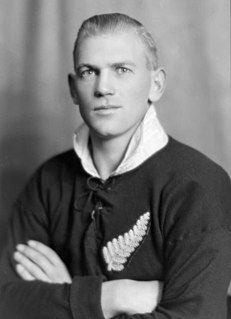
Eric William Thomas Tindill was a New Zealand sportsman. Tindill held a number of unique records: he was the oldest ever Test cricketer at the time of his death, the only person to play Tests for New Zealand in both cricket and rugby union, and the only person ever to play Tests in both sports, referee a rugby union Test, and umpire a cricket Test: a unique "double-double".
Leon Raymond MacDonald is a retired New Zealand rugby union footballer, and now head coach for the Auckland Blues rugby team, who played 56 tests for the national team, All Blacks. He played as a first five-eighth (fly-half), centre, and fullback.
Duncan McGregor, was a New Zealand rugby union and rugby league footballer. He was a member of the legendary 1905 Original All Blacks and later converted to rugby league when he went on the 1907 New Zealand league tour of Britain and Australia. He stayed in Britain following the 1907–08 tour, and opened a sport store as well as playing for Merthyr Tydfil RLFC. He returned to New Zealand after five years and continued to be involved in rugby league as an administrator and official.
The South Canterbury Rugby Football Union (SCRFU) is a rugby province based in the central South Island city of Timaru, New Zealand. The South Canterbury team play from Alpine Energy Stadium located in Timaru.
Sir Frederick Richard Allen was a captain and coach of the All Blacks, New Zealand's national rugby union team. The All Blacks won all 14 of the test matches they played under his coaching.
Jerome Kaino is a New Zealand rugby union player. He currently plays flanker and number eight for Stade Toulousain in the Top 14. In 2004, he was named IRB International Under-21 player of the year. In 2011, he was named the New Zealand Rugby player of the year, finishing ahead of Richie McCaw and Ma'a Nonu in the voting. He is a key member of 2011 and 2015 Rugby World Cup winning teams, becoming one of only twenty dual Rugby World Cup winners. Kaino is considered by many to be one of the game's greats.

William Varnham Millton was a New Zealand rugby union player and cricketer. He was the first captain of the New Zealand national rugby union team, leading them on their 1884 tour of New South Wales, and represented Canterbury in both rugby union and cricket.
Aaron Whittaker is a former professional rugby league footballer. A New Zealand international representative halfback, he played club football in Australia, England and New Zealand.
William "Bill" Thomas Tyler was a New Zealand rugby footballer who was part of the professional 1907-1908 New Zealand rugby tour of Great Britain.
Tom "Angry" William Cross was a New Zealand rugby footballer who represented New Zealand in both rugby union and rugby league.
The 1926 New Zealand rugby league season was the 19th season of rugby league that had been played in New Zealand.
Luke Charles Whitelock is a New Zealand rugby union player who currently plays as a loose forward for Canterbury in New Zealand's domestic Mitre 10 Cup and the Highlanders in the international Super Rugby competition.
Richard Fou'a Mo'unga is a New Zealand rugby union player who currently plays as a first five-eighth or fullback for Canterbury in New Zealand's domestic Mitre 10 Cup and the Crusaders in the international Super Rugby competition.
Fred Newton was a New Zealand rugby union player who represented the All Blacks between 1905 and 1906. His positions of choice were lock and loose forward.
George Crispin Bridge is a New Zealand rugby union player who currently plays as an outside back for Canterbury in New Zealand's domestic Mitre 10 Cup and for the Crusaders in the international Super Rugby competition.
Lachlan Ashwell Grant was a New Zealand rugby union player. Born in Temuka, Grant is regarded as that town's finest rugby product. A flanker and lock, Booth represented South Canterbury at a provincial level, and was a member of the New Zealand national side, the All Blacks, from 1947 to 1951. He played 23 matches for the All Blacks including four internationals, and captained the team in two matches during the 1951 tour of Australia.
| Records | ||
|---|---|---|
| Preceded by Bob Scott | Oldest living All Black 16 November 2012 – 21 October 2016 | Succeeded by Ron Elvidge |