|
| Maya civilization |
|---|
| History |
| Preclassic Maya |
| Classic Maya collapse |
| Spanish conquest of the Maya |
Wamaw K'awiil[ pronunciation? ] was an 8th century Maya ruler [1] of Kaan (Calakmul). [2]

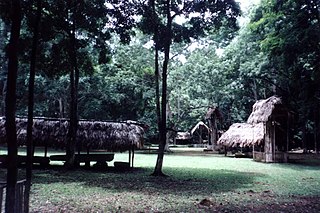
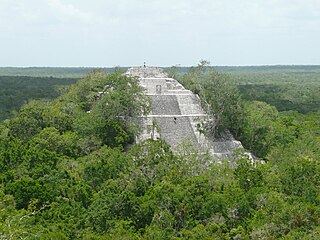
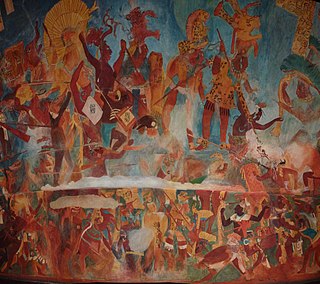
The Maya civilization was a Mesoamerican civilization developed by the Maya peoples, and noted for its logosyllabic script—the most sophisticated and highly developed writing system in pre-Columbian Americas—as well as for its art, architecture, mathematics, calendar, and astronomical system. The Maya civilization developed in an area that encompasses southeastern Mexico, all of Guatemala and Belize, and the western portions of Honduras and El Salvador. This region consists of the northern lowlands encompassing the Yucatán Peninsula, and the highlands of the Sierra Madre, running from the Mexican state of Chiapas, across southern Guatemala and onwards into El Salvador, and the southern lowlands of the Pacific littoral plain.

Ajaw or Ahau ('Lord') is a pre-Columbian Maya political title attested from epigraphic inscriptions. It is also the name of the 20th day of the tzolkʼin, the Maya divinatory calendar, on which a king's kʼatun-ending rituals would fall.
Judging by the marked reduction in explicit statements of overlordship and foreign mentions of any sort, Calakmul’s vanquishment at the hands of Tikal in AD 695 had lasting effects on its sphere of influence. [3] Kaan still retained something of the far-ranging expansionistic impulse that had seen it assert hegemony over kingdoms as far afield as Moral-Reforma in the west and Dos Pilas in the south in the years before 695. For the king of Chiik Nahb' (Calakmul) is named on a monument in Quiriguá even further to the south and east in 736. The Kaan lord’s name is difficult to read, but may be wa?-ma?-wi-K’AWI:L, Wamaw K'awiil. [4]

A monarchy is a form of government in which a single person holds supreme authority in ruling a country, also performing ceremonial duties and embodying the country's national identity. Although some monarchs are elected, in most cases, the monarch's position is inherited and lasts until death or abdication. In these cases, the royal family or members of the dynasty usually serve in official capacities as well. The governing power of the monarch may vary from purely symbolic, to partial and restricted, to completely autocratic.

Tikal is the ruin of an ancient city, which was likely to have been called Yax Mutal, found in a rainforest in Guatemala. It is one of the largest archaeological sites and urban centers of the pre-Columbian Maya civilization. It is located in the archaeological region of the Petén Basin in what is now northern Guatemala. Situated in the department of El Petén, the site is part of Guatemala's Tikal National Park and in 1979 it was declared a UNESCO World Heritage Site.

Hegemony is the political, economic, or military predominance or control of one state over others. In ancient Greece, hegemony denoted the politico-military dominance of a city-state over other city-states. The dominant state is known as the hegemon.
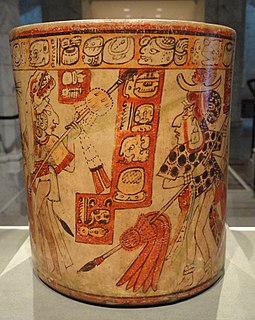
In 2007 a new inscription featuring Wamaw K’awiil was brought to light. A small panel in a private collection names the king, accords him the Snake emblem glyph, and depicts him playing ball with the king of Hix Witz — suggesting that Calakmul retained at least part of its network of subordinate sites in the years after the second Tikal defeat of c. 736. [5]

Snakes are elongated, legless, carnivorous reptiles of the suborder Serpentes. Like all other squamates, snakes are ectothermic, amniote vertebrates covered in overlapping scales. Many species of snakes have skulls with several more joints than their lizard ancestors, enabling them to swallow prey much larger than their heads with their highly mobile jaws. To accommodate their narrow bodies, snakes' paired organs appear one in front of the other instead of side by side, and most have only one functional lung. Some species retain a pelvic girdle with a pair of vestigial claws on either side of the cloaca. Lizards have evolved elongate bodies without limbs or with greatly reduced limbs about twenty-five times independently via convergent evolution, leading to many lineages of legless lizards. Legless lizards resemble snakes, but several common groups of legless lizards have eyelids and external ears, which snakes lack, although this rule is not universal.

An emblem is an abstract or representational pictorial image that represents a concept, like a moral truth, or an allegory, or a person, like a king or saint.

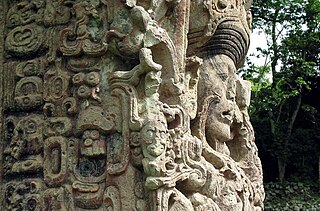
In typography, a glyph is an elemental symbol within an agreed set of symbols, intended to represent a readable character for the purposes of writing. Glyphs are considered to be unique marks that collectively add up to the spelling of a word or contribute to a specific meaning of what is written, with that meaning dependent on cultural and social usage.