Wamaw K'awiil

Last updated

Wamaw K'awiil[ pronunciation? ] was an 8th century Maya ruler [1] of Kaan (Calakmul). [2]

Maya civilization Mesoamerican civilization

The Maya civilization was a Mesoamerican civilization developed by the Maya peoples, and noted for its logosyllabic script—the most sophisticated and highly developed writing system in pre-Columbian Americas—as well as for its art, architecture, mathematics, calendar, and astronomical system. The Maya civilization developed in an area that encompasses southeastern Mexico, all of Guatemala and Belize, and the western portions of Honduras and El Salvador. This region consists of the northern lowlands encompassing the Yucatán Peninsula, and the highlands of the Sierra Madre, running from the Mexican state of Chiapas, across southern Guatemala and onwards into El Salvador, and the southern lowlands of the Pacific littoral plain.

Ajaw

Ajaw or Ahau ('Lord') is a pre-Columbian Maya political title attested from epigraphic inscriptions. It is also the name of the 20th day of the tzolkʼin, the Maya divinatory calendar, on which a king's kʼatun-ending rituals would fall.

Judging by the marked reduction in explicit statements of overlordship and foreign mentions of any sort, Calakmul’s vanquishment at the hands of Tikal in AD 695 had lasting effects on its sphere of influence. [3] Kaan still retained something of the far-ranging expansionistic impulse that had seen it assert hegemony over kingdoms as far afield as Moral-Reforma in the west and Dos Pilas in the south in the years before 695. For the king of Chiik Nahb' (Calakmul) is named on a monument in Quiriguá even further to the south and east in 736. The Kaan lord’s name is difficult to read, but may be wa?-ma?-wi-K’AWI:L, Wamaw K'awiil. [4]

Monarchy system of government where the head of state position is inherited within family

A monarchy is a form of government in which a single person holds supreme authority in ruling a country, also performing ceremonial duties and embodying the country's national identity. Although some monarchs are elected, in most cases, the monarch's position is inherited and lasts until death or abdication. In these cases, the royal family or members of the dynasty usually serve in official capacities as well. The governing power of the monarch may vary from purely symbolic, to partial and restricted, to completely autocratic.

Tikal Ruins of major ancient Maya city

Tikal is the ruin of an ancient city, which was likely to have been called Yax Mutal, found in a rainforest in Guatemala. It is one of the largest archaeological sites and urban centers of the pre-Columbian Maya civilization. It is located in the archaeological region of the Petén Basin in what is now northern Guatemala. Situated in the department of El Petén, the site is part of Guatemala's Tikal National Park and in 1979 it was declared a UNESCO World Heritage Site.

Hegemony form of government in which a leader state rules over a number of subordinate states

Hegemony is the political, economic, or military predominance or control of one state over others. In ancient Greece, hegemony denoted the politico-military dominance of a city-state over other city-states. The dominant state is known as the hegemon.

In 2007 a new inscription featuring Wamaw K’awiil was brought to light. A small panel in a private collection names the king, accords him the Snake emblem glyph, and depicts him playing ball with the king of Hix Witz — suggesting that Calakmul retained at least part of its network of subordinate sites in the years after the second Tikal defeat of c. 736. [5]

Snake wiggling animal without legs

Snakes are elongated, legless, carnivorous reptiles of the suborder Serpentes. Like all other squamates, snakes are ectothermic, amniote vertebrates covered in overlapping scales. Many species of snakes have skulls with several more joints than their lizard ancestors, enabling them to swallow prey much larger than their heads with their highly mobile jaws. To accommodate their narrow bodies, snakes' paired organs appear one in front of the other instead of side by side, and most have only one functional lung. Some species retain a pelvic girdle with a pair of vestigial claws on either side of the cloaca. Lizards have evolved elongate bodies without limbs or with greatly reduced limbs about twenty-five times independently via convergent evolution, leading to many lineages of legless lizards. Legless lizards resemble snakes, but several common groups of legless lizards have eyelids and external ears, which snakes lack, although this rule is not universal.

Emblem pictorial image that epitomizes a concept or that represents a person

An emblem is an abstract or representational pictorial image that represents a concept, like a moral truth, or an allegory, or a person, like a king or saint.

Glyph Element of writing

In typography, a glyph is an elemental symbol within an agreed set of symbols, intended to represent a readable character for the purposes of writing. Glyphs are considered to be unique marks that collectively add up to the spelling of a word or contribute to a specific meaning of what is written, with that meaning dependent on cultural and social usage.
Related Research Articles

Dos Pilas human settlement

Dos Pilas is a Pre-Columbian site of the Maya civilization located in what is now the department of Petén, Guatemala. It dates to the Late Classic Period, being founded by an offshoot of the dynasty of the great city of Tikal in AD 629 in order to control trade routes in the Petexbatún region, particularly the Pasión River. In AD 648 Dos Pilas broke away from Tikal and became a vassal state of Calakmul, although the first two kings of Dos Pilas continued to use the same emblem glyph that Tikal did. It was a predator state from the beginning, conquering Itzan, Arroyo de Piedra and Tamarindito. Dos Pilas and a nearby city, Aguateca, eventually became the twin capitals of a single ruling dynasty. The kingdom as a whole has been named as the Petexbatun Kingdom, after Lake Petexbatún, a body of water draining into the Pasión River.

Calakmul archaeological site

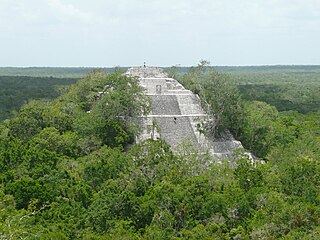
Calakmul is a Maya archaeological site in the Mexican state of Campeche, deep in the jungles of the greater Petén Basin region. It is 35 kilometres (22 mi) from the Guatemalan border. Calakmul was one of the largest and most powerful ancient cities ever uncovered in the Maya lowlands.

Uaxaclajuun Ubʼaah Kʼawiil Ruler of the Maya associated with the site of Copán

Uaxaclajuun Ubʼaah Kʼawiil, was the 13th ajaw or ruler of the powerful Maya polity associated with the site of Copán in modern Honduras. He ruled from January 2, 695, to May 3, 738.

Jasaw Chan Kʼawiil I Rulers of Tikal

Jasaw Chan Kʼawiil I also known as Ruler A, Ah Cacao and Sky Rain,, was an ajaw of the Maya city of Tikal. He took the throne on May 3, 682 and reigned until his death.

Yikʼin Chan Kʼawiil Ruler of Tikal

Yikʼin Chan Kʼawiil also known as Ruler B, Yaxkin Caan Chac and Sun Sky Rain,, was an ajaw of the Maya city of Tikal. He took the throne on December 8, 734.

Women rulers in Maya society

During the 7th and 8th centuries in Mesoamerica, there was an evident shift in the roles women played in ancient Maya society as compared with the previous two centuries. It was during this time that there was a great deal of political complexity seen both in Maya royal houses as well as in the Maya area. Warfare was a significant factor in political competition and marriage was one of the ways that alliances were made between the different polities. This was accompanied by a shift in women's roles from wife and mother to playing integral parts in courtly life, such as participating in rituals involving the supernatural world and at times ruling individual polities.

Bʼalaj Chan Kʼawiil King of Dos Pilas

Bʼalaj Chan Kʼawiil was a Maya ruler of Dos Pilas. He is also known as Ruler 1, Flint Sky God K and Malah Chan Kʼawil.

Yax Yopaat Maya king

Yax Yopaat was a Maya king of the Kaan kingdom (Calakmul) who ruled AD 572-579.

Scroll Serpent

Scroll Serpent was a Maya ruler of the Kaan kingdom. He ruled from AD 579 to 611. He acceded on September 2.

Tajoom Ukʼab Kʼahkʼ

Tajoom Ukʼab Kʼahkʼ was a Maya ruler of the Kaan kingdom. He became a king on March 28, 622.

Calakmul Ruler Y

Ruler Y was a Maya king of Calakmul. He is also known as Ruler 8 and Bolon K'awiil I. He reigned >741>.

Yuknoom Chʼeen II, known as Yuknoom the Great, was a Mayan ruler of the Kaan kingdom, which had its capital at Calakmul during the Classic Period of Mesoamerican chronology.

Yuknoom Yichʼaak Kʼahkʼ King of Kaan

Yuknoom Yichʼaak Kʼahkʼ ) or Yuknoom Ixquiac was a Maya king of the Kaan kingdom, which had its capital at Calakmul during the Classic Period of Mesoamerican chronology.

Yuknoom Tookʼ Kʼawiil King of Calakmul

Yuknoom Tookʼ Kʼawiil was a Maya ruler of the Kaan kingdom (Calakmul).

Great Serpent

Great Serpent was a Maya king of Calakmul, a Maya city-state.

Bolon Kʼawiil II

Bolon Kʼawiil II was a Maya king of Calakmul (>771-789?>). His monuments are Stelae 57 and 58 in his city.

Dzibanche

Dzibanche is an archaeological site of the ancient Maya civilization located in southern Quintana Roo, in the Yucatan Peninsula of southeastern Mexico. Dzibanche was a major Maya city and investigations in the first decade of the 21st century indicate that it was the early capital of the Kan dynasty, which later ruled from the great city of Calakmul. Dzibanche features the earliest known use of the Kaan dynasty emblem glyph.

First Tikal–Calakmul War

The Tikal–Calakmul wars were a series of wars between Tikal and Calakmul. The First Tikal–Calakmul War was the first of these wars. During this and following conflicts in Petén vassal states like Naranjo and Dos Pilas were often used. Though Yaxchilan was in the war it only had a minor presence at the beginning.

Third Tikal–Calakmul War

The Third Tikal–Calakmul War was the third in a series of wars between Tikal and Calakmul, two of the Major superpowers of the Maya Civilization during the classic period.

Tikal–Calakmul wars

The Tikal–Calakmul wars were a series of wars, mainly between Tikal and Calakmul on the Yucatán Peninsula, but also with vassal states in the Petén Basin such as Copan, Dos Pilas, Naranjo, Sacul, Quiriguá, and briefly Yaxchilan had a role in initiating the first war.

References

  1. Travel Cancun : Cozumel, Playa del Carmen, Tulum, Xcaret, Mexican Riviera, and Yucatan Peninsula.
  2. Braswell, Geoffrey E.; Gunn, Joel D.; Dominguez Carrasco, María del Rosario; Folan, William J.; Fletcher, Laraine A.; Morales López, Abel; Glascock, Michael D. (2005). "Defining the Terminal Classic at Calakmul, Campeche". In Arthur A. Demarest, Prudence M. Rice and Don S. Rice (eds.). The Terminal Classic in the Maya lowlands: Collapse, transition, and transformation. Boulder: University Press of Colorado. pp. 162–194. ISBN   0-87081-822-8. OCLC   61719499.
  3. Martin and Grube 2008:44-45, 114
  4. Chronicle of the Maya Kings and Queens by Martin and Nikolai Grube (2008:114)
  5. Mesoweb