Related Research Articles
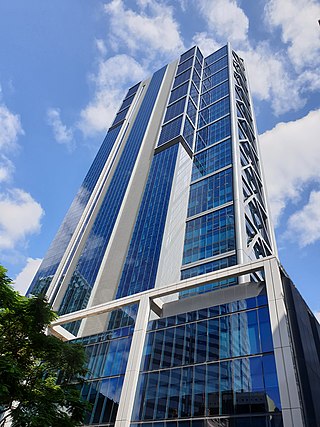
BHP Group Limited is an Australian multinational mining and metals public company headquartered in Melbourne, Victoria, Australia.
Richard Lowenstein is an Australian filmmaker. He has written, produced and directed: feature films, including Strikebound (1984), Dogs in Space (1986) and He Died with a Felafel in His Hand (2001); music videos for bands such as INXS and U2; concert performance films, Australian Made: The Movie (1987) and U2: LoveTown (1989); and TV adverts.

Orica Limited is an Australian-based multinational corporation that is one of the world's largest providers of commercial explosives and blasting systems to the mining, quarrying, oil and gas, and construction markets, a supplier of sodium cyanide for gold extraction, and a specialist provider of ground support services in mining and tunnelling.

Dorothy Coade Hewett was an Australian playwright, poet and author, and a romantic feminist icon. In writing and in her life, Hewett was an experimenter. As her circumstances and beliefs changed, she progressed through different literary styles: modernism, socialist realism, expressionism and avant garde. She was a member of the Australian Communist Party in the 1950s and 1960s, which informed her work during that period.
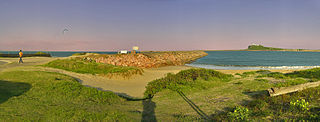
Stockton is a suburb of Newcastle, New South Wales, Australia, located 600 m (0.4 mi) from Newcastle's central business district. It is the only residential suburb of the City of Newcastle that lies north of the Hunter River.

On December 16, 1929, New South Wales Police drew their revolvers and shot into a crowd of locked-out miners in the New South Wales town of Rothbury in Australia, killing a 29-year-old miner, Norman Brown, and injuring approximately forty-five miners. The incident became known as the Rothbury affair or the Rothbury riot, and is described as the "bloodiest event in national industrial history."
The Newcastle Poetry Prize is an annual Australian award for Australian poetry. It was established in 1981 as the Mattara Poetry Prize.
David Musgrave is an Australian poet, novelist, publisher and critic. He is the founder of and publisher at Puncher & Wattmann, an independent press which publishes Australian poetry and literary fiction. He is also Deputy Chair of Australian Poetry Limited.

Australian Book Review is an Australian arts and literary review. Created in 1961, ABR is an independent non-profit organisation that publishes articles, reviews, commentaries, essays, and new writing. The aims of the magazine are 'to foster high critical standards, to provide an outlet for fine new writing, and to contribute to the preservation of literary values and a full appreciation of Australia's literary heritage'.
The Grace Leven Prize for Poetry was an annual poetry award in Australia, given in the name of Grace Leven who died in 1922. It was established by William Baylebridge who "made a provision for an annual poetry prize in memory of 'my benefactress Grace Leven' and for the publication of his own work". Grace was his mother's half-sister.

Kooragang is the northernmost and largest suburb of the city of Newcastle, in the Hunter Region of New South Wales, Australia. Dominated by Kooragang Island, the eastern part of the suburb is primarily industrial, while the western part of the suburb consists of nature reserves. Covering an area of 35.4 km2 (13.7 sq mi), at the 2016 census, there were no people living in the suburb.

Henry Robertson was a Scottish-born Australian seaman, engineer, folk-singer/songwriter, poet and activist, who became a key figure in the development of the Australian folk music tradition. During the 1950s he served in commercial whaling fleets in both sub-antarctic and sub-tropical regions, and wrote a number of songs about his experiences which formed the basis of his 1971 LP release Whale Chasing Men: Songs of Whaling in Ice and Sun, a unique record of life in the whaling industry in the 20th century. He also composed and performed songs on a range of other subjects, including compositions for historical documentaries commissioned by Australian television, a number of which have since been recorded posthumously by musicians interested in perpetuating his musical legacy.
Robyn Mary Parker, is a former Australian politician, and was a member of the New South Wales Legislative Assembly representing Maitland for the Liberal Party from 2011 to 2015 and was previously a member of the Legislative Council of New South Wales between 2003 and 2011. Parker was the New South Wales Minister for the Environment and the Minister for Heritage in the O'Farrell government from 2011 until April 2014. Parker was succeeded by Rob Stokes in the Baird cabinet.
Wendy Lowenstein was an Australian historian, author, and teacher notable for her recording of people's everyday experiences and her advocacy of social activism. She pioneered oral history in Australia, with Weevils in the Flour in 1978 but she began collecting folklore and oral histories of early Australian working life in the 1960s.
The Cockatoo Docks & Engineering Company was a ship building and maintenance company which operated the Cockatoo Island Dockyard on Cockatoo Island in Sydney, Australia, between 1933 and 1992.
The Walsh Island Dockyard and Engineering Works was a dockyard and engineering workshop established by the Government of New South Wales in 1913, at Walsh Island, Newcastle, Australia. The foundation stone was laid on 15 June 1913 by Arthur Griffith, the Minister for Works. The dockyard was constructed as a replacement for Sydney's Cockatoo Island Dockyard, that was taken over by the Federal Government in 1913.
The coastal coal-carrying trade of New South Wales involved the shipping of coal—mainly for local consumption but also for export or coal bunkering—by sea to Sydney from the northern and southern coal fields of New South Wales. It took place in the 19th and 20th centuries. It should not be confused with the export coal trade, which still exists today. There was also an interstate trade, carrying coal and coke to other Australian states that did not have local sources of black coal.
Australian Iron & Steel was an Australian iron and steel manufacturer.
The Chapel Perilous, Dorothy Hewett's third full-length play, was written in 1970. The play is Expressionist in style, where the theatrical spectacle dominates the plot. It introduces Sally Banner, a picaresque heroine moving without success through a search for love and freedom, while oppressed by authority figures and disappointed by unsatisfactory lovers. She is, in brief succession, a defiant schoolgirl, a promiscuous wartime student, a Communist, a suburban de facto, and a well-known poet. It is recognised as Hewett's best play.
What About the People! is a joint 1961 book of verse by Dorothy Hewett (1923-2002) and Merv Lilley (1919-2014). It was the first book-length publication of poetry by either poet. What About the People! represented much of their significant output up to that time.The 1962 reprinting contained 43 poems by Lilley and 31 by Hewett, with one poem probably composed jointly.
References
- ↑ "WHERE I GREW TO BE A MAN". Tribune. 30 November 1960. Retrieved 21 September 2022.
- 1 2 "Ash Island - History". www.ashisland.org.au. Retrieved 21 September 2022.
- ↑ "From an Island in a River: Remembering Vera Deacon". Australian Society for the Study of Labour History. Retrieved 21 September 2022.
- ↑ "Peter Leyden Publishing". Leyden Publishing. Retrieved 21 September 2022.
- ↑ "Weevils in the Flour". unionsong.com. Retrieved 23 September 2022.
- 1 2 Gregory, Mark (15 September 2012). "Weevils in the Flour - a short history of a song" (PDF).
- ↑ Atkinson, Peter (30 June 2022). "Robyn Archer's 200-year playlist is music for the soul". InQueensland. Retrieved 27 March 2023.
- ↑ "Joy Durst Songbook" (PDF).
- ↑ Lowenstein, Wendy (2 March 1981). Weevils in the Flour. Scribe Publications. ISBN 978-0-908011-33-9.