
Wiesbaden is a city in central western Germany and the capital of the state of Hesse. As of June 2020, it had 290,955 inhabitants, plus approximately 21,000 United States citizens. The Wiesbaden urban area is home to approximately 560,000 people. Wiesbaden is the second-largest city in Hesse after Frankfurt am Main.

Gothelo, called the Great, was the duke of Lower Lorraine from 1023 and of Upper Lorraine from 1033. He was also the margrave of Antwerp from 1005 and count of Verdun. Gothelo was the youngest son of Godfrey I, Count of Verdun, and Matilda, daughter of Herman, Duke of Saxony. On his father's death, he received the march of Antwerp and became a vassal of his brother, Godfrey II, who became duke of Lower Lorraine in 1012. He succeeded his brother in 1023 with the support of the Emperor Henry II, but was opposed until Conrad II forced the rebels to submit in 1025. When the House of Bar, which ruled in Upper Lorraine, became extinct in 1033, with the death of his cousin Frederick III, Conrad made him duke of both duchies, so that he could assist in the defence of the territory against Odo II, count of Blois, Meaux, Chartres and Troyes.

The Duchy of Nassau was an independent state between 1806 and 1866, located in what is now the German states of Rhineland-Palatinate and Hesse. It was a member of the Confederation of the Rhine and later of the German Confederation. Its ruling dynasty, now extinct, was the House of Nassau. The duchy was named for its historical core city, Nassau, although Wiesbaden rather than Nassau was its capital. In 1865, the Duchy of Nassau had 465,636 inhabitants. After being occupied and annexed into the Kingdom of Prussia in 1866 following the Austro-Prussian War, it was incorporated into the Province of Hesse-Nassau. The area today is a geographical and historical region, Nassau, and Nassau is also the name of the Nassau Nature Park within the borders of the former duchy.
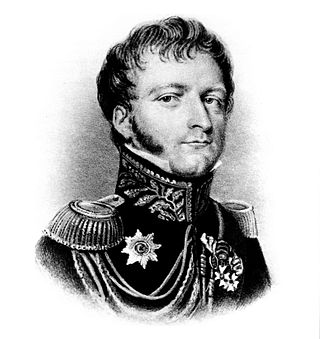
Major-General August von Kruse, was a general in the army of the Duke of Nassau during the Napoleonic Wars and an experimental farmer in his retirement.

The Museum Wiesbaden is a two-branch museum of art and natural history in the Hessian capital of Wiesbaden, Germany. It is one of the three Hessian State museums, in addition to the museums in Kassel and Darmstadt.

Limburg Cathedral (German: Limburger Dom, also known as Georgsdom after its dedication to Saint George, is located above the old town of Limburg in Hesse, Germany. It is the cathedral of the Catholic Diocese of Limburg. Its high location on a rock above the river Lahn provides its visibility from far away. It is the result of an Early Gothic modernization of an originally Early Romanesque building and therefore shows a Romanesque-Gothic transitional style.

The Taunus Railway is a double-track electrified railway line, which connects Frankfurt and Wiesbaden, Germany. It is 41.2 km long and follows the course of the Main on its north side, running quite close to it in some places. Its first stage was opened in September 1839 and is thus the oldest railway line in the German state of Hesse and one of the oldest in Germany. Today it is used by Regional-Express trains between Frankfurt and Wiesbaden and the trains of line S1 of the Rhine-Main S-Bahn between Frankfurt-Höchst and Wiesbaden. Between Frankfurt Hbf and Frankfurt-Höchst, they run on the line of the former Hessian Ludwig Railway.

Dietkirchen an der Lahn is a borough (Ortsbezirk) of Limburg an der Lahn, seat of the district of Limburg-Weilburg in the state of Hesse, Germany. The formerly independent village was incorporated into Limburg in 1971. The town is dominated by the basilica St. Lubentius, which was the most important early-medieval church building in the region.

Heinrich Eduard Ausfeld was a German archivist and historian.
John, Count of Nassau-Dillenburg was the third son of Count Otto I of Nassau and his wife Agnes, daughter of Count Emich IV of Leiningen-Landeck. John was a first cousin of King Adolf of the Romans.

Otto Piper (1841–1921) was a German architectural historian who, with August von Cohausen (1812–1896), is regarded as one of the two founders of scientific research into castles.

Franz Erwein, Count of Schönborn-Wiesentheid (1776–1840) was a German art collector and politician from the House of Schönborn.
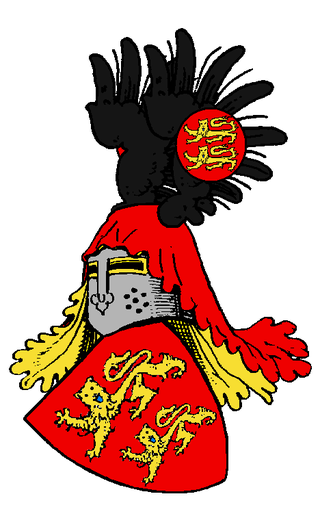
The County of Diez was a county of the Holy Roman Empire, centred on the Grafenschloss at Diez in Lahngau. The county is first attested in 1073 and seems to have been created from the territory of the Conradine dynasty after they relocated to Swabia. The Counts rose to prominence in the second half of the twelfth century as close partisans of the Hohenstaufen dynasty. During this period, it was known as the "Golden County".
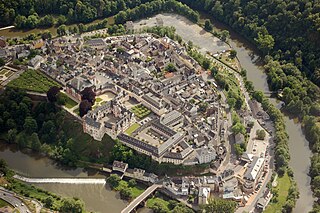
Schloss Weilburg is a Baroque schloss in Weilburg, Hesse, Germany. It is located on a spur above the river Lahn and occupies about half of the area of the Old Town of Weilburg. It contains the Hochschloss, built between 1530 and 1572, which is one of the best-preserved Renaissance palaces in Hesse. In the 1700s, the palace was expanded by John Ernst, Count of Nassau-Weilburg, and his builder, Julius Ludwig Rothweil. The buildings and gardens now belong to the Verwaltung der Staatlichen Schlösser und Gärten Hessen, and they can be visited as a museum on guided tours. Parts of the palace are venues for the music festival Weilburger Schlosskonzerte, which is named after the palace.
Prima Divisio is the term used by historians for the Family Treaty from 1255 containing the first division of the county of Nassau between the brothers Walram II and Otto I.

Friedrich Uhlhorn was an honorary professor at the Philipps-Universität Marburg, whose scientific focus was on the history of the State of Hesse and was also known for his work outside Hesse. His special scientific interest was mainly focused on the problems of historical cartography. In collaboration with Edmund Ernst Stengel, he published the Geschichtlichen Atlas von Hessen, which is considered his major work. He also wrote the article Die deutschen Territorien. A: The West, which deals with the West German regional history. Likewise he was responsible as editor for the Hessisches Jahrbuch für Landesgeschichte by Bruno Gebhardt.
Kurt Köster, also spelled Koetser, was a German librarian and historian.
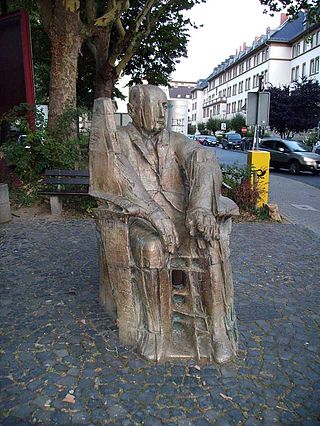
Fritz Michel was a German physician, politician, historian and art historian.
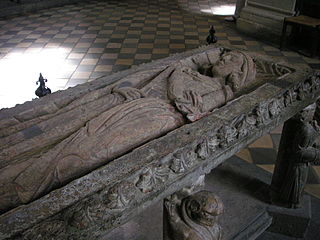
Conrad, called Conrad Kurzbold in order to distinguish him from other members of the Conradine dynasty, was Count of Lower Lahngau and a retainer of East Francian kings Louis the Child, Henry the Fowler, and Holy Roman Emperor Otto the Great. He was a cousin of King Conrad the Younger and founded the Stift of St George in Limburg, around which the city of Limburg an der Lahn developed.
The Hessian Central State Archives, Wiesbaden is a department of the Hessian State Archives and is located in Wiesbaden, the capital of the German state of Hesse. It serves alongside the Hessian State Archives, Darmstadt and the Hessian State Archives, Marburg as the main regional archives for Hesse and additionally functions as the central archives for the state government and ministries, as well as other institutions with nationwide jurisdiction.
