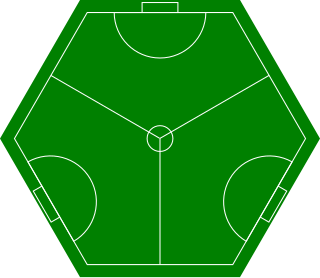
Three-sided football is a variation of association football played with three teams instead of the usual two. Played on a hexagonal pitch, the game can be adapted to soccer, as well as other versions of football.
Boat racing is a sport in which boats, or other types of watercraft, race on water. Boat racing powered by oars is recorded as having occurred in ancient Egypt, and it is likely that people have engaged in races involving boats and other water-borne craft for as long as such watercraft have existed.

Swarm robotics is an approach to the coordination of multiple robots as a system which consist of large numbers of mostly simple physical robots. It is supposed that a desired collective behavior emerges from the interactions between the robots and interactions of robots with the environment. This approach emerged on the field of artificial swarm intelligence, as well as the biological studies of insects, ants and other fields in nature, where swarm behaviour occurs.

OpenSym is a shorthand for International Symposium on Open Collaboration, formerly International Symposium on Wikis and Open Collaboration, also formerly WikiSym or the Wiki Symposium, a conference dedicated to wiki research and practice. In 2014, the name of the conference was changed from WikiSym to OpenSym to reflect a broadening of scope from wiki and Wikipedia research and practice to open collaboration research, including wikis and Wikipedia research, but also free/libre/open source, open data, etc. research. The conference series is held in-cooperation with ACM SIGWEB and ACM SIGSOFT and its proceedings are published in the ACM Digital Library.

The International Aerial Robotics Competition (IARC) began in 1991 on the campus of the Georgia Institute of Technology and is the longest running university-based robotics competition in the world. Since 1991, collegiate teams with the backing of industry and government have fielded autonomous flying robots in an attempt to perform missions requiring robotic behaviors never before exhibited by a flying machine. In 1990, the term “aerial robotics” was coined by competition creator Robert Michelson to describe a new class of small highly intelligent flying machines. The successive years of competition saw these aerial robots grow in their capabilities from vehicles that could at first barely maintain themselves in the air, to the most recent automatons which are self-stable, self-navigating, and able to interact with their environment—especially objects on the ground.

A robot competition is an event where the abilities and characteristics of robots may be tested and assessed. Usually they have to beat other robots in order to become the best one. Many competitions are for schools but several competitions with professional and hobbyist participants are also arising.
The Student Yachting World Cup (SYWoC) is an annual sailing competition for students which was created in 1979 and is held in France.

Robofest is an autonomous robotics competition for 4th ~ 12th graders. It is similar to FIRST Lego League (FLL), but while FLL limits the student's robots to Lego Mindstorms robots, Robofest allows the student to use any robotics system, parts, materials, or even custom electronics, in some of the events. Note that FLL students are required to use parts manufactured by Lego only, preventing the use of such aids as string or glue. Another important difference is that Robofest games have UTF components. Students must solve the unveiled tasks and factors within 30 minutes work-time without external help. Lawrence Tech's Robofest was founded by Computer Science Professor Dr. Chan-Jin Chung in 1999-2000 academic year and is sponsored by Lawrence Technological University and other sponsors. LTU's Robofest is also held internationally, in countries including Brazil, Canada, China, Colombia, Ecuador, Egypt, Ethiopia, England, France, Ghana, Greece, Hong Kong, Hungary, India, Kenya, Lebanon, Macau, Malawi, Mexico, Morocco, Nigeria, Philippines, Saudi Arabia, Singapore, South Africa, South Korea, Taiwan, and UAE. Teams who win their regional event are welcome to participate at the worldwide tournament held at Lawrence Technological University in Michigan. ROBOFEST is a registered trademark of Lawrence Technological University in the USA and other countries.
There are a number of competitions and prizes to promote research in artificial intelligence.
The Conference on Mobile Human-Computer Interaction (MobileHCI) is a leading series of academic conferences in Human–computer interaction and is sponsored by ACM SIGCHI, the Special Interest Group on Computer-Human Interaction. MobileHCI has been held annually since 1998 and has been an ACM SIGCHI sponsored conference since 2012 The conference is very competitive, with an acceptance rate of below 20% in 2017 from 25% in 2006 and 21.6% in 2009. MobileHCI 2011 was held in Stockholm, Sweden, and MobileHCI 2012 which was sponsored by SIGCHI held in San Francisco, USA.

Eurobot is an international robotics contest dedicated to universities and robotics clubs.
The Symposium on Principles of Distributed Computing (PODC) is an academic conference in the field of distributed computing organised annually by the Association for Computing Machinery.

The UAV Challenge - Outback Rescue, also known as the UAV Outback Challenge or UAV Challenge, is an annual competition for the development of unmanned aerial vehicles. The competition was first held in 2007 and features an open challenge for adults, and a high-school challenge. The event is aimed at promoting the civilian use of unmanned aerial vehicles and the development of low-cost systems that could be used for search and rescue missions. The event is one of the largest robotics challenges in the world and one of the highest stakes UAV challenges, with the current Medical Express version of the event offering $75,000 to the winner.

European BEST Engineering Competition (EBEC) is an annual engineering competition organised by the Board of European Students of Technology (BEST). EBEC spreads in 32 countries with the mission to develop students by offering them the opportunity to challenge themselves in solving a theoretical or a practical problem. Students form teams of four and are called upon to solve an interdisciplinary Team Design or Case Study task, thus addressing students from all the fields of engineering.

The Intelligent Ground Vehicle Competition (IGVC) is an annual international robotics competition for teams of undergraduate and graduate students. Teams design and build an autonomous ground vehicle capable of completing several difficult challenges. The competition is well suited to senior design “capstone” courses as well as extracurricular design projects.
The Microtransat Challenge is a competition to design and build an autonomous sailboat under 4 meters in length, which is capable of crossing the Atlantic Ocean without human interaction.

Horacio Carabelli is an international sailor and engineer.
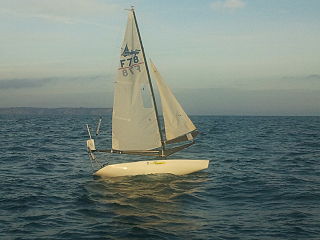
Vaimos is an autonomous sailing boat with embedded instrumentation for ocean surface measurements.

The University of Engineering & Management (UEM), Kolkata is a private university located in New Town, Kolkata. It provides engineering, technological & management education. It was established in 2015 by IEM Trust, Act no. XXV and it is the third engineering institution founded by the IEM-UEM Group. This university is administrated by the Institute of Engineering and Management (IEM) education group trust.

