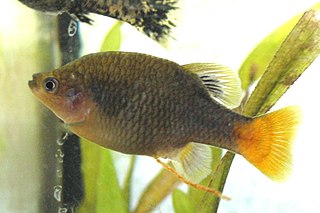
Goodeidae is a family of teleost fish endemic to Mexico and some areas of the United States. Many species are known as splitfins. This family contains about 50 species within 18 genera. The family is named after ichthyologist George Brown Goode (1851-1896).

The belted sandfish, also known as the dwarf sea bass or stubby sea bass, is a species of marine ray-finned fish, a sea bass from the subfamily Serraninae, classified as part of the family Serranidae which includes the groupers and anthias. It is found in the western Atlantic Ocean. This species is found in the aquarium trade.

The gag grouper, also known as velvet rockfish, the gag, or charcoal belly, is a species of marine ray-finned fish, a grouper from the subfamily Epinephelinae which is part of the family Serranidae, which also includes the anthias and sea basses. It comes from warmer parts of the West Atlantic, including the Caribbean and Gulf of Mexico. It is a drab, mottled-gray fish lacking the distinguishing features of most other groupers. Its pattern of markings resemble the box-shaped spots of the black grouper. It lacks the streamer-points on the tail fin that scamp and yellowmouth grouper have and lacks yellow coloration around the mouth.

The sand goby, also known as a polewig or pollybait, is a species of ray-finned fish native to marine and brackish waters European waters from the Baltic Sea through the Mediterranean Sea and into the Black Sea where it occurs in sandy or muddy areas of inshore waters at depths of from 4 to 200 metres. This species can reach a length of 11 centimetres (4.3 in) TL. This species is sometimes kept in public aquariums. The sand goby is of a sandy colour, with darker markings on the sides and a creamy-white underside. In the breeding season the male fish has blue spot at the rear of the first dorsal fin, ringed with white. The fish has a slender body, and the head is about a quarter of the total length.

The butterfly splitfin or butterfly goodeid is a bony fish from the monotypic genus Ameca of the splitfin family (Goodeidae). It was formerly found throughout the Ameca River drainage in Mexico; the type locality is Rio Teuchitlán in the vicinity of Teuchitlán, Jalisco. The species was only ever found in an area about 10 miles (15 km) in diameter.

The marbled grouper, donkey fish, mutton hamlet, rockhind and sicklefish grouper, is a species of marine ray-finned fish, a grouper from the subfamily Epinephelinae which is part of the family Serranidae, which also includes the anthias and sea basses. It is a predatory reef fish which is found in the Western Atlantic Ocean.

Epinephelus andersoni, the catface grouper, brown-spotted grouper, catface rockcod or brown spotted rockcod, is a species of marine ray-finned fish, a grouper from the subfamily Epinephelinae which is part of the family Serranidae, which also includes the anthias and sea basses. It is found in the southwestern Indian Ocean where it is associated with reefs.

The Gulf grouper is a species of marine ray-finned fish, a grouper from the subfamily Epinephelinae which is part of the family Serranidae, which also includes the anthias and sea basses. It is endemic to Mexico.
Xenotoca is a genus of fish in the family Goodeidae from Mexico, where found in a wide range of habitats, from rivers and creeks to pools and lakes, in the Lerma–Grande de Santiago, Panuco, Cuitzeo and other basins of the Mesa Central. While no goodeid is a very common aquarium fish, the redtail splitfin, is one of the most common aquarium goodeids. Its relatively bright colors offset its reputation for being aggressive towards tankmates, occasionally even killing them. Similarly to that species, two species described in 2016 have males with red-orange tails, but this feature is not shared by the remaining members of the genus. The Xenotoca species are small, reaching up to 9 cm (4 in) in standard length.
The redtail splitfin or redtail goodeid is a species of goodeid fish from the family Goodeidae and subfamily Goodeinae. Like other members of Goodeinae, the redtail splitfin is native to Mexico and a livebearer. However, the goodeid mating system differs in several ways from the more common livebearing fish from the family Poeciliidae that includes guppies and swordtails. While no goodeid species is a very popular aquarium fish, the redtail splitfin is one of the most popular. Only the male has the red-orange tail for which it is named. Its specific name honours the collector of the type, Gustav Eisen (1847–1940) who was Curator of Marine Invertebrates at the California Academy of Sciences in San Francisco, California.

Cephalopholis panamensis, the Pacific graysby or Panama graysby, is a species of marine ray-finned fish, a grouper from the subfamily Epinephelinae which is in the family Serranidae which also includes the anthias and sea basses. It is found in the Eastern Pacific Ocean.

The green swordtail is a species of freshwater/brackish fish in family Poeciliidae of order Cyprinodontiformes. A live-bearer, it is closely related to the southern platyfish or 'platy' and can crossbreed with it. It is native to an area of North and Central America stretching from Veracruz, Mexico, to northwestern Honduras.
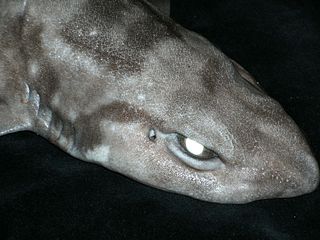
Scyliorhinus meadi, the blotched catshark, is a little-known species of catshark, and part of the family Scyliorhinidae, found in the western central Atlantic Ocean. It inhabits banks of deep-sea coral at depths of 329–548 m (1,079–1,798 ft), feeding on cephalopods, shrimp, and bony fishes. This species can be identified by its wide body and head, and the dark saddle-like markings on its back. It also has small spots that fluoresce yellow under a blue light. Adult blotched catsharks have not been observed; the largest immature specimen is 49 cm (19 in) long. Like other catsharks, it is believed to be oviparous. This species is not dangerous to humans and has no commercial significance.
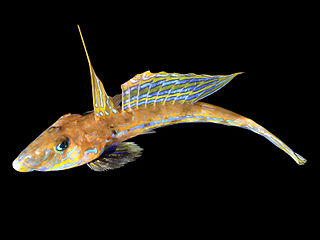
The common dragonet is a species of dragonet which is widely distributed in the eastern North Atlantic where it is common near Europe from Norway and Iceland southwards. It is a demersal species that occurs over sand bottoms. It lives to a maximum age of around seven years. It is caught in bycatch by fisheries and is used in the aquarium trade.

Hypleurochilus geminatus, the crested blenny, is a species of combtooth blenny found in the western Atlantic ocean. This species grows to a length of 10 centimetres (3.9 in) TL.

The seaweed blenny is a species of combtooth blenny found in coral reefs in the western Atlantic Ocean along the coasts of New York, Bermuda, the Bahamas, also in the Gulf of Mexico, south to southern Brazil. This species reaches a length of 8.5 centimetres (3.3 in) TL.

Zoogoneticus tequila, Tequila splitfin or simply Tequila fish, is a species of goodeid fish from Mexico. The specific epithet, tequila, derives from the Tequila Volcano, which looms near the type locality.
Galaxias tantangara, the stocky galaxias, is a galaxiid of the genus Galaxias, a member of the Mountain Galaxias species complex group of freshwater fish, found in Australia. Only discovered in 2014, the fish is classed as critically endangered, mainly because of being preyed upon by introduced species of trout.

Allotoca goslinei, commonly known as the banded allotoca or tiro rayado in Spanish, is a species of fish in the family Goodeidae. First described in 1987, it was once endemic only to the Ameca River basin in the Mexican state of Jalisco. It is now known to be extinct in the wild.
Xenotoca lyonsi, the Tamazula redtail splitfin, is a bony fish species in the goodeid family. Until 2016 it was considered to be a variant of the redtail goodeid, X. eiseni. A 2016 study by Omar Dominguez-Dominguez, et al. split the redtail goodeid into three separate species: X. eiseni, X. doadrioi and X. lyonsi.


