
Alexey Leonidovich Pajitnov is a Russian computer engineer and video game designer who is best known for creating, designing, and developing Tetris in 1985 while working at the Dorodnitsyn Computing Centre under the Academy of Sciences of the Soviet Union. After Tetris was released internationally in 1987, he released a sequel in 1989, entitled Welltris.
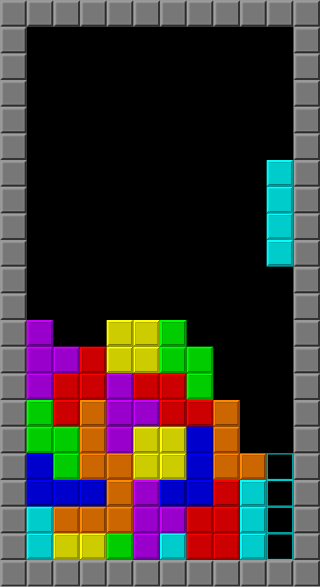
Tetris is a puzzle video game created in 1985 by Alexey Pajitnov, a Soviet software engineer. It has been published by several companies for multiple platforms, most prominently during a dispute over the appropriation of the rights in the late 1980s. After a significant period of publication by Nintendo, in 1996 the rights reverted to Pajitnov, who co-founded the Tetris Company with Henk Rogers to manage licensing.

Puzzle video games make up a broad genre of video games that emphasize puzzle solving. The types of puzzles can test problem-solving skills, including logic, pattern recognition, sequence solving, spatial recognition, and word completion. Many puzzle games involve a real-time element and require quick thinking, such as Tetris (1985) and Lemmings (1991).

Zoop is a puzzle video game originally developed by Hookstone and published by Viacom New Media in 1995 for the Genesis, Super Nintendo Entertainment System, MS-DOS, Macintosh, PlayStation, Game Gear, and Game Boy, then in 1996 for the Saturn and Jaguar. Zoop has similarities to Taito's 1989 arcade video game Plotting, but Zoop runs in real-time instead. Players are tasked with eliminating pieces that spawn from one of the sides of the screen before they reach the center of the playfield. By pointing at a piece and shooting it, the player can either swap it with the current player color and thus arrange the same color pieces in a row or column, or match the color.

Columns is a match-three puzzle video game released by Jay Geertsen in 1989. Designed for the Motorola 68000-based HP 9000 running HP-UX, it was ported to Mac and MS-DOS before being released commercially by Sega who ported it to arcades and then to several Sega consoles. The game was subsequently ported to other home computers, including the Atari ST.

Rampart is a 1990 video game released by Atari Games and Midway Games that combines the shoot 'em up, strategy, and puzzle genres. It debuted as an arcade game with trackball controls, and was ported to home systems. It had a limited US release in October 1990, and a wide release in early 1991. It was distributed in Japan by Namco.

Klax is a puzzle video game released in arcades in 1990 by Atari Games while Namco distributed the game in Japanese markets. It was designed and animated by Mark Stephen Pierce with the software engineering done by Dave Akers. The object is to catch colored blocks tumbling down a machine and arrange them in colored rows and patterns to make them disappear. Klax was originally published as a coin-op follow-up to Tetris, about which Atari Games was in a legal dispute at the time.

Cinemaware was a video game developer and publisher. It had released several titles in the 1980s based on various film themes. The company was resurrected in 2000, before being acquired by eGames in 2005.
Tengen Inc. was an American video game publisher and developer that was created by the arcade game manufacturer Atari Games for publishing computer and console games. It had a Japanese subsidiary named Tengen Ltd..

Wordtris is a Tetris offshoot designed by Sergei Utkin, Vyacheslav Tsoy and Armen Sarkissian and published by Spectrum HoloByte in 1991 for MS-DOS compatible operating systems. A port to the Game Boy, by Realtime Associates, and Super Nintendo Entertainment System were released in 1992.
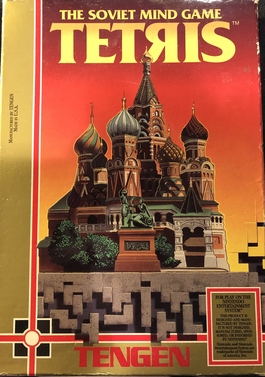
Tetris is a puzzle game developed by Atari Games and originally released for arcades in 1988. Based on Alexey Pajitnov's Tetris, Atari Games' version features the same gameplay as the computer editions of the game, as players must stack differently shaped falling blocks to form and eliminate horizontal lines from the playing field. The game features several difficulty levels and two-player simultaneous play.

Puzzle Bobble 2 is a tile-matching video game by Taito. The first sequel to Puzzle Bobble, it is also known in Europe and North America as Bust-A-Move Again for arcades and Bust-A-Move 2: Arcade Edition for home consoles. Released into the arcades in 1995, home conversions followed for the PlayStation, Sega Saturn, Nintendo 64, and Windows platforms. The game was included in Taito Legends 2, but the US arcade version was included in the US PS2 version instead. Further ports for the Nintendo Switch, PlayStation 4, and Xbox One were released by City Connection alongside Puzzle Bobble 3 in February 2023.
Vadim Viktorovich Gerasimov is an engineer at Google. From 1994 to 2003, Vadim worked and studied at the MIT Media Lab. Vadim earned a BS/MS in applied mathematics from Moscow State University in 1992 and a Ph.D. from MIT in 2003.

Tetris is a puzzle video game developed and published by Nintendo for the Game Boy in 1989. It is a portable version of Alexey Pajitnov's original Tetris and it was bundled with the North American and European releases of the Game Boy itself. It is the first game to have been compatible with the Game Link Cable, a pack-in accessory that allows two Game Boy consoles to link for multiplayer purposes. A remaster, Tetris DX, was released on the Game Boy Color in 1998. A Nintendo 3DS Virtual Console version of Tetris was released in December 2011, lacking multiplayer functionality. The game was released on the Nintendo Switch Online service in February 2023.
Gerasimov or Gerasimova is a Russian surname, derived from the given name Gerasim. Notable people with the surname include:

Cleopatra Fortune (クレオパトラフォーチュン), released in North America as Cleopatra's Fortune, is a 1995 arcade puzzle video game created by Taito in association with Natsume Co., Ltd.

Welltris is a puzzle video game, developed by Doca and licensed to Bullet-Proof Software. It is an official game in the Tetris series. Adaptations were made by Sphere, Inc., for Spectrum HoloByte, and by Infogrames. It was released for MS-DOS compatible operating systems in 1989. Ports for Macintosh, Amiga, Amstrad CPC, and Atari ST followed 1990, then ZX Spectrum and Commodore 64 1991.
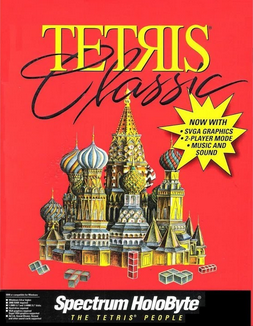
Tetris Classic is a 1992 puzzle video game developed and published by Spectrum HoloByte for DOS systems. It is an adaptation of the 1985 Soviet video game Tetris, which was first released in North America in 1988. Spectrum HoloByte subsequently developed a series of annual spin-off titles for Tetris, and intended to take advantage of improvements in computer technology since the original game's release; for Tetris Classic, they showcased the Video Graphics Array (VGA) standard via illustrations depicting scenes from Alexander Pushkin's poem Ruslan and Ludmila, as well as a soundtrack consisting of selections from Mikhail Glinka's opera adaptation of the poem. The game additionally includes competitive and cooperative two-player modes and an option to set a time limit on games. The game received mixed critical commentary; while reviewers appreciated the enhanced presentation and new multiplayer modes, they noted that the gameplay was unchanged from the original version.
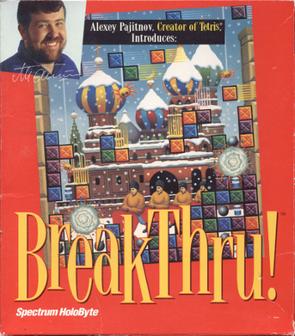
BreakThru! is a tile-matching puzzle video game released for Windows and MS-DOS in 1994. It was created by Steve Fry for the Japanese company ZOO Corporation and published by Spectrum HoloByte for the North American market.

