 | Look up yellowwood in Wiktionary, the free dictionary. |
Yellowwood may refer to:
| Look up yellowwood in Wiktionary, the free dictionary. |
Yellowwood may refer to:
 | This disambiguation page lists articles associated with the title Yellowwood. If an internal link led you here, you may wish to change the link to point directly to the intended article. |

Podocarpus latifolius is a large evergreen tree up to 35 m high and 3 m trunk diameter, in the conifer family Podocarpaceae; it is the type species of the genus Podocarpus.

The Mascarene Islands or Mascarenes or Mascarenhas Archipelago is a group of islands in the Indian Ocean east of Madagascar consisting of the islands belonging to the Republic of Mauritius as well as the French department of Réunion. Their name derives from the Portuguese navigator Pedro Mascarenhas, who first visited them in April 1512. The islands share a common geologic origin in the volcanism of the Réunion hotspot beneath the Mascarene Plateau and form a distinct ecoregion with a unique flora and fauna.

Podocarpaceae is a large family of mainly Southern Hemisphere conifers, comprising about 156 species of evergreen trees and shrubs. It contains 19 genera if Phyllocladus is included and if Manoao and Sundacarpus are recognized.

Podocarpus is a genus of conifers, the most numerous and widely distributed of the podocarp family, Podocarpaceae. Podocarpus are evergreen shrubs or trees, usually from 1 to 25 metres tall, known to reach 40 metres (130 ft) at times. The cones have two to five fused cone scales which form a fleshy, berry-like, brightly coloured receptacle at maturity. The fleshy cones attract birds which then eat the cones and disperse the seeds in their droppings. There are approximately 97 to 107 species in the genus depending on the circumscription of the species.

Nageia is a genus of conifers belonging to the podocarp family Podocarpaceae. Nageia includes evergreen shrubs and trees, from one to 54 meters in height. A 2009 treatment of the genus recognized five species. Some authors consider Nageia formosensis to be a separate species from Nageia nagi, thus recognizing six species. The podocarp genera have been reshuffled by various botanists. Most recently, several species formerly classed as Nageia were moved to the new genus Retrophyllum, while Nageia falcata and Nageia mannii were moved to the new genus Afrocarpus.

Afrocarpus is a genus of conifers of the family Podocarpaceae. Two to six species are recognized. They are evergreen trees native to Africa. Afrocarpus was designated a genus in 1989, when several species formerly classified in Podocarpus and Nageia were reclassified.
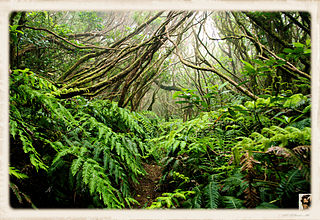
Laurel forest, also called laurisilva or laurissilva, is a type of subtropical forest found in areas with high humidity and relatively stable, mild temperatures. The forest is characterized by broadleaf tree species with evergreen, glossy and elongated leaves, known as "laurophyll" or "lauroid". Plants from the laurel family (Lauraceae) may or may not be present, depending on the location.

Cotinus, the smoketree or smoke bush, is a genus of two species of flowering plants in the family Anacardiaceae, closely related to the sumacs (Rhus).

The Hispaniolan pine forests are a subtropical coniferous forest ecoregion found on the Caribbean island of Hispaniola, which is shared by Haiti and the Dominican Republic. The ecoregion covers 11,600 km2 (4,500 sq mi), or about 15% of the island. It lies at elevations greater than 800 m (2,600 ft) in the mountains of Hispaniola, extending from the Cordillera Central of the Dominican Republic and into the Massif du Nord of Haiti. It is surrounded at lower elevations by the Hispaniolan moist forests and Hispaniolan dry forests ecoregions, which cover the remainder of the island. Annual rainfall is 1,000–2,000 mm (39–79 in).

Nichols Arboretum, locally known as the Arb, is an arboretum operated by the University of Michigan. Located on the eastern edge of its Central Campus at 1610 Washington Heights in Ann Arbor, Michigan, the Arboretum is a mosaic of University and City properties operated as one unit. The arboretum is open daily from sunrise to sunset with no charge for admission. The Huron River separates a northern section of the arboretum's floodplain woods; the railroad marks the northern border.
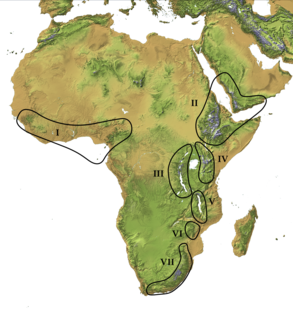
The Afromontane regions are subregions of the Afrotropical realm, one of the Earth's eight biogeographic realms, covering the plant and animal species found in the mountains of Africa and the southern Arabian Peninsula. The Afromontane regions of Africa are discontinuous, separated from each other by lower-lying areas, and are sometimes referred to as the Afromontane archipelago, as their distribution is analogous to a series of sky islands.

Afrocarpus falcatus is a species of tree in the family Podocarpaceae. It is native to the montane forests of southern Africa, where it is distributed in Malawi, Mozambique, South Africa, and Eswatini. Common names include common yellowwood, bastard yellowwood, outeniqua yellowwood, African fern pine, weeping yew, Afrikaans: outeniekwageelhout, kalander, Sotho: mogôbagôba, Xhosa: umkhoba and Zulu: umsonti. It is widespread, in some areas abundant, and not considered threatened, but it is a protected tree in South Africa. It is grown as an ornamental tree, especially in South Africa, and occasionally abroad.

Afrocarpus gracilior is a species of coniferous tree in the family Podocarpaceae known as benet in Marakwet and East African yellowwood, African fern tree, or bastard yellowwood in English

Zanthoxylum brachyacanthum, known as thorny yellowwood or satinwood, is an Australian rainforest tree. The natural range is from the Clarence River in New South Wales to tropical Queensland in the Eungella National Park and the Wet Tropics region.
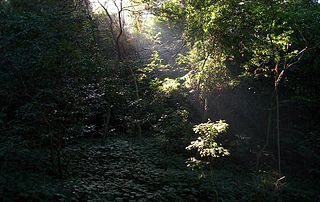
Areas of forest which grow in KwaZulu-Natal, South Africa mostly on south facing slopes in higher rainfall areas, and along the humid coastal areas. Different types of forest can be identified by their species composition which depends mostly on the altitude, latitude and substrate in which they grow. South facing slopes are favourable for the development of forest as they are more shaded, and therefore cooler and retain more moisture than the northern slopes. The extra moisture on the south slopes is not only favoured by forest trees, but also helps to prevent or subdue wildfires. Fires can also be blocked by cliff faces and rocks or boulders on these slopes, and by streams or rivers at the base of the slopes. The coastal regions are conducive to forest formation, because of high rainfall and humidity which are favoured by forest trees and also help to prevent or subdue fires. The rivers of the coastal areas are also broader than further inland, which may often prevent fires from spreading long distances, and fires generally burn uphill and therefore more often away from areas at low altitude.

The Karkloof Forest is situated in the Karkloof Nature Reserve, 22 km north of Howick, KwaZulu-Natal, South Africa.

Zanthoxylum ovalifolium is a species of flowering plant in the family Rutaceae. Common names include thorny yellowwood, oval-leaf yellow wood and little yellowwood. A widespread species, Zanthoxylum ovalifolium can be found from India, through southeast Asia, New Guinea, and on to northern Australia. It is a timber tree valued for its yellow heartwood.