- ↑ In lunar calendar, Yun was born on 17 April 1840
- ↑ Emory University, Manuscript, Archives, and Rare Book Library (MARBL): Yun Ch'i-ho papers, 1883-1943
- ↑ "100 Koreans Freed; But Baron Yun Chi-ho and Other Prominent Men Are Found Guilty," New York Times. March 21, 1913.
- 1 2 "최혁 주필의 전라도 역사이야기". 남도일보 (in Korean). 2017-07-23. Retrieved 2023-03-19.
- ↑ "윤웅렬(尹雄烈)". Encyclopedia of Korean Culture (in Korean). Retrieved 2023-04-06.
- ↑ Speer, Robert E. (1905). "Korea, Japan and Russia," p. 60.
- ↑ 조선-대한제국 관보. "9月30日".
- ↑ 조선·대한제국 관보. "參謀部副長尹雄烈辭職疏".
- ↑ (in Korean) 2006년도 조사보고서 II - 친일반민족행위결정이유서, p. 257~262 친일반민족행위진상규명위원회, 11-1560010-0000002-10, 2006; n.b., investigative report II - pro-Japanese anti-national act decisive reasons, p. 257~262 pro-Japanese anti-national act truth close examination committees.
Related Research Articles

Gojong, personal name Yi Myŏngbok, later Yi Hui, also known as the Gwangmu Emperor, was the penultimate Korean monarch. He ruled Korea for 43 years, from 1864 to 1907, first as the last king of Joseon, and then as the first emperor of the Korean Empire from 1897 until his forced abdication in 1907. His wife, Queen Min, played an active role in politics until her assassination.
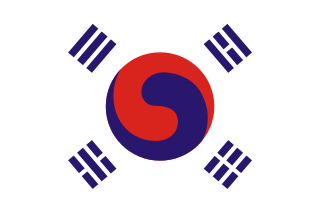
The Korean Empire, officially the Empire of Korea or Imperial Korea, was a Korean monarchical state proclaimed in October 1897 by King Gojong of the Joseon dynasty. The empire stood until Japan's annexation of Korea in August 1910.

Yun Po-sun was a South Korean politician and activist who served as the second president of South Korea from 1960 to 1962. He was the only president of the parliamentary Second Republic of Korea.
The Gapsin Coup, also known as the Gapsin Revolution, was a failed three-day coup d'état that occurred in Korea during 1884. Korean reformers in the Enlightenment Party sought to initiate rapid changes within the country, including eliminating social distinctions by abolishing the legal privileges of the yangban class. The coup d'état attempt, with Japanese support, began on December 4, 1884, with seizure of the royal palace in Seoul and the killing of several members of the pro-Chinese conservative faction. However, the coup was eventually suppressed by a Chinese garrison stationed in the country. Thwarted by the Chinese actions, some of the pro-Japanese faction leaders found exile in Japan. The event led to informal Chinese domination of Korea from 1885 to 1894. Within the Joseon court, Chinese influence grew particularly under the Resident-General Yuan Shikai.

Min Yeong-hwan was a politician, diplomat, and general of the Korean Empire and known as a conservative proponent for reform. He was born in Seoul into the powerful Yeoheung Min clan which Heungseon Daewongun hated, and committed suicide as an act of resistance against the Eulsa Treaty imposed by Japan on Korea. He is remembered today for his efforts on behalf of Korean independence in the waning days of the Joseon period and a statue to his memory now stands on a traffic island near Chungjeongno Intersection, his namesake, after having previously been located at Anguk Intersection in 1957, before being moved due to road widening to near Donhwa Gate of Changdeok Palace in 1970 where it was criticized for not matching the surroundings, and then near the General Post Office next to Jogye Temple in 2003, where it was reportedly neglected until 2022.

Yun Chi-ho was a Korean politician. His name is sometimes spelled Yun Tchi-Ho, his art name was Jwaong (좌옹), and his courtesy name was Seongheum (성흠).
Yun Chi-oh was a Korean educator and politician. He was a member of the prominent Yun family of Korea, which also included Yun Chi-ho, Yun Chi-young, and Yun Bo-seon. His art name was Dongam and his courtesy name was Jajung. Yun was born in Dunpo, in Asan County, South Chungcheong Province, Joseon.

General Yun Chi-wang was a South Korean politician, soldier and gynecologist. He was the half brother of Yun Chi-ho, uncle of Yun Posun, and cousin of Yun Chi-young. His art name was Namppo, and his courtesy name was Seongun.

Kim Hong-jip was a Korean politician best known for his role as prime minister during the Gabo Reform period from 1895–1896. His name was originally Kim Goeng-jip (김굉집) which he later changed to Kim Hong-jip. His father, Kim Yeong-jak, served as mayor of Kaesŏng in the Joseon Dynasty.
The Gaehwa Party, Gaehwapa or Gaehwadang was a liberal and progressive party in the Korean state Joseon. It was also called the Independence Party of Joseon, the Innovation Party of Joseon, and the Reformist Faction.
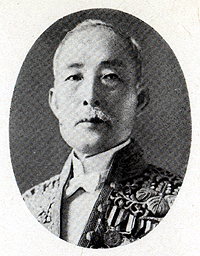
Park Jung-yang was a Korean bureaucrat and politician in the Japanese colonial government. His art names were Haeak 해악) and Ilso 일소), and his courtesy name was Wongeun 원근). He also had the Japanese names Shigeyō Hōchū (朴忠重陽), Jūyō Boku and Shin Yamamoto. Park was Governor of the prefecture Kōkai-dō from 1921 to 1923 and in 1928. He was also governor of Chūseihoku-dō from 1923 to 1925.
Yun Won-hyeong was a Korean political figure of the Joseon period. He was the younger brother of Queen Munjeong, the 3rd wife of 11th King Jungjong and was the maternal uncle of the 13th King Myeongjong.

Yun Yeong-ryeol was a Korean Joseon Dynasty politician and soldier. nickname was Gyungjae, Yeongu. uncle of Yun Chi-ho and grandfather of Yun Bo-seon, father of Yun Chi-young.

Pak Che-soon was a Korean politician and diplomat during the late Joseon period. His art name was Pyeongjae. In modern South Korea, he is regarded as one of the Five Eulsa Traitors who betrayed the country into Japanese domination in 1905.
Seo Jae-chang was a Korean politician, serviceperson, liberal ideologist during the Joseon period. He was a member of the reformist Party(개화당;開化黨). In 1884 he was a participant in the Gapsin coup. The coup failed and he was arrested and executed. Seo was the younger brother of Seo Jae-pil.

Yi Jae-gak was a member of the Imperial house of the Korean Empire and an official of Korean Empire. After the annexation of Korea, he was ennobled as Marquess.
The Ministry of Military (Korean: 군부) was a department of the governments of Joseon and its successor the Korean Empire that oversaw military affairs.

Kim Ga-jin was an Imperial Korean politician, diplomat and an independence activist during Korea under Japanese rule.

Yi Do-jae was a politician and career soldier of Imperial Korea.

No Baek-rin was an Imperial Korean army officer and independence activist.
References
- Kranewitter, Rudolf. (2005). Dynamik der Religion Schamanismus, Konfuzianismus, Buddhismus und Christentum in der Geschichte Koreas von der steinzeitlichen Besiedlung des Landes bis zum Ende des 20. Jahrhunderts. Münster: LIT Verlag. ISBN 978-3-825-88628-8; OCLC 181472594
- Leibo, Steven A. (2006). East and Southeast Asia. Harpers Ferry, West Virginia: Stryker-Post Publications. OCLC 61691567
- Speer, Robert E. (1905). "Korea, Japan and Russia," in The Ideal Home Educator: a Superb Library of Useful Knowledge. Chicago: Bible House. OCLC 17303311
- Wells, Kenneth M. (1991). New God, New nation: Protestants and Self-Reconstruction Nationalism in Korea, 1896-1937. Honolulu: University of Hawaii Press. ISBN 9780824813383; OCLC 216760168
Text is available under the CC BY-SA 4.0 license; additional terms may apply.
Images, videos and audio are available under their respective licenses.
| Yun Ung-nyeol | |
 Yun Ung-nyeol (left) and a friend attired in traditional Korean clothing. The two are engaged in a game of "Go-ban" (oriental chess) in one of the rooms of Yun's home in Seoul c. 1903. |