Related Research Articles
Chinese classic texts or canonical texts or simply dianji (典籍) refers to the Chinese texts which originated before the imperial unification by the Qin dynasty in 221 BC, particularly the "Four Books and Five Classics" of the Neo-Confucian tradition, themselves a customary abridgment of the "Thirteen Classics". All of these pre-Qin texts were written in either Old or Classical Chinese. All three canons are collectively known as the Classics.

Qiu Jin was a Chinese revolutionary, feminist, and writer. Her courtesy names are Xuanqing and Jingxiong. Her sobriquet name is Jianhu Nüxia. Qiu was executed after a failed uprising against the Qing dynasty and is considered a national heroine in China and a martyr of republicanism and feminism.

Xin Qiji was a Chinese poet, calligrapher, and military general during the Southern Song dynasty (1127–1279).
Liu Xin, courtesy name Zijun, was a Chinese librarian, astronomer, mathematician, classicist, and politician during the Western Han dynasty and the Xin dynasty. He later changed his name to Liu Xiu due to the naming taboo of Emperor Ai of Han. He was the son of Imperial librarian Liu Xiang and an associate of other eminent thinkers such as the philosopher Huan Tan. Liu was a prominent supporter of the Old Text classics.

The Central Academy of Drama is a national public drama school in Beijing, China. It is affiliated with the Ministry of Education. The academy is part of the Double First Class University Plan.
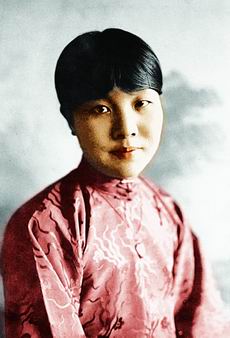
Xie Wanying, better known by her pen name Bing Xin or Xie Bingxin, was one of the most prolific Chinese women writers of the 20th century. Many of her works were written for young readers. She was the chairperson of the China Federation of Literary and Art Circles. Her pen name Bing Xin carries the meaning of a morally pure heart, and is taken from a line in a Tang dynasty poem by Wang Changling.

The Three Qins refer to three of the Eighteen Kingdoms, the short-lived power-sharing arrangement formed in 206 BC after the collapse of the Qin Dynasty. The three kingdoms were located in Guanzhong Plain, the heartland of the Qin Empire.

Huang Xin is a fictional character in Water Margin, one of the Four Great Classical Novels in Chinese literature. Nicknamed "Guardian of the Three Mountains", he ranks 38th among the 108 Stars of Destiny and second among the 72 Earthly Fiends.
Sun Xin is a fictional character in Water Margin, one of the Four Great Classical Novels in Chinese literature. Nicknamed "Little Yuchi", he ranks 100th among the 108 Stars of Destiny and 64th among the 72 Earthly Fiends.
Li Xun, courtesy name Shiru (士如), was the final ruler of China's Western Liang dynasty during the Sixteen Kingdoms period. Li Xun tried to hold out against the conquering Northern Liang armies under its prince Juqu Mengxun, after his brother Li Xin's death in 420. He was only able to hold the city of Dunhuang for several months, before Juqu Mengxun successfully sieged the city, and Li Xun committed suicide.

Ulmus lamellosa, commonly called the Hebei elm, is a small deciduous tree native to four Chinese provinces, Hebei, Henan, Nei Mongol, and Shanxi, to the west and south of Beijing.
Zhang Jie was a Chinese novelist and short-story writer. She also co-wrote a biography of the film director Wu Zuguang in 1986. She worked on writing different kinds of books for or with young protagonists; these types of works are included in junior and senior high school textbooks in China. She was one of China's first feminist writers.

Zhang Xin is a Chinese billionaire businesswoman, having primarily earned her fortune in the real estate industry. With her husband Pan Shiyi, she is the co-founder and former CEO of SOHO China, a Chinese office building developer. She stepped down from the role of CEO on 7 September 2022 “in order to focus on supporting the arts and philanthropic pursuits.”

China Writers Association or Chinese Writers Association is a subordinate people's organization of the China Federation of Literary and Art Circles (CFLAC). Founded in July 1949, the organization was initially named the China National Literature Workers Association. In September 1953, it was renamed the China Writers Association. The association's leadership was purged shortly after the 1989 Tiananmen Square protests and massacre. In April 2012, the organization changed its translated name to China Writers Association.

Chen Xuezhao was a Chinese writer and journalist. She was earlier known as Chen Shuzhang or Chen Shuying. She used the pen names Ye Qu, Shi Wei, Xue Zhao and Hui. She was one of the most prolific Chinese women writers of the 20th century. Chen gave her support to Mao Zedong's policy on Art and Literature.
Despite a long-held belief in pre-modern China that women lacked literary talent, women's works – particularly poetry – did win a degree of respect within Chinese literature during the Imperial period. During the first half of the 20th century, writing by women reflected feminist ideas and the political upheavals of the time. Women writers conveyed expression from a feminine perspective, as opposed to man writers who conveyed expressions from a masculine perspective.
Zhang Xin is a Chinese professional footballer who plays as a midfielder for Shanghai Shengli. She studied in Tongji University.
Zhang Xin is a Chinese skateboarder. She has competed in women's park events at several World Skateboarding Championships, finishing 19th in 2018 and 25th in 2019.
References
- ↑ 作家张欣谈“言情”:别叫我“大陆琼瑶”
- ↑ Six Contemporary Chinese Women Writers, IV . Chinese Literature Press. 1995. ISBN 0835131750.
- ↑ Chinese Literature , Autumn 1993.
- ↑ Chinese Literature , Autumn 1995.
- ↑ Chinese Literature , Spring 1997.
- ↑ Chinese Literature , Winter 1998.

