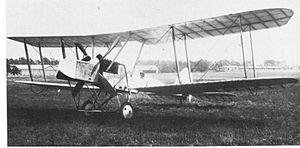
The Royal Aircraft Factory B.E.2 is a British single-engine tractor two-seat biplane, designed and developed at the Royal Aircraft Factory. Most of the roughly 3,500 built were constructed under contract by private companies, including established aircraft manufacturers and firms new to aircraft construction.

The Bristol F.2 Fighter is a British First World War two-seat biplane fighter and reconnaissance aircraft developed by Frank Barnwell at the British and Colonial Aeroplane Company later known as the Bristol Aeroplane Company. It is often simply called the Bristol Fighter, "Brisfit" or "Biff".
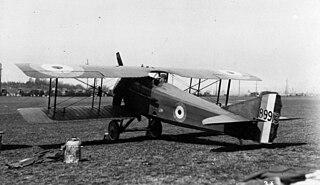
The SPAD S.VII C.1 was the first in a series of single-seat biplane fighter aircraft produced by Société Pour L'Aviation et ses Dérivés (SPAD) during the First World War. Like its successors, the S.VII was renowned as a sturdy and rugged aircraft with good diving characteristics. It was also a stable gun platform, although pilots used to the more maneuverable Nieuport fighters found it heavy on the controls. It was flown by a number of the famous aces, such as France's Georges Guynemer, Italy's Francesco Baracca and Australia's Alexander Pentland.

Between 1911 and 1914, the Royal Aircraft Factory used the F.E.2 designation for three quite different aircraft that shared only a common "Farman" pusher biplane layout.

The Royal Aircraft Factory R.E.8 is a British two-seat biplane reconnaissance and bomber aircraft of the First World War that was designed and produced at the Royal Aircraft Factory. It was also built under contract by Austin Motors, Daimler, Standard Motors, Siddeley-Deasy and the Coventry Ordnance Works.

The Royal Aircraft Factory S.E.5 is a British biplane fighter aircraft of the First World War. It was developed at the Royal Aircraft Factory by a team consisting of Henry Folland, John Kenworthy and Major Frank Goodden. It was one of the fastest aircraft of the war, while being both stable and relatively manoeuvrable. According to aviation author Robert Jackson, the S.E.5 was: "the nimble fighter that has since been described as the 'Spitfire of World War One'".

The Sopwith 1+1⁄2 Strutter is a British single- or two-seat multi-role biplane aircraft of the First World War. It was the first British two-seat tractor fighter and the first British aircraft to enter service with a synchronised machine gun. It was given the name 1+1⁄2 Strutter because of the long and short cabane struts that supported the top wing. The type was operated by both British air services and was in widespread but lacklustre service with the French Aéronautique Militaire.

The Vickers F.B.5 was a British two-seat pusher military biplane of the First World War. Armed with a single .303 in (7.7 mm) Lewis gun operated by the observer in the front of the nacelle, it was the first aircraft purpose-built for air-to-air combat to see service, making it the world's first operational fighter aircraft.

The Armstrong Whitworth F.K.3 was a British two-seat general-purpose biplane built by Armstrong Whitworth Aircraft during the First World War. By the end of the war it was considered obsolete for combat.

The Airco DH.5 was a British First World War single-seat biplane fighter aircraft. It was designed and manufactured at British aviation company Airco. Development was led by aircraft designer Geoffrey de Havilland as a replacement for the obsolete Airco DH.2.

The Airco DH.1 was an early military biplane of typical "Farman" pattern flown by Britain's Royal Flying Corps during World War I. By the time the powerplant for which it was designed was sufficiently plentiful it was obsolete as an operational aircraft, and apart from a few examples sent to the Middle East it served as a trainer and Home Defence fighter.

The Royal Aircraft Factory B.E.12 was a British single-seat aeroplane of The First World War designed at the Royal Aircraft Factory. It was essentially a single-seat version of the B.E.2.

The Royal Aircraft Factory F.E.8 is a British single-seat fighter of the First World War designed at the Royal Aircraft Factory. It could not escape the drag penalty imposed by its tail structure and was no match for the Albatros fighters of late 1916.

The SPAD S.A was a French two-seat tractor biplane first flown in 1915. It was used by France and Russia in the early stages of the First World War in the fighter and reconnaissance roles. It was a unique aircraft that carried its observer in a nacelle ahead of wing, engine and propeller.
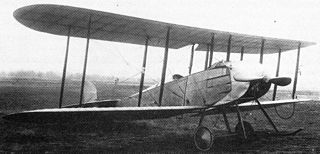
The Royal Aircraft Factory B.E.8 was a British two-seat single-engined general purpose biplane of the First World War, designed by John Kenworthy at the Royal Aircraft Factory in 1913. Small numbers were used by the Royal Flying Corps over the Western Front in the first year of the war, with the type being used as a trainer until 1916.

The Royal Aircraft Factory R.E.5 was a British two-seat reconnaissance and artillery observation biplane designed and built by the Royal Aircraft Factory for the Royal Flying Corps.
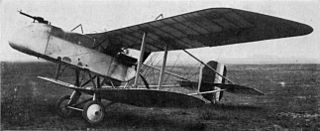
The Royal Aircraft Factory F.E.9 was a prototype British two-seat fighter-reconnaissance aircraft of the First World War. A single-engined pusher biplane of 1917, the F.E.9 had poor performance and handling, and only three were built.

The Royal Aircraft Factory N.E.1 was a prototype British night fighter of the First World War. A single-engined pusher biplane, it was a development of the Royal Aircraft Factory's earlier F.E.9 fighter, but was not successful, only six being built.
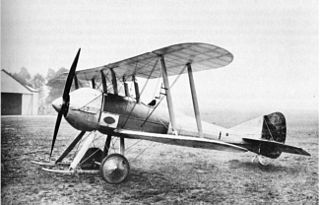
The Royal Aircraft Factory S.E.2 was an early British single-seat scout aircraft. Designed and built at the Royal Aircraft Factory in 1912–13 as the B.S.1, the prototype was rebuilt several times before serving with the Royal Flying Corps over the Western Front in the early months of the First World War.
The Royal Aircraft Factory C.E.1 was a prototype British flying boat of the First World War. It was a single-engined pusher configuration biplane intended to carry out coastal patrols to protect shipping against German U-boats, but only two were built, the only flying boats to be designed and built by the Royal Aircraft Factory.