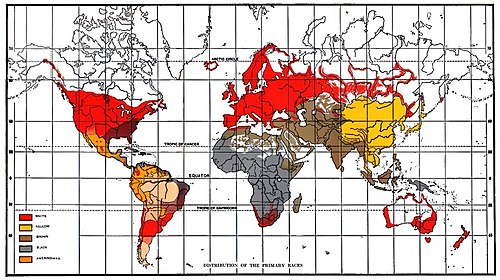
The Rising Tide of Color: The Threat Against White World-Supremacy (1920), by Lothrop Stoddard, is a book about racialism and geopolitics, in which the author predicted the eventual collapse of white supremacy and colonialism because of the population growth among coloured people, rising nationalism in the colonized countries, and the industrialization of China and Japan. To counter the perceived racialist and geopolitical threat, Stoddard advocated the application of Nordicism, racial segregation, and racism to restrict the immigration of the non-white Other into "white countries", because colored immigrants would dilute the whiteness of the local populations of the "Nordic race"; restricting Asian migration to Africa; and the piecemeal granting of political and economic independence to the European colonies in Asia and the Middle East. As a famous eugenicist, Stoddard supported the racialist segregation of the "primary races" of the world, and warned against miscegenation and the acceptance of mixed-race marriage and children of mixed race.
In the early twentieth century, Stoddard claimed that the non-white races were an existential threat to the global dominance of the white race, as "typified by the Russo-Japanese War", which he represents as a struggle of colored people against white people.[1]
In addition to Japan, Stoddard describes a "brown reaction", which he labelled "the Mohammedan Revival",[2], presenting as an example the book "The Awakening of the Islamic Peoples in the Fourteenth Century of the Hegira", by Yahya Siddyk.[3] That in Africa, the "Ethiopian movement (Ethiopian Church) preached by "Afro-American Methodist preachers", as "having had a hand in the Bambatha Rebellion (Zulu uprising) that occurred in Natal in 1907".[4]
Moreover, The Rising Tide of Color also warns of the danger of miscegenation, of the mixing of "the races" and the need for white countries to maintain their racial purity. Sodard's thesis is that the immigration of non-white foreigners to the U.S. interferes with white women having many children, which then are the "human capital" required to live in white communities:
"As long as the people of any community are relatively homogeneous, what differences of wealth and social position there may be do not affect the birth-rate, or do so only after a considerable time. But put into that community a number of immigrants, inferior mentally, socially, and economically, and the natives are unwilling to have their children associate with them in work or social life. They then limit the number of their children in order to give them the capital or education to enter occupations in which they will not be brought into contact with the new arrivals."[5]
Stoddard claimed that the increasing population and economic power of non-white races, particularly in Asia, will lead to a "collapse of civilization", typified by the situation in Latin America, which he describes as "the mongrel's political ascendancy", saying further that "[t]hese unhappy beings, every cell of whose bodies is a battle-ground of jarring heredities, express their souls in acts of hectic violence and aimless instability. The normal state of tropical America is anarchy, restrained only by domestic tyrants or foreign masters".[6] Stoddard's thesis is that the white race has dominated world affairs for centuries and has created a civilization that is superior to all others.
Publication and reception
Lothrop Stoddard's analyses of the world's "primary races" White, Yellow, Black, Brown, and Amerindian, and their interactions
In 1920, The Rising Tide of Color Against White World-Supremacy was positively reviewed and recommended by The New York Times: "Lothrop Stoddard evokes a new peril, that of an eventual submersion beneath vast waves of yellow men, brown men, black men and red men, whom the Nordics have hitherto dominated . . . with Bolshevism menacing us on the one hand and race extinction through warfare on the other, many people are not unlikely to give [Stoddard's book] respectful consideration".[7]
Civil rights activist W. E. B. Du Bois stated "the Nordic peoples...have been responsible for more intermixture of races than any other people, ancient and modern," and in reply to whites' fears of miscegenation declared "Who in Hell asked to marry your daughters?"[7]
In reply to Stoddard's notion that "if the Negroes have separate schools, they shall be good schools; that if they have separate train accommodations, they shall have good accommodations", black audiences allegedly laughed in disbelief.[7]
In 1921, in a speech to a mixed-race audience in Birmingham, Alabama, U.S. President Warren Harding said that Black Americans must have full economic and political rights, but that segregation was also essential to prevent "racial amalgamation" and that social equality was thus a dream that Blacks must give up, and used the book to support his segregationist views: "Whoever will take the time to read and ponder Mr. Lothrop Stoddard’s book on The Rising Tide of Color . . . must realize that our race problem here in the United States is only a phase of a race issue that the whole world confronts."[7]
The anthropologist Franz Boas criticised the scientific racism presented and advocated in The Rising Tide of Color, and U.S. black newspapers called Stoddard "the high priest of racial baloney".[7] In the 21st century, the racialism presented by Stoddard remains an ideological influence upon the philosophy and the politics of the white supremacist movement in the United States.[8]
In F. Scott Fitzgerald's novel The Great Gatsby, the antagonist Tom Buchanan refers to the book, lightly disguising the author as "Goddard", who writes about how the white race will be "utterly submerged".[9]
↑Crean, Jeffrey (2024). The Fear of Chinese Power: an International History. New Approaches to International History series. London, UK: Bloomsbury Academic. p.47. ISBN978-1-350-23394-2.
This page is based on this Wikipedia article Text is available under the CC BY-SA 4.0 license; additional terms may apply. Images, videos and audio are available under their respective licenses.