In theoretical economics, an abstract economy (also called a generalized N-person game) is a model that generalizes both the standard model of an exchange economy in microeconomics, and the standard model of a game in game theory. An equilibrium in an abstract economy generalizes both a Walrasian equilibrium in microeconomics, and a Nash equilibrium in game-theory.
The concept was introduced by Gérard Debreu in 1952. He named it generalized N-person game, and proved the existence of equilibrium in this game. [1] Later, Debreu and Kenneth Arrow (who renamed the concept to abstract economy) used this existence result to prove the existence of a Walrasian equilibrium (aka competitive equilibrium) in the Arrow–Debreu model. [2] Later, Shafer and Sonnenschein extended both theorems to irrational agents - agents with non-transitive and non-complete preferences. [3] [4]
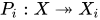
In the model of Debreu, [1] an abstract economy contains a finite number N of agents. For each agent , there is:
The goal of each agent is to choose an action that maximizes his utility.
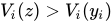
An equilibrium in an abstract economy is a vector of choices, , such that, for each agent , the action maximizes the function subject to the constraint :
Equivalently, for each agent , there is no action such that:
The following conditions are sufficient for the existence of equilibrium: [1] [5] [6]
The continuity conditions on the utility functions can be weakened as follows: [7] : Thm.2
Another weakening, which does not use graph-continuity, is: [7]
The proofs use the Kakutani fixed point theorem.
An exchange economy is a system with N-1 consumers and homogeneous divisible goods. For each consumer i, there is:
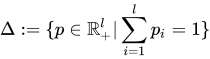
Define the set of possible price-vectors as: .
A Walrasian equilibrium (aka competitive equilibrium) in an exchange economy is a vector of consumption-bundles and a price-vector, , such that:

Arrow and Debreu [2] presented the following reduction from exchange economy to abstract economy.
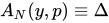
Given an (N-1)-agent exchange economy, we define an N-agent abstract economy by adding a special agent called the market maker or market player. The "consumption" of this special player is denoted by p. The components of the abstract economy are defined as follows:
Intuitively, the market player chooses the price in a way that balances supply and demand: for commodities with more supply than demand, the right-hand term in is negative so the market player chooses a low price; for commodities with more demand than supply, the term is positive so the market player chooses a high price.
The following conditions in the exchange economy are sufficient to guarantee that the abstract economy satisfies the conditions for equilibrium:
Moreover, the following additional condition is sufficient to guarantee that the equilibrium in the abstract economy corresponds to a competitive equilibrium in the exchange economy:
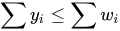
The definition guarantees that the total expense of each agent is at most his budget. The definition guarantees that the consumption of each agent maximizes his utility given the budget. And the definition guarantees that the total consumption equals the total endowment.
Therefore, if the exchange economy satisfies the above three conditions, a competitive equilibrium exists.
In the proof we assumed that depends only on , but this assumption is not really needed: the proof remains valid even if the utility depends on the consumptions of other agents (externalities), or on the prices.
In the generalized model of Shafer and Sonnenschein, [3] For each agent there is:
The model of Debreu is a special case of this model, in which the preference correspondences are defined based on utility functions: . However, the generalized model does not require that the preference-correspondence can be represented by a utility function. In particular, it does not have to correspond to a transitive relation.
An equilibrium in a generalized abstract economy is a vector of choices, , such that, for each agent , and . The equilibrium concept of Debreu is a special case of this equilibrium.
The following conditions are sufficient for the existence of equilibrium in the generalized abstract economy: [3]
Mas-Colell generalized the definition of exchange economy in the following way. [8] For every consumer i, there is:
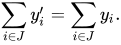
A competitive equilibrium in such exchange economy is defined by a price-vector p and an allocation y such that:
The "market maker" reduction shown above, from the exchange economy of Arrow-Debreu to the abstract economy of Debreu, can be done from the generalized exchange economy of Mas-Collel to the generalized abstract economy of Shafer-Sonnenschein. This reduction implies that the following conditions are sufficient for existence of competitive equilibrium in the generalized exchange economy:
The following example shows that, when the open graph property does not hold, equilibrium may fail to exist.
There is an economy with two goods, say apples and bananas. There are two agents with identical endowments (1,1). They have identical preferences, based on lexicographic ordering: for every vector of apples and bananas, the set , i.e., each agent wants as many apples as possible, and subject to that, as many bananas as possible. Note that represents a complete and transitive relation, but it does not have an open graph.
This economy does not have an equilibrium. Suppose by contradiction that an equilibrium exists. Then the allocation of each agent must be lexicographically at least (1,1). But this means that the allocations of both agents must be exactly (1,1). Now there are two cases: if the price of bananas is 0, then both agents can afford the bundle (1,2) which is strictly better than their allocation. If the price of bananas is some p > 0 (where the price of apples is normalized to 1), then both agents can afford the bundle (1+p, 0), which is strictly better than their allocation. In both cases it cannot be an equilibrium price.
Fon and Otani [9] study extensions of welfare theorems to the generalized exchange economy of Mas-Collel. They make the following assumptions:
A competitive equilibrium is a price-vector and an allocation such that:
A compensated equilibrium has the same feasibility and budget conditions, but instead of the preference condition, it satisfies:
A Pareto-optimal allocation is, as usual, an allocation without a Pareto-improvement. A Pareto-improvement of an allocation is defined as another allocation that is strictly better for a subset of the agents, and remains the same allocation for all other agents. That is:
Note that this definition is weaker than the usual definition of Pareto-optimality (the usual definition does not require that the bundles of other agents remain the same - only that their utility remains the same).
Fon and Otani prove the following theorems.
A further generalization of these equilibrium concepts for a general model without ordered preferences can be found in Barabolla (1985). [10]