Related Research Articles

The modern combine harvester, also called a combine, is a machine designed to harvest a variety of cultivated seeds. Combine harvesters are one of the most economically important labour-saving inventions, significantly reducing the fraction of the population engaged in agriculture. Among the crops harvested with a combine are wheat, rice, oats, rye, barley, corn (maize), sorghum, millet, soybeans, flax (linseed), sunflowers and rapeseed. The separated straw is then either chopped onto the field and ploughed back in, or laid out in rows, ready to be baled and used for bedding and cattle feed.

A forage harvester – also known as a silage harvester, forager or chopper – is a farm implement that harvests forage plants to make silage. Silage is grass, corn or hay, which has been chopped into small pieces, and compacted together in a storage silo, silage bunker, or in silage bags. It is then fermented to provide feed for livestock. Haylage is a similar process to silage but using grass which has dried.

The International Harvester Company was an American manufacturer of agricultural and construction equipment, automobiles, commercial trucks, lawn and garden products, household equipment, and more. It was formed from the 1902 merger of McCormick Harvesting Machine Company and Deering Harvester Company and three smaller manufacturers: Milwaukee; Plano; and Warder, Bushnell, and Glessner. Its brands included McCormick, Deering, and later McCormick-Deering, as well as International. Along with the Farmall and Cub Cadet tractors, International was also known for the Scout and Travelall vehicle nameplates. In the 1980s all divisions were sold off except for International Trucks, which changed its parent company name to Navistar International.

AGCO Corporation is an American agricultural machinery manufacturer headquartered in Duluth, Georgia, United States. It was founded in 1990. AGCO designs, produces and sells tractors, combines, foragers, hay tools, self-propelled sprayers, smart farming technologies, seeding equipment, and tillage equipment.

Allis-Chalmers was a U.S. manufacturer of machinery for various industries. Its business lines included agricultural equipment, construction equipment, power generation and power transmission equipment, and machinery for use in industrial settings such as factories, flour mills, sawmills, textile mills, steel mills, refineries, mines, and ore mills.

Farmall was a model name and later a brand name for tractors manufactured by International Harvester (IH), an American truck, tractor, and construction equipment company. The Farmall name was usually presented as McCormick-Deering Farmall and later McCormick Farmall in the evolving brand architecture of IH.

The Advance-Rumely Company of La Porte, Indiana was an American pioneering producer of many types of agricultural machinery, most notably threshing machines and large tractors. Started in 1853 manufacturing threshers and later moved on to steam engines. Allis-Chalmers Manufacturing Co. purchased Advance-Rumley in 1931. The company's main works would become what was later known as the "La Porte plant".

The Allis-Chalmers model B was a small agricultural tractor produced by the Allis-Chalmers Manufacturing company from 1937 to 1957. With over 125,000 units produced, the model B became one of the best selling and longest-produced tractors for Allis-Chalmers. The B came in several different variations including the Asparagus B, Potato Special, and the IB industrial tractor, and gave rise to the larger Allis-Chalmers Model C. The Model B was styled by Brooks Stevens, an industrial designer and graphic designer.

A corn harvester is a machine used on farms to harvest corn, stripping the stalks about one foot from the ground shooting the stalks through the header to the ground. The corn is stripped from its stalk and then moves through the header to the intake conveyor belt. From there it goes up the conveying system through a fan system, separating the remaining stalks from the ears. The stalks blow out the fan duct into the field while the ears drop onto another conveyor belt. The ears ride the belt and drop into a large moving bucket.
The Gleaner Manufacturing Company is an American manufacturer of combine harvesters. Gleaner has been a popular brand of combine harvester particularly in the Midwestern United States for many decades, first as an independent firm, and later as a division of Allis-Chalmers. The Gleaner brand continues today under the ownership of AGCO.

The Gleaner E was a self-propelled combine harvester manufactured by the Gleaner Manufacturing Company while part of the Allis-Chalmers Manufacturing Company in the 1960s. 17,300 machines were manufactured in total from 1962 to 1969.

The Allis-Chalmers D series is a line of tractors made by the Allis-Chalmers Manufacturing Company from 1957 to 1969.

The Model G is a small implement carrier tractor that was made by the Allis-Chalmers Manufacturing Company. At the time of its introduction the Model G was unique for its rear-mounted, Continental N62 engine. It was a four-cylinder engine with a 2+3⁄8 by 3+1⁄2 inches bore and stroke. The Model G was designed for small farms and vegetable gardeners, and a line of implements specifically designed for it, including ploughs, planters, and cultivators. The design of the Model G allowed for a great view of the belly-mounted implements.
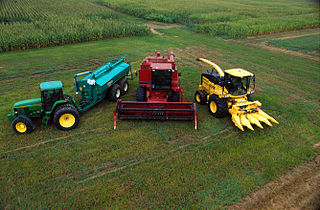
Agricultural machinery relates to the mechanical structures and devices used in farming or other agriculture. There are many types of such equipment, from hand tools and power tools to tractors and the farm implements that they tow or operate. Machinery is used in both organic and nonorganic farming. Especially since the advent of mechanised agriculture, agricultural machinery is an indispensable part of how the world is fed.

The Model WC was a tractor made by Allis-Chalmers from 1933 to 1948. The WC was designed from its start as a nimble, low-cost, but well-powered row-crop tractor that would make the best use of pneumatic rubber tires, which Allis-Chalmers had just introduced to agriculture in 1932. A successful model at the historical height of row-crop tractor demand, the WC was the best-selling tractor model that Allis-Chalmers ever built.

Case IH axial-flow combines are a type of combine harvester that has been manufactured by International Harvester, and later Case International, Case Corporation, and CNH Global, used by farmers to harvest a wide range of grains around the world.

The Farmall A is a small one-plow row crop tractor produced by International Harvester under the Farmall brand from 1939 to 1947. The tractor was popular for its set of innovative features in a small, affordable implement. It succeeded the Farmall F-14. The A was incrementally updated with new model numbers as the Super A, 100, 130 and 140, but remained essentially the same machine. Like the smaller Farmall Cub, the Farmall A features a distinctive offset engine, displaced to the left over wide-set front wheels, to allow vision straight ahead. An International Harvester C113 4-cylinder in-line engine was used for early models, increased to an IH C123 with the A-1. The most significant change was the introduction of hydraulics with the Super A. The series was produced until 1973.
The Farmall 04 series tractors are a family of row-crop tractors with four-cylinder engines, continuing the tradition of four-cylinder engines in Farmall and parent company International Harvester for general-purpose and row-crop tractors. In the early 1960s demand for more power led to the 06 series with six-cylinder engines. Four-cylinder engines were reserved for tractors equivalent to the Farmall H and smaller.


