The education system in New Zealand implements a three-tier model which includes primary and intermediate schools, followed by secondary schools and by tertiary education at universities and polytechnics. The academic year in New Zealand varies between institutions, but generally runs from early February until mid-December for primary schools, late January to late November or early December for secondary schools and polytechnics, and from late February until mid-November for universities.
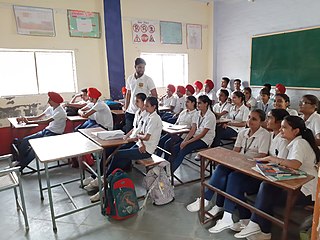
Education in India is primarily managed by the state-run public education system, which falls under the command of the government at three levels: central, state and local. Under various articles of the Indian Constitution and the Right of Children to Free and Compulsory Education Act, 2009, free and compulsory education is provided as a fundamental right to children aged 6 to 14. The approximate ratio of the total number of public schools to private schools in India is 10:3.

In contemporary education, mathematics education—known in Europe as the didactics or pedagogy of mathematics—is the practice of teaching, learning, and carrying out scholarly research into the transfer of mathematical knowledge.

Education in England is overseen by the Department for Education. Local government authorities are responsible for implementing policy for public education and state-funded schools at a local level. State-funded schools may be selective grammar schools or non-selective comprehensive schools. All state schools are subject to assessment and inspection by the government department Ofsted. England also has private schools and home education; legally, parents may choose to educate their children by any suitable means.
Education in the Republic of Ireland is a primary, secondary and higher education. In recent years, further education has grown immensely, with 51% of working age adults having completed higher education by 2020. Growth in the economy since the 1960s has driven much of the change in the education system. For universities there are student service fees, which students are required to pay on registration, to cover examinations, insurance and registration costs.
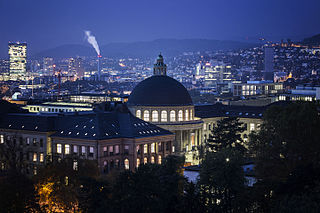
The education system in Switzerland is very diverse, because the constitution of Switzerland delegates the authority for the school system mainly to the cantons. The Swiss constitution sets the foundations, namely that primary school is obligatory for every child and is free in state schools and that the confederation can run or support universities.

Education in Bangladesh is administered by the country's Ministry of Education. The Ministry of Primary and Mass Education implements policies for primary education and state-funded schools at a local level. Education in Bangladesh is compulsory for all citizens until the end of grade eight. Primary and secondary education is funded by the state and free of charge in public schools.
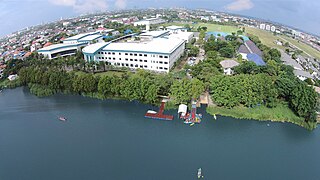
International schools are private schools that promote education in an international environment or framework. Although there is no uniform definition or criteria, international schools are usually characterised by a multinational student body and staff, multilingual instruction, curricula oriented towards global perspectives and subjects, and the promotion of concepts such as world citizenship, pluralism, and intercultural understanding; most are private schools. Many international schools adopt a curriculum from programmes and organisations such as the International Baccalaureate, Edexcel, Cambridge International Education, FOBISIA, International Primary Curriculum, or Advanced Placement. International schools often follow a curriculum different from the host country, catering mainly to foreign students, such as members of expatriate communities, international businesses or organisations, diplomatic missions, or missionary programmes. Admission is sometimes open to local students to provide qualifications for employment or higher education in a foreign country, offer high-level language instruction, and/or foster cultural and global awareness.
The Academia Británica Cuscatleca (ABC) is an established and highly regarded international bilingual school in El Salvador. It is a community of some 1400 students and is fully accredited by Council of International Schools (CIS), the International Baccalaureate Organisation (IBO), the International Primary Curriculum (IPC) and the Values-Based Trust for Education (VBFT).

Lalitpur District (Nepali: ललितपुर जिल्ला, in Bagmati Province, is one of the seventy-seven districts of Nepal. The district, with Lalitpur as its district headquarters, covers an area of 396.92 km2 and has a population of 337,785. It is one of three districts in the Kathmandu Valley, along with Kathmandu and Bhaktapur. Its population was 466,784 in the initial 2011 census tabulation. It is surrounded by Makwanpur, Bhaktapur, Kathmandu and Kavre.

The Dhirubhai Ambani International School (DAIS) is a private co-educational LKG-15 day school in Mumbai, Maharashtra, India, built by Reliance Industries, named after the late patriarch of the conglomerate, Dhirubhai Ambani. The school was established in 2003 and has been an IB World School since January 2003. It offers the International Baccalaureate Program in its Diploma form. Nita Ambani, wife of Mukesh Ambani is the chairperson of the school.
Sharjah English School (SES) is a British-curriculum school in Sharjah, United Arab Emirates (UAE). It is one of the oldest private, not for profit, coeducational schools in the UAE. It currently has an enrollment of 850 students across primary and secondary (ages 3-18).

St. Xavier's High School, Kolhapur, is a private Catholic primary and secondary school located in Kolhapur, southern Maharashtra, India. Founded by the Jesuits in 1957, the English-medium school has been co-educational since 2008. The school admits students from kindergarten till the Secondary School Certificate or 10th standard. The school celebrated its Golden Jubilee in 2007 and Diamond Jubilee in 2017.

Gandaki Boarding School, , formerly known as Nepal Adarsha Bidyashram, is a model boarding school in Nepal, established on 11 June 1966 in the city of Pokhara, 200 kilometers west of Kathmandu. It was established as a result of the initiation of by three groups - The United Mission to Nepal, The Shining Hospital, and the local community.

The German Swiss International School is an international school in Hong Kong established in 1969 by German and Swiss families looking for a bilingual German–English education in an international setting. Beginning with 73 students in its inaugural year, GSIS now has approximately 1,300 students from over 30 countries.

Redlands College is an independent non-denominational Christian co-educational primary and secondary day school, located in the Redland City suburb of Wellington Point, Queensland, Australia. The college caters for approximately 1,300 students from P to Year 12 and is operated by an association formed by members of the Churches of Christ in Australia.

V.S. Niketan Secondary School is located in 32-Tinkune, Kathmandu, Nepal, and schools above 4000 current students. V.S. Education Foundation is the outcome of the expansion of an education system aiming to coordinate all the educational activities of the institution so that the entity established at V.S. Niketan is uniformly maintained in all levels of teaching and learning under the same roof. The institution function form Pre-Primary to Bachelor's Levels of education. It has been awarded the "Best School of Nepal" for two times, recently.

The Renaissance International School Saigon is a private school in District 7, Ho Chi Minh City, Vietnam. Founded in 2007, the school opened in May 2008. Its study program was based on a British-style international English medium curriculum, teaching both academic subjects and creative/performing arts to its 500+ students. Its teaching staff are mostly from the UK. The four buildings on the school's one-hectare site include facilities such as a 350-seat auditorium, a computer resource centre, gymnasium and 25 m swimming pool.

Education in Nauru is compulsory for children between the ages of 5 and 16. There are eleven schools in Nauru, including three primary schools and two secondary schools. There is an Able/Disable Centre for children with special needs. Education at these schools is free. In 2011, the Australian Department of Foreign Affairs and Trade reported that 3,026 children were enrolled at Nauru's schools. The previous Minister for Education was the Hon. Charmaine Scotty, MP from 2013. The current Minister is Asterio Appi.
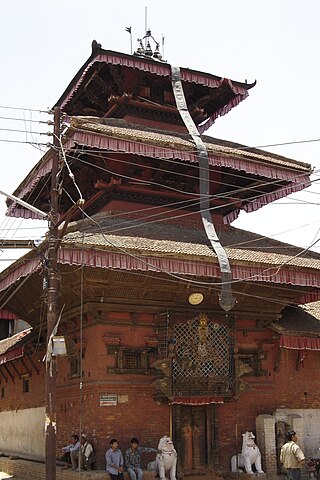
Mahalaxmi is a municipality that lies in the north-eastern part of the Lalitpur district of Nepal. As per the declaration by the government of Nepal in 2015, it was created through the merger of the Village development committees Imadol, Lubhu, Tikathali, Siddhipur and Lamatar. The city derives its name from the Mahalaxmi-Mahabhairav Temple in Lubhu. The city's total area is 26.5 square kilometres. The municipality has a total number of 10 wards. The old VDC offices are used as joint ward office now.

