
Dessert wines, sometimes called pudding wines in the United Kingdom, are sweet wines typically served with dessert.

Dhanvantari is the physician of the devas in Hinduism. He is regarded as an avatar of Vishnu. He is mentioned in the Puranas as the god of Ayurveda.
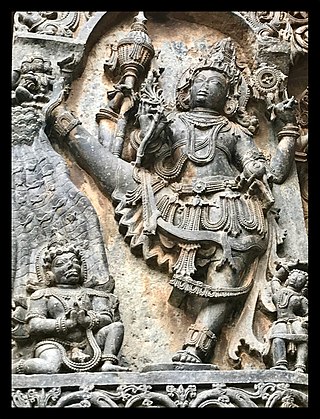
Trailokya literally means "three worlds". It can also refer to "three spheres," "three planes of existence," and "three realms".
The pitrs are the spirits of departed ancestors in Hinduism. Following an individual's death, the performance of the antyesti is regarded to allow the deceased to enter Pitrloka, the abode of one's ancestors. The non-performance of these rituals is believed to result in the fate of wandering the earth as a restless preta.
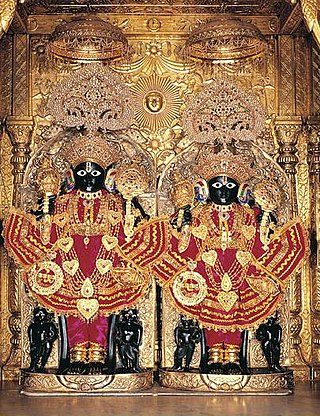
Naranarayana, also rendered Nara-Narayana, is a Hindu duo of sage-brothers. Generally regarded to be the partial-incarnation (aṃśa-avatara) of the preserver deity, Vishnu, on earth, Nara-Narayana are described to be the sons of Dharma and Ahimsa.

Satyabhama, also known as Satrajiti, is a Hindu goddess and the third queen consort of the Hindu god Krishna. Satyabhama is described as an incarnation of Bhumi, an aspect of Lakshmi. She is the goddess and the personification of the Earth. She has two sisters named Bratini, and Prasvapini who are her co-wives as well. According to some traditions, she is regarded to have aided Krishna in defeating the asura Narakasura.

The Hindu marriage is the most important of all the samskaras, the rites of passage described in the Dharmashastra texts.

Ras malai, also known as rasamalei, or roshmalai, is a dessert that originated in the Bengal region of Indian subcontinent. The dessert is called roshmalai in Bengali, ras malai in Hindi, and rasa malei in Odia. It is popular in India, Bangladesh and Pakistan.

Peda or Pera is an Indian sweet that originated in the city of Mathura, Uttar Pradesh, India. Traditionally prepared as thick, semi-soft round balls, its main ingredients are khoa, sugar and traditional flavourings including cardamom seeds. It is brown in colour. Variant spellings and names for the dessert include pedha, penda and pera.

The Vishalakshi Temple or Vishalakshi Gauri Temple is a Hindu temple dedicated to the goddess Vishalakshi, at Mir Ghat on the banks of the Ganges at Varanasi in Uttar Pradesh, India. It is generally regarded as a Shakti Pitha, the most sacred temples dedicated to the Hindu Divine Mother.
Nahusha is a king of the Chandravamsha in Hindu mythology. He is described to be the son of Āyus, the eldest son of Pururavas, and Prabha, the daughter of Svarbhānu.
Pulastya is one of the ten Prajapati, and one of the mind-born sons of Brahma in Hinduism. He is also one of the Saptarishi in the first age of Manu, the Manvantara.

Basundi is an Indian sweet mostly in Maharashtra, Gujarat, Andhra Pradesh, Telangana, Tamil Nadu and Karnataka. It is a sweetened condensed milk made by boiling milk on low heat until the milk is reduced by half. In North India, a similar dish goes by the name rabri.

Sharanga also spelt as Saranga, is the celestial bow of the Hindu god Vishnu, primarily associated with his avatar of Rama. In South India, the Sharanga is also simply known as the Kodanda, literally meaning bow. Rama is often praised as Kodandapani, the holder of the Kodanda. The attribute of the bow is also mentioned in the Vishnu Sahasranama.

Tulasi Vivaha, also called Tulasi Kalyanam, is a Hindu festival, in which a symbolic ceremonial wedding takes place between a tulasi plant or holy basil and a shaligrama or an amla branch. Tulasi Vivaha signifies the end of the monsoon, and the beginning of the wedding season in Hinduism.
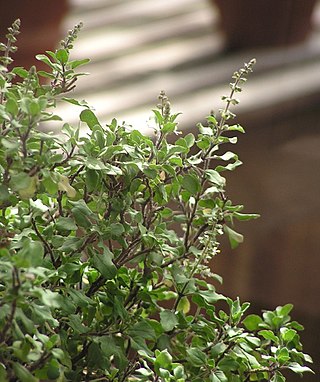
Tulasi, or Vrinda is a sacred plant in Hindu tradition. Hindus regard it as an earthly manifestation of the goddess Tulasi; she is regarded as the avatar of Lakshmi, and thus the consort of the god Vishnu. In another iteration, as Vrinda, she is married to Jalandhara. The offering of its leaves is recommended in ritualistic worship of Vishnu and his avatars, like Krishna and Vithoba.

Mahagauri is the eighth form among the Navadurga aspects of the Hindu mother goddess Mahadevi. She is worshipped on the eighth day of Navaratri. Mahagauri is believed to be able to fulfill all the desires of her devotees.
The Brahma marriage is a righteous form of marriage in described in Hindu texts. It refers to the marriage of one's daughter to a man of good conduct, learned in the Vedas, and invited by oneself. Originally intended only for the Brahmins, a Brahma marriage is where a boy is able to get married once he has completed his education in the first stage of life, the Brahmacharya. Brahma marriage holds the supreme position of the eight types of Hindu matrimony. When the parents of a boy seek a suitable bride, they consider her family background, and the girl's father would ensure that his daughter's prospective groom is a scholar, one who is well-versed in the Vedas. This form of marriage is described in the Manusmriti.

