
In music, an arrangement is a musical adaptation of an existing composition. Differences from the original composition may include reharmonization, melodic paraphrasing, orchestration, or formal development. Arranging differs from orchestration in that the latter process is limited to the assignment of notes to instruments for performance by an orchestra, concert band, or other musical ensemble. Arranging "involves adding compositional techniques, such as new thematic material for introductions, transitions, or modulations, and endings. Arranging is the art of giving an existing melody musical variety". In jazz, a memorized (unwritten) arrangement of a new or pre-existing composition is known as a head arrangement.

A passerine is any bird of the order Passeriformes, which includes more than half of all bird species. Sometimes known as perching birds, passerines generally have an anisodactyl arrangement of their toes, which facilitates perching.

The trogons and quetzals are birds in the order Trogoniformes which contains only one family, the Trogonidae. The family Trogonidae contains 46 species in seven genera. The fossil record of the trogons dates back 49 million years to the Early Eocene. They might constitute a member of the basal radiation of the order Coraciiformes and order Passeriformes or be closely related to mousebirds and owls. The word trogon is Greek for "nibbling" and refers to the fact that these birds gnaw holes in trees to make their nests.

Petrels are tube-nosed seabirds in the bird order Procellariiformes.
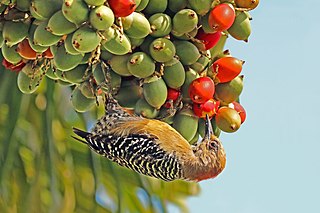
Nine families of largely arboreal birds make up the order Piciformes, the best-known of them being the Picidae, which includes the woodpeckers and close relatives. The Piciformes contain about 71 living genera with a little over 450 species, of which the Picidae make up about half.

Orcinus is a genus of Delphinidae, the family of carnivorous marine mammals known as dolphins. It includes the largest delphinid species, Orcinus orca, known as the orca or killer whale. Two extinct species are recognised, Orcinus paleorca and O. citoniensis, describing fossilised remains of the genus. The other extinct species O. meyeri is disputed.

Gesneriaceae, the gesneriad family, is a family of flowering plants consisting of about 152 genera and ca. 3,540 species in the tropics and subtropics of the Old World and the New World, with a very small number extending to temperate areas. Many species have colorful and showy flowers and are cultivated as ornamental plants.

The Japanese spider crab is a species of marine crab that lives in the waters around Japan. It has the largest known leg-span of any arthropod.The Japanese name for this species is taka-ashi-gani,, literally translating to “tall legs crab”. It goes through three main larval stages along with a prezoeal stage to grow to its great size.

Passerida is, under the Sibley-Ahlquist taxonomy, one of two parvorders contained within the suborder Passeri. While more recent research suggests that its sister parvorder, Corvida, is not a monophyletic grouping, the Passerida as a distinct clade are widely accepted.

The longtail stingray, is a species of stingray in the family Dasyatidae, found in the eastern Pacific Ocean from Baja California to Colombia. It inhabits sandy habitats down to a depth of 90 m (300 ft). Measuring up to 1.56 m (5.1 ft) across, this species has a rhomboid pectoral fin disc, a lower fin fold on the tail, and numerous dermal denticles along the back and behind the stinging spine. The longtail stingray feeds mainly on bottom-dwelling bony fishes and crustaceans. It is aplacental viviparous, with females giving birth to 1–5 young in late summer. It is caught for food, likely throughout its range, but specific fishery data is lacking.
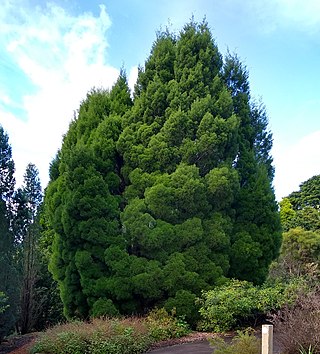
Callitris baileyi is a species of conifer in the family Cupressaceae. It is found only in Australia, more specifically Southeast Queensland. Its common English name is Bailey's cypress-pine. The name is dedicated to Australian botanist Frederick Manson Bailey, who was the first to collect specimens of this tree. Bailey's name is closely associated with much of the flora of Queensland and their elucidation in Southeastern Queensland. Over the past few decades the conifer has been severely threatened by habitat loss Fruiting for the species has been recorded year-round.

The roughtail stingray is a species of stingray in the family Dasyatidae, with separate populations in coastal waters of the northwestern and southwestern Atlantic Ocean. This bottom-dwelling species typically inhabits sandy or muddy areas with patches of invertebrate cover, at a depth of 15–50 m (49–164 ft). It is seasonally migratory, overwintering in offshore waters and moving into coastal habitats for summer. The largest whip-tail stingray in the Atlantic, the roughtail stingray grows up to 2.6 m (8.5 ft) across and 360 kg (800 lb) in weight. It is plain in color, with an angular, diamond-shaped pectoral fin disc and a long, whip-like tail bearing a subtle fin fold underneath. The many thorns on its back and tail serve to distinguish it from other stingrays that share its range.
Anthocephalum philruschi is a species of flatworms. It can be differentiated by its overall size, the number of proglottids and marginal loculi, the number and arrangement of its testes, the size of its apical sucker, the arrangement and distribution of vitelline follicles, and the "muscularity" of its genital pore.
Anthocephalum papefayei is a species of flatworms. It can be differentiated by its overall size, the number of proglottids and marginal loculi, the number and arrangement of its testes, the size of its apical sucker, the arrangement and distribution of vitelline follicles, and the "muscularity" of its genital pore.
Anthocephalum meadowsi is a species of flatworms. It can be differentiated by its overall size, the number of proglottids and marginal loculi, the number and arrangement of its testes, the size of its apical sucker, the arrangement and distribution of vitelline follicles, and the "muscularity" of its genital pore.
Anthocephalum mattisi is a species of flatworms. It can be differentiated by its overall size, the number of proglottids and marginal loculi, the number and arrangement of its testes, the size of its apical sucker, the arrangement and distribution of vitelline follicles, and the "muscularity" of its genital pore.
Anthocephalum jensenae is a species of flatworms. It can be differentiated by its overall size, the number of proglottids and marginal loculi, the number and arrangement of its testes, the size of its apical sucker, the arrangement and distribution of vitelline follicles, and the "muscularity" of its genital pore.
Anthocephalum healyae is a species of flatworms. It can be differentiated by its overall size, the number of proglottids and marginal loculi, the number and arrangement of its testes, the size of its apical sucker, the arrangement and distribution of vitelline follicles, and the "muscularity" of its genital pore.
Anthocephalum decrisantisorum is a species of flatworms. It can be differentiated by its overall size, the number of proglottids and marginal loculi, the number and arrangement of its testes, the size of its apical sucker, the arrangement and distribution of vitelline follicles, and the "muscularity" of its genital pore.
Anthocephalum is a genus of flatworms belonging to the family Rhinobothriidae.

