
Hasora, the awls, are a genus of skipper butterflies. Hasora species are found in the Indomalayan and Australasian realms.
Batracharta is a genus of moths of the family Erebidae. The genus was erected by Francis Walker in 1862.
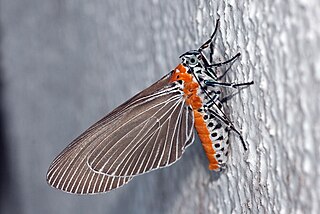
Euplocia is a monotypic moth genus in the family Erebidae erected by Jacob Hübner in 1819. Its only species, Euplocia membliaria, was first described by Pieter Cramer in 1780. It is found from the northeastern Himalayas to Sundaland, the Philippines, Sulawesi and the Lesser Sundas.

Targalla is a genus of moths of the family Euteliidae. The genus was erected by Francis Walker in 1858.
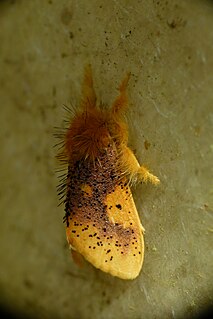
Nygmia is a genus of tussock moths in the family Erebidae. The genus was erected by Jacob Hübner in 1820.

Asota is a genus of moths in the family Erebidae first described by Jacob Hübner in 1819. Species are widely distributed throughout Africa, India, Sri Lanka, Myanmar, the Malayan region and tropical parts of the Australian region.

Ozola is a genus of moths in the family Geometridae first described by Francis Walker in 1861.

Asota egens is a species of noctuoid moths in the family Erebidae. It is found from Japan and the Oriental tropics, east to New Guinea.

Asota kinabaluensis is a species of noctuoid moth in the family Erebidae first described by Walter Rothschild in 1896. It appears to have no close relatives in the genus Asota.

Asota heliconia is a moth in the family Erebidae. It is found from the Indo-Australian tropics east to Queensland and the Solomons.

Asota plana is a moth in the family Erebidae first described by Francis Walker in 1854. It is found from the Oriental tropics east to New Guinea.
Asota trinacria is a moth of the family Erebidae first described by Georg Semper in 1899. It is found in Borneo, Seram and the Philippines.
Asota paphos is a moth of the family Erebidae first described by Johan Christian Fabricius in 1787. It is found from the north-eastern Himalayas to Sundaland.
Asota albiformis is a moth of the family Erebidae first described by Charles Swinhoe in 1892. It is found in Borneo, the Philippines, Sulawesi and the Moluccas.

Asota plaginota is a moth of the family Erebidae first described by Arthur Gardiner Butler in 1875. It is found in China, India, Indonesia, Myanmar, Malaysia, Nepal, Papua New Guinea, the Philippines, Sikkim, Singapore, Sri Lanka, Thailand and Vietnam.
Asota albivena is a moth of the family Erebidae first described by Francis Walker in 1864. It is found in Sulawesi, Maluku and the Kai Islands.
Asota dohertyi is a moth of the family Erebidae first described by Walter Rothschild in 1897. It is found on Sulawesi.

Platyja umminia is a species of moth of the family Noctuidae first described by Pieter Cramer in 1780. It is found from the Indo-Australian tropics of China, Japan, India, Sri Lanka, Myanmar to New Guinea and Queensland. It is also present on Guam. Adults have been recorded piercing fruit in Thailand and Guam.
Serrodes caesia is a moth of the family Erebidae first described by Warren in 1915. It is found in Indonesia, New Guinea and Thailand. The habitat consists of alluvial forests, dipterocarp forests and primary forests.
This page is based on this
Wikipedia article Text is available under the
CC BY-SA 4.0 license; additional terms may apply.
Images, videos and audio are available under their respective licenses.


