
Salasar Balaji or Salasar Dham in India is a place of religious importance for the devotees of Lord Hanuman. It is located in the town of Salasar, on National Highway 65 near Sujangarh in Churu district, Rajasthan. The temple of Balaji, founded by a farmer is situated in the middle of Salasar and attracts innumerable worshippers throughout the year. On Chaitra Purnima and Ashvin Purnima, large fairs are organized that attract devotees as they pay homage to the deity.

Hyposmocoma is a genus of moths with more 350 species endemic to the Hawaiian Islands. The genus was first described by Arthur Gardiner Butler in 1881. Most species of Hyposmocoma have plant-based diets, but four species, such as Hyposmocoma molluscivora, eat snails. The caterpillars spin silk, which they then use to capture and eat snails. These are the first caterpillars known to eat snails.

The Cape genet, also known as the South African large-spotted genet, is a genet species endemic to South Africa. As it is common and not threatened, it is listed as Least Concern on the IUCN Red List. Like other genets, it is nocturnal and arboreal, preferring to live in the riparian zones of forests, as long as these are not marshy areas.

Asota is a genus of moths in the family Erebidae first described by Jacob Hübner in 1819. Species are widely distributed throughout Africa, India, Sri Lanka, Myanmar, the Malayan region and tropical parts of the Australian region.

Marumba is a genus of moths in the family Sphingidae first described by Frederic Moore in 1882.

Asota producta is a species of noctuoid moth in the family Erebidae. It is found from Sri Lanka and India to Sundaland.

Asota heliconia is a moth in the family Erebidae. It is found from the Indo-Australian tropics east to Queensland and the Solomons.
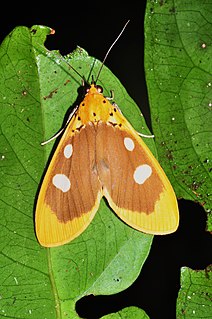
Asota javana is a moth of the family Erebidae first described by Pieter Cramer in 1780. It is found in Sundaland, the Philippines, Sulawesi and on Sula Island.

Asota plaginota is a moth of the family Erebidae first described by Arthur Gardiner Butler in 1875. It is found in China, India, Indonesia, Myanmar, Malaysia, Nepal, Papua New Guinea, the Philippines, Sikkim, Singapore, Sri Lanka, Thailand and Vietnam.
Asota orbona is a moth of the family Erebidae first described by Samuel Constantinus Snellen van Vollenhoven in 1863. It is found in Indonesia, Papua New Guinea and Queensland.

Asota clara is a species of noctuoid moth in the family Erebidae first described by Arthur Gardiner Butler in 1875. It is found in Indonesia, Peninsula Malaysia and Myanmar.
Asota diana is a moth of the family Erebidae first described by Arthur Gardiner Butler in 1887. It is found on Solomon Islands and in Indonesia.
Asota iodamia is a moth of the family Erebidae first described by Gottlieb August Wilhelm Herrich-Schäffer in 1854. It is found in the Australian states of New South Wales and Queensland.
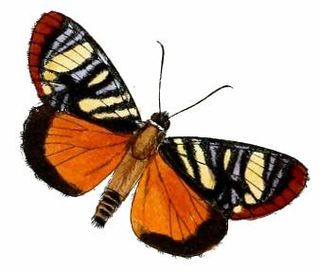
Polacanthopoda tigrina is a moth in the family Noctuidae first described by Herbert Druce in 1882. It is found in Cameroon, the Republic of Congo, the Democratic Republic of Congo, Gabon, Ghana, Guinea, Nigeria and Uganda.
Rathouisia tigrina is a species of carnivorous air-breathing land slug, terrestrial pulmonate gastropod mollusk in the family Rathouisiidae.

