
Gottfried Semper was a German architect, art critic, and professor of architecture, who designed and built the Semper Opera House in Dresden between 1838 and 1841. In 1849 he took part in the May Uprising in Dresden and was put on the government's wanted list. Semper fled first to Zürich and later to London. Later he returned to Germany after the 1862 amnesty granted to the revolutionaries.
Semper fidelis is a Latin phrase that means "always faithful" or "always loyal". It is the motto of the United States Marines, usually shortened to Semper Fi. It is also in use as a motto for towns, families, schools, and other military units.

Salasar Balaji or Salasar Dham in India is a place of religious importance for the devotees of Lord Hanuman. It is located in the town of Salasar, on National Highway 65 near Sujangarh in Churu district, Rajasthan. The temple of Balaji, founded by a farmer is situated in the middle of Salasar and attracts innumerable worshippers throughout the year. On Chaitra Purnima and Ashvin Purnima, large fairs are organized that attract devotees as they pay homage to the deity.

Holothuria is the type genus of the marine animal family Holothuriidae, part of the class Holothuroidea, commonly known as sea cucumbers. Members of the genus are found in coastal waters in tropical and temperate regions. They are soft bodied, limbless invertebrates that dwell on the ocean floor and are usually detritivore. They resemble a cucumber in form. The genus contains some species that are harvested and sold as food.
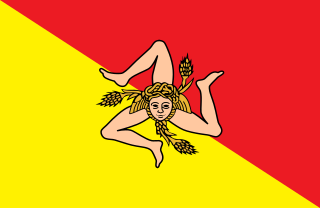
The flag of Sicily shows a triskeles symbol, and at its centre a Gorgoneion and a pair of wings and three wheat ears.
Asota is a town near Shewa Adda and Union Council of Swabi District in the Khyber-Pakhtunkhwa province of Pakistan. It is located at 34°14'0N 72°21'0E with an altitude of 340 metres.

Miltochrista is a genus of moths of the family Erebidae, subfamily Arctiinae. The genus was erected by Jacob Hübner in 1819.
Heliozona lianga is a moth of the family Erebidae first described by Georg Semper in 1899. It is found on Mindanao in the Philippines.

Asota is a genus of moths in the family Erebidae first described by Jacob Hübner in 1819. Species are widely distributed throughout Africa, India, Sri Lanka, Myanmar, the Malayan region and tropical parts of the Australian region.

Asota egens is a species of noctuoid moths in the family Erebidae. It is found from Japan and the Oriental tropics, east to New Guinea.

Asota heliconia is a moth in the family Erebidae. It is found from the Indo-Australian tropics east to Queensland and the Solomons.
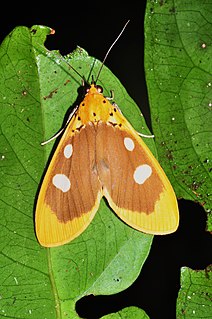
Asota javana is a moth of the family Erebidae first described by Pieter Cramer in 1780. It is found in Sundaland, the Philippines, Sulawesi and on Sula Island.
Asota orbona is a moth of the family Erebidae first described by Samuel Constantinus Snellen van Vollenhoven in 1863. It is found in Indonesia, Papua New Guinea and Queensland.
Asota iodamia is a moth of the family Erebidae first described by Gottlieb August Wilhelm Herrich-Schäffer in 1854. It is found in the Australian states of New South Wales and Queensland.
Asota australis is a moth of the family Erebidae first described by Jean Baptiste Boisduval in 1832. It is found in Australia, Indonesia and Papua New Guinea.
Macna is a genus of snout moths. It was described by Francis Walker in 1859.

Balanophyllia is a genus of solitary corals in the order of stony corals.
Birthana is a genus of moths in the family Immidae.

Heterocyathus is a genus of coral of the family Caryophylliidae.

