Related Research Articles

Peyton Randolph was an American politician and planter who was a Founding Father of the United States. Born into Virginia's wealthiest and most powerful family, Randolph served as speaker of Virginia's House of Burgesses, president of the first two Virginia Conventions, and president of the First Continental Congress. He also served briefly as president of the Second Continental Congress.
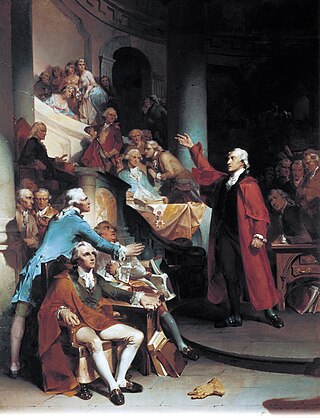
The House of Burgesses was the elected representative element of the Virginia General Assembly, the legislative body of the Colony of Virginia.

Richard Bland, sometimes referred to as Richard Bland II or Richard Bland of Jordan's Point, was an American Founding Father, planter, lawyer and politician from Virginia. A cousin and early mentor of Thomas Jefferson, Bland served 34 years in the Virginia General Assembly, and with John Robinson and this man's cousin Peyton Randolph as one of the most influential and productive burgesses during the last quarter century of the colonial period.
Thomas Lewis was an Irish-American surveyor, lawyer, politician and pioneer of early western Virginia. He was among the signers of the Fairfax Resolves, represented Augusta County at four of the five Virginia Revolutionary Conventions and the first session of the Virginia House of Delegates during the American War for Independence, and after the conflict, represented newly established Rockingham County at the Virginia Ratification Convention, as well as contributed to the settlement of an area that long after his death become part of West Virginia.
Stephen Trigg was an American pioneer and soldier from Virginia. He was killed ten months after the surrender of Cornwallis at Yorktown in one of the last battles of the American Revolution while leading the Lincoln County militia at the Battle of Blue Licks, Kentucky.
Hugh Blair Grigsby was an American lawyer, journalist, politician, planter and historian. In addition to representing Norfolk in the Virginia House of Delegates before the American Civil War, he served as the 16th Chancellor of the College of William & Mary from 1871 to 1881.

The Virginia Conventions have been the assemblies of delegates elected for the purpose of establishing constitutions of fundamental law for the Commonwealth of Virginia superior to General Assembly legislation. Their constitutions and subsequent amendments span four centuries across the territory of modern-day Virginia, West Virginia and Kentucky.

The Fifth Virginia Convention was a meeting of the Patriot legislature of Virginia held in Williamsburg from May 6 to July 5, 1776. This Convention declared Virginia an independent state and produced its first constitution and the Virginia Declaration of Rights.

Robert Carter Nicholas was a Virginia lawyer, patriot, legislator and judge. He served in the Virginia House of Burgesses and its successor, the Virginia House of Delegates. He became the last treasurer of the Colony of Virginia, and sat on the first High Court of Chancery, one of the predecessors of the Supreme Court of Virginia.
The Virginia Ratifying Convention was a convention of 168 delegates from Virginia who met in 1788 to ratify or reject the United States Constitution, which had been drafted at the Philadelphia Convention the previous year.
Robert Lawson was a Virginia lawyer, planter and politician who distinguished himself in the American Revolutionary War, rising to the rank of brigadier general in the Virginia militia. After the conflict, he practiced law, held various political offices and operated a plantation in Prince Edward County, Virginia, but also suffered from alcoholism, which caused his estrangement from his family as well as being swindled. As discussed by the United States Supreme Court in Wagner v. Baird, 48 U.S. 234 (1849), although granted over 10,000 acres of land in what became the state of Ohio, Lawson transferred those rights to a swindler, so decades later his heirs unsuccessfully sought redress.
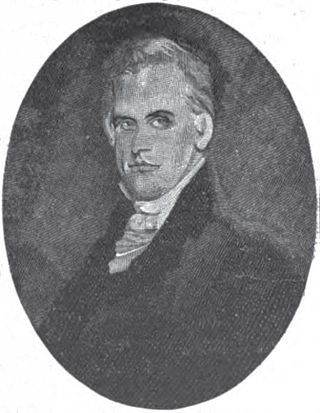
Samuel McDowell was a soldier in three wars and political leader in Virginia and Kentucky. He served under George Washington in the French and Indian War, as an aide-de-camp to Isaac Shelby in Lord Dunmore's War, and under Nathanael Greene during the Revolutionary War. He then relocated to Kentucky and became a surveyor. Later, he was appointed one of the first district court judges in what would become the state of Kentucky. He became a leader of the movement to separate Kentucky from Virginia, and presided over nine of the state's ten constitutional conventions. He was the father of Dr. Ephraim McDowell.
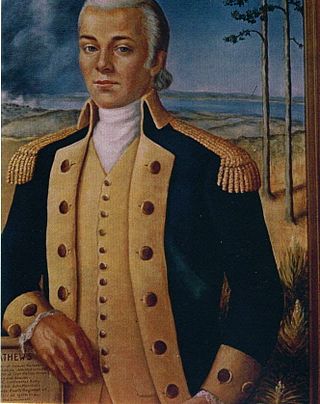
Thomas Mathews was an American Revolutionary War general and Virginia lawyer and politician. For almost two decades, Mathews represented variously Norfolk Borough and Norfolk County in the Virginia House of Delegates, and served as that body's Speaker from 1782 until 1793. He also represented Norfolk at the Virginia Ratifying Convention of 1788.

Sampson Mathews was an American merchant, soldier, and legislator in the colony of Virginia.
The Mathews family is an American political family descended from John Mathews and Ann Archer, originating in colonial Virginia and active in Virginia and the American South in the 18th–20th centuries.
Gabriel Jones was an 18th-century Welsh American lawyer, legislator, court clerk and civil servant in the colony of Virginia.
The Augusta Resolves was a statement adopted on February 22, 1775 by six representatives of Augusta County, Colony of Virginia, in the early stages of the American Revolution. The resolves expressed support for Congress' resistance to the Intolerable Acts, issued in 1774 by the British Parliament, and a commitment to risk 'lives and fortune' in preservation of natural rights.
The Augusta Declaration, or the Memorial of Augusta County Committee, May 10, 1776, was a statement presented to the Fifth Virginia Convention in Williamsburg, Virginia on May 10, 1776. The Declaration announced the necessity of the Thirteen Colonies to form a permanent and independent union of states and national government separate from Great Britain, with whom the Colonies were at war.

Ralph Wormeley was a Virginia planter who served as a member of the Governor's Advisory Council (1771-1775), was suspected of being a Loyalist during the American Revolutionary War, and after the conflict represented Middlesex County, Virginia in the Virginia House of Delegates (1788-1791) as well as at the Virginia Ratifying Convention of 1788, where he voted in favor of ratification of the federal Constitution.