Related Research Articles

The Hail Mary or Angelical salutation is a traditional Catholic prayer addressing Mary, the mother of Jesus. The prayer is based on two biblical passages featured in the Gospel of Luke: the Angel Gabriel's visit to Mary and Mary's subsequent visit to Elisabeth, the mother of John the Baptist. It is also called the Angelical Salutation, as the prayer is based on the Archangel Gabriel's words to Mary. The Hail Mary is a prayer of praise for and of petition to Mary, regarded as the Theotokos. Since the 16th century, the version of the prayer used in the Catholic Church closes with an appeal for her intercession. The prayer takes different forms in various traditions and has often been set to music.
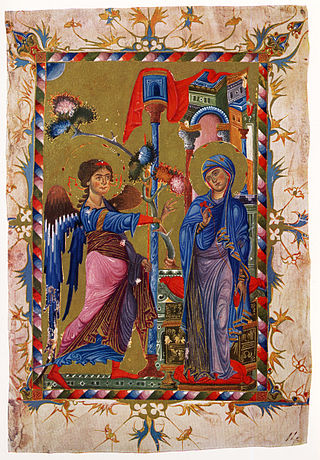
The Annunciation is, according to the Gospel of Luke, the announcement made by the archangel Gabriel to Mary that she would conceive and bear a son through a virgin birth and become the mother of Jesus Christ, the Christian Messiah and Son of God, marking the Incarnation.

Cheek kissing is a ritual or social kissing gesture to indicate friendship, family relationship, perform a greeting, to confer congratulations, to comfort someone, or to show respect.

The Paschal greeting, also known as the Easter Acclamation or Easter Day Greeting, is an Easter custom among many Christian churches, including Eastern Orthodox, Oriental Orthodox, Roman Catholic, Anglican, Lutheran, Methodist, Presbyterian, and Congregational.

Elizabeth was the mother of John the Baptist, the wife of Zechariah and a relative of Mary, mother of Jesus, according to the Gospel of Luke and in Islamic tradition. She was past normal child-bearing age when she conceived and gave birth to John. She is revered as a saint by the Roman Catholic, Eastern Orthodox, Oriental Orthodox, and Lutheran churches, in addition to being a highly respected figure in Islam.

The Angelus is a Catholic devotion commemorating the Incarnation of Christ. As with many Catholic prayers, the name Angelus is derived from its incipit—the first few words of the text: Angelus Domini nuntiavit Mariæ. The devotion is practised by reciting as versicle and response three Biblical verses narrating the mystery, alternating with the prayer "Hail Mary". The Angelus exemplifies a species of prayers called the "prayer of the devotee".

Ave is a Latin word, used by the Romans as a salutation and greeting, meaning 'hail'. It is the singular imperative form of the verb avēre, which meant 'to be well'; thus one could translate it literally as 'be well' or 'farewell'.
Laine is Finnish and Estonian for "wave", and a surname in various languages. Laine is a Laine type Finnish surname. In Finland it is the seventh most common surname. In Estonian, it is also a female given name.
Máire is a feminine given name. It is the Irish language form of Maria, which was in turn a Latin form of the Greek names Μαριαμ (Mariam), and Μαρια (Maria), found in the New Testament. Both New Testament names were forms of the Hebrew name מִרְיָם (Miryam).
Maria may refer to:

Liisa is a Finnish and Estonian female given name. Its name day is 19 November in both countries. It originated as a variation of the name Lisa or Alisa. As of January 2013, there are more than 100,000 women registered in Finland with this name. It is listed by the Finnish Population Register Centre as one of the top 10 most popular female given names ever. As of 1 January 2020, 1,114 women in Estonia have the first name Liisa, making it the 169th most popular female name in the country. The name is most commonly found in Saare County.
Moonika is an Estonian feminine given name; a cognate of the names Monica and Monique. Another cognate, Monika, is also found in Estonia.
Epp is predominantly an Estonian feminine given name. As of 1 January 2021, 671 women in Estonia have the first name Epp, making it the 248th most popular female name in the country. The name is most commonly found in Põlva County. Individuals bearing the name Epp include:
Kertu is an Estonian feminine given name; an Estonian variant of the given name Gertud.
Pille is an Estonian feminine given name; a cognate and occasional diminutive of the given name Sibülle.
Tiia is an Estonian and Finnish feminine given name.
Aet is an Estonian feminine given name, a cognate of Agatha and often a diminutive of the Estonian form, Agaate.
Heljo is an Estonian feminine given name.

Eha is an Estonian feminine given name from the Estonian language word eha, meaning "dusk" and "twilight", and is occasionally a diminutive of the name Ehala.
Marju is an Estonian feminine given name, a cognate of the English language given name Mary.
References
- 1 2 "Estonian Name Days". Behind the Name. 2017. Retrieved 24 December 2021.
- ↑ "Hail Mary | Prayer, History, & Uses | Britannica". www.britannica.com. 2024-10-28. Retrieved 2024-12-01.
- ↑ "Nimede statistika". Eesti statiska (in Estonian). 2020. Retrieved 4 November 2020.

If an internal link led you here, you may wish to change that link to point directly to the intended article.