BL 8-inch howitzer Mk I–V

Last updated
BL 8-inch howitzer Mk V

8inchHowitzerMk1SommeJuly11916.jpg

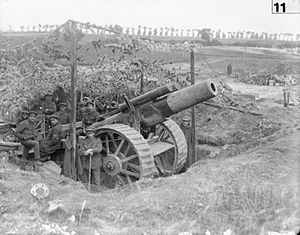
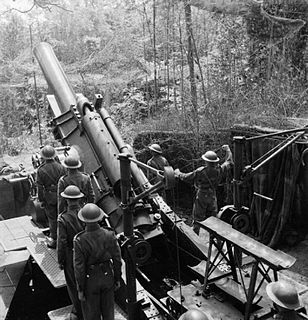
Eight-inch howitzer Mk V near Carnoy, Battle of Albert, July 1916
Type heavy howitzer
Place of origin United Kingdom
Service history
In service 1915−1918
Wars World War I
Production history
Designer Major M L Wilkinson, RGA [1]
No. built 91 [2]
Specifications
Weight Gun & Breech: 5 Long tons [3]
Total: 13.5 Long tons [4]
Barrel  length

Bore: 9 ft 10 in to 10 ft 5 in (3.00−3.18 m)

Total: 10 ft 8 in to 11 ft 4 in (3.25−3.45 m)

Shell HE  : 200 lb (91 kg), bagged charge
Calibre 8 inches (203 mm)
Recoil Hydro-spring constant. 18-, 13- or 13.25-inch [5]
Elevation -5°−45°
Traverse nill
Muzzle velocity Maximum: 1,301 ft/s (397 m/s)
Maximum firing range 10,500 yd (9,600 m) [6]

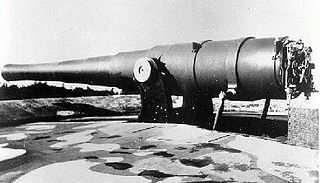
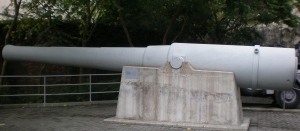
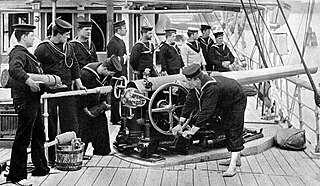
The BL 8-inch howitzer Mark I through to Mark V (1 to 5) [note 1] were a British improvisation developed early in the First World War to provide heavy artillery. It used shortened and bored-out barrels from various redundant naval 6-inch guns.

World War I 1914–1918 global war originating in Europe

World War I, also known as the First World War or the Great War, was a global war originating in Europe that lasted from 28 July 1914 to 11 November 1918. Contemporaneously described as "the war to end all wars", it led to the mobilisation of more than 70 million military personnel, including 60 million Europeans, making it one of the largest wars in history. It is also one of the deadliest conflicts in history, with an estimated nine million combatants and seven million civilian deaths as a direct result of the war, while resulting genocides and the 1918 influenza pandemic caused another 50 to 100 million deaths worldwide.

Artillery class of weapons which fires munitions beyond the range and power of personal weapons

Artillery is a class of heavy military weapons built to fire munitions far beyond the range and power of infantry's small arms. Early artillery development focused on the ability to breach defensive walls, and fortifications during sieges, and led to heavy, fairly immobile siege engines. As technology improved, lighter, more mobile field artillery cannons developed for battlefield use. This development continues today; modern self-propelled artillery vehicles are highly mobile weapons of great versatility providing the large share of an army's total firepower.

Contents

It bore no relation to the later 8-inch howitzer of the First World War, the Vickers 8-inch Mark VI to VIII howitzers which succeeded it.
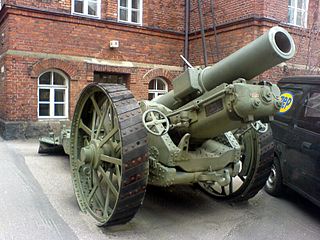
BL 8-inch howitzer Mk VI – VIII howitzer

The BL 8-inch howitzer Marks VI, VII and VIII were a series of British artillery siege howitzers on mobile carriages of a new design introduced in World War I. They were designed by Vickers in Britain and produced by all four British artillery manufacturers, but mainly by Armstrong, and one American company. They were the equivalents of the German 21 cm Morser 16 and in British service were used similarly to the BL 9.2-inch howitzer, but were quicker to manufacture, and more mobile. They delivered a 200 lb shell to 12,300 yards. They had limited service in the British Army in World War II before being converted to the new 7.2-inch calibre. They also equipped a small number of Australian and Canadian batteries in World War I and by the US Army in that war. They were used in small numbers by other European armies.

History

The weapon entered service in February 1915.

The Mark I–V had many relatively minor differences in the carriages and trails and Mk IV, Mk VI and QF Mk II 6-inch naval gun barrels were used. [note 2] However, the ballistic characteristics, propellant charges and shells used were similar for all Mks I–V. They are easily identified by their short thick barrel and twin recoil buffers above the barrel.

A recoil buffer is a factory-installed or aftermarket component of firearms which serves to reduce the velocity and/or cushion the impact of recoilling parts of a firearm.

Mks I–IV were no longer repaired from summer 1917 onwards. [7]

Combat use

At almost full recoil after firing 8inchHowitzerMkIRecoiling.jpg
At almost full recoil after firing

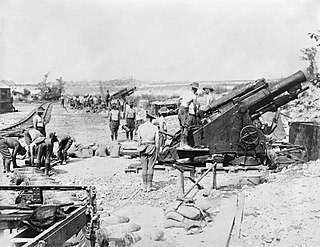
They were operated by siege batteries of the Royal Garrison Artillery (RGA). Holt caterpillar tractors were used to tow them into position.

Royal Garrison Artillery

The Royal Garrison Artillery (RGA) was formed in 1899 as a distinct arm of the British Army's Royal Regiment of Artillery serving alongside the other two arms of the Regiment, the Royal Field Artillery (RFA) and the Royal Horse Artillery (RHA). The RGA were the 'technical' branch of the Royal Artillery who were responsible for much of the professionalisation of technical gunnery that was to occur during the First World War. It was originally established to man the guns of the British Empire's forts and fortresses, including coastal artillery batteries, the heavy gun batteries attached to each infantry division and the guns of the siege artillery. The RGA was amalgamated with the RFA in 1924, from when the only two arms within the Royal Regiment of Artillery are the Royal Artillery and the Royal Horse Artillery.

Holt tractor

The Holt tractors were a range of continuous track haulers built by the Holt Manufacturing Company, which was named after Benjamin Holt.
Between 1908 and 1913, twenty-seven of the first 100 Holt caterpillar track-type tractors were used on the Los Angeles Aqueduct project, which provided a good proving ground for these machines.

Mks I–V were limited by a short range and high weight, being 4–5 tons heavier than the succeeding Mk VI which was designed as a howitzer and hence had a much lighter barrel.

The improvised nature of the design led to failures such as premature explosion and unreliability in action, and difficulties of maintenance in workshops. There were also early quality-control problems with British mass production of ammunition in 1915 and early 1916 : "the 8-inch fuses failed so often that the battlefield was littered with unexploded 8-inch shells". [8]

Despite their shortcomings they were generally considered a success :

"They were monstrous things and extremely heavy, but the machinery of the guns was very simple and that's why they did so extremely well and didn't give nearly as much trouble as some of the more complicated guns that came to appear later on. One was the very first to be made and it was marked, 'Eight-inch Howitzer No. 1 Mark I' so we called that gun, 'The Original'. It was marvellously accurate". Second Lieutenant Montague Cleeve, 36th Siege Artillery Battery, Royal Garrison Artillery. [9]

They remained in use on the Western Front throughout the First World War as Britain's need for heavy artillery increased and was never fully met by production of modern equipment.

See also

Weapons of comparable role, performance and era

Notes

  1. I.e. models 1 through 5. Britain used Roman numerals to designate "Marks" or versions of guns until after World War II. Hence this article describes the first five models of British BL 8-inch howitzer.
  2. Mk I used barrels from BLC guns Mk I/IV; Mk II & III used barrels from BL Mk IV or VI; Mk IV used BLC Mk I/VI adapted for Mk IV carriage; Mk V used QF Mk II barrels converted to BL (total of 63). Details from Clarke 2005, page 34, and Tony DiGiulian's website Britain 6"/40 (15.2 cm) QF Marks I, II and III

Related Research Articles

QF 18-pounder gun

The Ordnance QF 18-pounder, or simply 18-pounder gun, was the standard British Empire field gun of the First World War-era. It formed the backbone of the Royal Field Artillery during the war, and was produced in large numbers. It was used by British Forces in all the main theatres, and by British troops in Russia in 1919. Its calibre (84 mm) and shell weight were greater than those of the equivalent field guns in French (75 mm) and German (77 mm) service. It was generally horse drawn until mechanisation in the 1930s.

BL 60-pounder gun

The Ordnance BL 60-pounder was a British 5 inch (127 mm) heavy field gun designed in 1903–05 to provide a new capability that had been partially met by the interim QF 4.7 inch Gun. It was designed for both horse draft and mechanical traction and served throughout the First World War in the main theatres. It remained in service with British and Commonwealth forces in the inter-war period and in frontline service with British and South African batteries until 1942 being superseded by the BL 4.5 inch Medium Gun.

BL 6-inch 26 cwt howitzer howitzer

The Ordnance BL 6 inch 26cwt howitzer was a British howitzer used during World War I and World War II. The qualifier "26cwt" refers to the weight of the barrel and breech together which weighed 26 long hundredweight (1.3 t).

BL 6-inch 30 cwt howitzer

The Ordnance BL 6 inch 30cwt howitzer was a British medium howitzer used in the Second Boer War and early in World War I. The qualifier "30cwt" refers to the weight of the barrel and breech together which weighed 30 hundredweight (cwt) : 30 x 112 lb = 3360 lb. It can be identified by the slightly flared shape of the muzzle and large recuperator springs below the barrel.

QF 13-pounder 9 cwt

The 13 pounder 9 cwt anti-aircraft gun became the standard mobile British anti-aircraft gun of the World War I era, especially in theatres outside Britain.

BL 9.2-inch howitzer

The Ordnance BL 9.2-inch howitzer was a heavy siege howitzer that formed the principal counter-battery equipment of British forces in France in World War I. It equipped a substantial number of siege batteries of the Royal Garrison Artillery. It remained in service until about the middle of World War II.

BL 12-inch railway howitzer

The British Ordnance BL 12 inch howitzer on truck, railway, a type of railway gun, was developed following the success of the 9.2 inch siege howitzer. It was similar but unrelated to the 12 inch siege howitzers Mk II and IV.

BL 12-inch howitzer

The Ordnance BL 12-inch howitzer was a scaled-up version of the successful BL 9.2-inch siege howitzer.

QF 3-inch 20 cwt

The QF 3 inch 20 cwt anti-aircraft gun became the standard anti-aircraft gun used in the home defence of the United Kingdom against German airships and bombers and on the Western Front in World War I. It was also common on British warships in World War I and submarines in World War II. 20 cwt referred to the weight of the barrel and breech, to differentiate it from other "3 inch" guns. While other AA guns also had a bore of 3 inches, the term "3 inch" was only ever used to identify this gun in the World War I era, and hence this is what writers are usually referring to by "3 inch AA gun".

QF 12-pounder 12 cwt AA gun

The 12 pounder 12 cwt anti-aircraft gun was borrowed for AA use from the QF 12 pounder 12 cwt coast defence gun with the addition of a modified cradle for higher elevation, a retaining catch for the cartridge, and an additional spring recuperator above the barrel and high-angle sights. Writers commonly refer to it simply as "12 pounder anti-aircraft gun". 12 cwt referred to the weight of the barrel and breech to differentiate it from other "12 pounder" guns.

BL 15-pounder gun

The Ordnance BL 15-pounder, otherwise known as the 15-pounder 7 cwt, was the British Army's field gun in the Second Boer War and some remained in limited use in minor theatres of World War I. It fired a shell of 3-inch diameter with a maximum weight of 15 pounds (6.8 kg), hence its name which differentiated it from its predecessor '12-pounder' 3-inch gun which fired shells weighing only 12.5 pounds (5.7 kg).

QF 13-pounder Mk IV AA gun

The Ordnance QF 13 pounder Mk IV anti-aircraft gun was an Elswick Ordnance commercial 3 inch 13 pounder gun of which 6 were supplied during World War I. It is unrelated to other British Mks of 13 pounder.

QF 6-inch naval gun naval artillery

The QF 6-inch 40 calibre naval gun (Quick-Firing) was used by many United Kingdom-built warships around the end of the 19th century and the start of the 20th century.

BL 12-inch Mk I – VII naval gun

The BL 12 inch naval gun Mk I was a British rifled breech-loading naval gun of the early 1880s intended for the largest warships such as battleships and also coastal defence. It was Britain's first attempt to match the large guns being installed in rival European navies, particularly France, after Britain transitioned from rifled muzzle-loading guns to the modern rifled breech-loaders somewhat later than the European powers. Mks I - VII all had a barrel of approximately 303 inches in length and similar performance.

BL 9.2-inch Mk I – VII naval gun

The BL 9.2-inch Mk I–VII guns were a family of early British heavy breechloading naval and coast defence guns in service from 1881 to the end of World War I. They were originally designed to use the old gunpowder propellants.

BL 6-inch Mk II – VI naval gun naval artillery

The BL 6-inch gun Marks II, III, IV and VI were the second and subsequent generations of British 6-inch rifled breechloading naval guns, designed by the Royal Gun Factory in the 1880s following the first 6-inch breechloader, the relatively unsuccessful BL 6-inch 80-pounder gun designed by Elswick Ordnance. They were originally designed to use the old gunpowder propellants but from the mid-1890s onwards were adapted to use the new cordite propellant. They were superseded on new warships by the QF 6-inch gun from 1891.

BL 10-inch Mk I – IV naval gun naval artillery

The BL 10 inch guns Mks I, II, III, IV were British rifled breechloading 32-calibre naval and coast defence guns in service from 1885.

QF 4-inch naval gun Mk I – III QF 4 inch naval gun Mk I – III

The QF 4-inch gun Mks I, II, III were early British QF (quick-firing) naval guns originating in 1895. They all had barrels of 40 calibres length.

BL 4-inch Mk I – VI naval gun

The BL 4-inch gun Mk I – Mk VI were a family of early British breech-loading 4-inch naval guns.

References

  1. Clarke, page 34. Major Wilkinson suggested the use of bored-out and shortened 6-inch (152 mm) naval gun barrels.
  2. National Archives MUN5/373/9227 : Mk 1 - 12 (Mar - Jul 15); Mk 2 - 6 (May); Mk 3–6 May Jun; Mk 4 - 8 Oct; Mk 5 - 4 Dec, + 59 1916.
  3. Hogg & Thurston 1972, Page 152. 5 tons is a rounded average for weight of gun with breech. Details: How Mk I 5 ton 6 cwt; Mk II 4 ton 19 3/4 cwt; Mk III 5 ton 2 1/4 cwt; Mk IV 5 ton 6 cwt;Mk V 5 ton 1 cwt
  4. Hogg & Thurston 1972, Page 152. 13.5 tons is a rounded average for total weight of gun and carriage. Carriage averaged 8 ton 8 cwt. Weights for the carriages with gun : Carriage Mk I with Mk I how : 13 ton 13 cwt; Carriage Mk II with how : 13 ton 11 cwt; Carriage Mk III with how 13 ton 3 cwt; Carriage Mk IV with how 13 ton 3 cwt; Carriage Mk V with how 13 ton 5 cwt
  5. Hogg & Thurston 1972, Page 153. Carriage Mk I 18-inch; Mk II, Mk 5 13-inch; Mk III, Mk IV 13.25-inch
  6. Clarke, page 35
  7. National Archives MUN5/373/9227
  8. Farndale 1986, page 135
  9. Transcription of an interview. IWM Sound: M.S. Cleeve, AC 7310, Reel 2. Quoted from "The Somme" by Peter Hart, published by Cassell, 2006. Page 82.

Bibliography