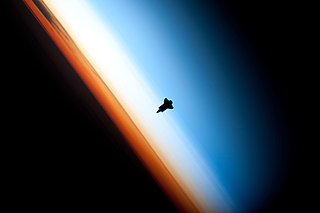
The stratosphere is the second layer of the atmosphere of the Earth, located above the troposphere and below the mesosphere. The stratosphere is an atmospheric layer composed of stratified temperature layers, with the warm layers of air high in the sky and the cool layers of air in the low sky, close to the planetary surface of the Earth. The increase of temperature with altitude is a result of the absorption of the Sun's ultraviolet (UV) radiation by the ozone layer. The temperature inversion is in contrast to the troposphere, near the Earth's surface, where temperature decreases with altitude.

An aerobot is an aerial robot, usually used in the context of an unmanned space probe or unmanned aerial vehicle.

New Horizons is an interplanetary space probe that was launched as a part of NASA's New Frontiers program. Engineered by the Johns Hopkins University Applied Physics Laboratory (APL) and the Southwest Research Institute (SwRI), with a team led by Alan Stern, the spacecraft was launched in 2006 with the primary mission to perform a flyby study of the Pluto system in 2015, and a secondary mission to fly by and study one or more other Kuiper belt objects (KBOs) in the decade to follow, which became a mission to 486958 Arrokoth. It is the fifth space probe to achieve the escape velocity needed to leave the Solar System.

The Discovery Program is a series of Solar System exploration missions funded by the US National Aeronautics and Space Administration (NASA) through its Planetary Missions Program Office. The cost of each mission is capped at a lower level than missions from NASA's New Frontiers or Flagship Programs. As a result, Discovery missions tend to be more focused on a specific scientific goal rather than serving a general purpose.

Deep Impact is a NASA space probe launched from Cape Canaveral Air Force Station on January 12, 2005. It was designed to study the interior composition of the comet Tempel 1 (9P/Tempel), by releasing an impactor into the comet. At 05:52 UTC on July 4, 2005, the Impactor successfully collided with the comet's nucleus. The impact excavated debris from the interior of the nucleus, forming an impact crater. Photographs taken by the spacecraft showed the comet to be more dusty and less icy than had been expected. The impact generated an unexpectedly large and bright dust cloud, obscuring the view of the impact crater.

Samuel Thornton Durrance (Ph.D.) is an American scientist who flew aboard two NASA Space Shuttle missions as a payload specialist.

The Nibiru cataclysm is a supposed disastrous encounter between Earth and a large planetary object that certain groups believed would take place in the early 21st century. Believers in this doomsday event usually refer to this object as Nibiru or Planet X. The idea was first put forward in 1995 by Nancy Lieder, founder of the website ZetaTalk. Lieder claims she is a contactee with the ability to receive messages from extraterrestrials from the Zeta Reticuli star system through an implant in her brain. She states that she was chosen to warn mankind that the object would sweep through the inner Solar System in May 2003 causing Earth to undergo a physical pole shift that would destroy most of humanity.

This listing of flight altitude records are the records set for the highest aeronautical flights conducted in the atmosphere, set since the age of ballooning.

An airborne observatory is an airplane, airship, or balloon with an astronomical telescope. By carrying the telescope to a sufficiently high altitude, the telescope can avoid cloud cover, pollution, and carry out observations in the infrared spectrum, above water vapor in the atmosphere which absorbs infrared radiation. Some drawbacks to this approach are the instability of the lifting platform, the weight restrictions on the instrument, the need to safely recover the gear afterward, and the cost compared to a comparable ground-based observatory.

A balloon-borne telescope is a type of airborne telescope, a sub-orbital astronomical telescope that is suspended below one or more stratospheric balloons, allowing it to be lifted above the lower, dense part of the Earth's atmosphere. This has the advantage of improving the resolution limit of the telescope at a much lower cost than for a space telescope. It also allows observation of frequency bands that are blocked by the atmosphere.

NEO Surveyor, formerly called Near-Earth Object Camera (NEOCam), then NEO Surveillance Mission, is a planned space-based infrared telescope designed to survey the Solar System for potentially hazardous asteroids.

Comet ISON, formally known as C/2012 S1, was a sungrazing comet from the Oort cloud which was discovered on 21 September 2012 by Vitaly Nevsky and Artyom Novichonok.
Exposing Microorganisms in the Stratosphere (E-MIST) is a NASA study to determine if a specific microorganism could survive conditions like those on the planet Mars. The study transported Bacillus pumilus bacteria and their spores by helium-filled balloon to the stratosphere of Earth and monitored the ability of the microorganisms to survive in extreme Martian-like conditions such as low pressure, dryness, cold, and ionizing radiation.

The Planetary Defense Coordination Office (PDCO) is a planetary defense organization established in January 2016 within NASA's Planetary Science Division of the Science Mission Directorate.
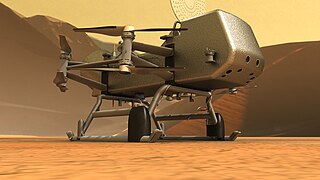
Dragonfly is a planned spacecraft and NASA mission, which will send a robotic rotorcraft to the surface of Titan, the largest moon of Saturn. It would be the first aircraft on Titan and is intended to make the first powered and fully controlled atmospheric flight on any moon, with the intention of studying prebiotic chemistry and extraterrestrial habitability. It will then use its vertical takeoffs and landings (VTOL) capability to move between exploration sites.

Double Asteroid Redirection Test (DART) is a NASA space mission aimed at testing a method of planetary defense against near-Earth objects (NEOs). Launched from Earth in November 2021, the mission will deliberately crash a space probe into the minor-planet moon Dimorphos of the double asteroid Didymos to assess the future potential of a spacecraft impact to deflect an asteroid on a collision course with Earth through a transference of momentum. The asteroid poses no actual threat to Earth, it was merely selected for the test.

Harold Anthony "Hal" Weaver, Jr. is an American astronomer, known for his research into the composition of solar system bodies including comets and Kuiper belt objects.

The GUSTO mission is a planned high-altitude balloon mission that will carry an infrared telescope to measure fine-structure line emission from the interstellar medium. The mission is being developed by NASA's Explorers Program for launch in December 2022 from Antarctica.

The Super-pressure Balloon-borne Imaging Telescope (SuperBIT) is a highly-stabilized, high resolution telescope that operates in the stratosphere via NASA's super-pressure balloon (SPB) system. At 40 km altitude above sea level, the football-stadium-sized balloon carries SuperBIT to a suborbital environment above 99.2% of the Earth's atmosphere in order to obtain space quality imaging. As a research instrument, SuperBIT's primary science goal is to provide insight into the distribution of dark matter in galaxy clusters and throughout the large scale structure of the universe. As demonstrated by numerous test flights, the survey data generated by SuperBIT is expected to have similar quality and data collection efficiency as the Hubble Space Telescope while complementing surveys from other up-and-coming observatories such as the James Webb Space Telescope (JWST), the Vera C. Rubin Observatory, and the Nancy Grace Roman Space Telescope.

Light Italian CubeSat for Imaging of Asteroids (LICIACube) is a 6-unit CubeSat of the Italian Space Agency (ASI). LICIACube is a part of the Double Asteroid Redirection Test (DART) mission and is built to carry out observational analysis of the Didymos asteroid binary system after DART's impact. It will communicate directly with Earth, sending back images of the ejecta and plume of DART's impact as well as do asteroidal study during its flyby of the Didymos system from a distance of 55 km (34 mi), 3 days after DART's impact. LICIACube is the first purely Italian autonomous spacecraft in deep space. Data archiving and processing is managed by the Space Science Data Center (SSDC) of the ASI.


 Related media on Wikimedia Commons