Related Research Articles

The Battle of Arcole or Battle of Arcola was fought between French and Austrian forces 25 kilometres (16 mi) southeast of Verona during the War of the First Coalition, a part of the French Revolutionary Wars. The battle saw a bold maneuver by Napoleon Bonaparte's French Army of Italy to outflank the Austrian army led by József Alvinczi and cut off its line of retreat. The French victory proved to be a highly significant event during the third Austrian attempt to lift the siege of Mantua. Alvinczi planned to execute a two-pronged offensive against Bonaparte's army. The Austrian commander ordered Paul Davidovich to advance south along the Adige River valley with one corps while Alvinczi led the main army in an advance from the east. The Austrians hoped to raise the siege of Mantua where Dagobert Sigmund von Wurmser was trapped with a large garrison. If the two Austrian columns linked up and if Wurmser's troops were released, French prospects were grim.

Dagobert Sigismund, Count von Wurmser was an Austrian field marshal during the French Revolutionary Wars. Although he fought in the Seven Years' War, the War of the Bavarian Succession, and mounted several successful campaigns in the Rhineland in the initial years of the French Revolutionary Wars, he is probably most remembered for his unsuccessful operations against Napoleon Bonaparte during the 1796 campaign in Italy.

The Battle of Castiglione saw the French Army of Italy under General Napoleon Bonaparte attack an army of the Habsburg monarchy led by Feldmarschall Dagobert Sigmund von Wurmser on 5 August 1796. The outnumbered Austrians were defeated and driven back along a line of hills to the river crossing at Borghetto, where they retired beyond the Mincio River. The town of Castiglione delle Stiviere is located 10 kilometres (6 mi) south of Lake Garda in northern Italy. This battle was one of four famous victories won by Bonaparte during the War of the First Coalition, part of the French Revolutionary Wars. The others were Bassano, Arcole, and Rivoli.

The Battle of Bassano was fought on 8 September 1796, during the French Revolutionary Wars, in the territory of the Republic of Venice, between a French army under Napoleon Bonaparte and Austrian forces led by Count Dagobert von Wurmser. The engagement occurred during the second Austrian attempt to raise the siege of Mantua. It was a French victory; however, it was the last battle in Napoleon's perfect military career as two months later he would be defeated at the Second Battle of Bassano, ending his victorious streak. The Austrians abandoned their artillery and baggage, losing supplies, cannons, and battle standards to the French. The victory led to Wurmser being trapped in Mantua, but Napoleon would find his army now badly overstretched, due to holding both Trento and Bassano, meaning he could not support either of those locations without being drawn too far away from the other, something that would nearly allow the Austrians to win during the third attempt to raise the siege of Mantua in November.

In the Battle of Rovereto on 4 September 1796 a French army commanded by Napoleon Bonaparte defeated an Austrian corps led by Paul Davidovich during the War of the First Coalition, part of the French Revolutionary Wars. The battle was fought near the town of Rovereto, in the upper Adige River valley in northern Italy.
Baron Paul Davidovich or Pavle Davidović became a general of the Austrian Empire and a Knight of the Military Order of Maria Theresa. He played a major role in the 1796 Italian campaign during the French Revolutionary Wars, leading corps-sized commands in the fighting against the French army led by Napoleon Bonaparte. He led troops during the Napoleonic Wars and was Proprietor (Inhaber) of an Austrian infantry regiment.

The Battle of Lonato was fought on 3 and 4 August 1796 between the French Army of Italy under General Napoleon Bonaparte and a corps-sized Austrian column led by Lieutenant General Peter Quasdanovich. A week of hard-fought actions that began on 29 July and ended on 4 August resulted in the retreat of Quasdanovich's badly mauled force. The elimination of Quasdanovich's threat allowed Bonaparte to concentrate against and defeat the main Austrian army at the Battle of Castiglione on 5 August. Lonato del Garda is located near the SP 668 highway and the Brescia-Padua section of Autostrada A4 to the southwest of Lake Garda.

Giovanni Marchese di Provera or Johann Provera served in the Habsburg Austrian army in Italy during the French Revolutionary Wars, rising to command a 9,000-man independent corps during the War of the First Coalition. Previously, he fought in the Seven Years' War, the War of the Bavarian Succession, and the Austro-Turkish War. In 1796–1797, Provera played a significant role in three Italian campaigns against the Republican French army of Napoleon Bonaparte.

During the siege of Mantua, which lasted from 4 June 1796 to 2 February 1797 with a short break, French forces under the overall command of Napoleon Bonaparte besieged and blockaded a large Austrian garrison at Mantua for many months until it surrendered. This eventual surrender, together with the heavy losses incurred during four unsuccessful relief attempts, led indirectly to the Austrians suing for peace in 1797. The siege occurred during the War of the First Coalition, which is part of the French Revolutionary Wars. Mantua, a city in the Lombardy region of Italy, lies on the Mincio River.
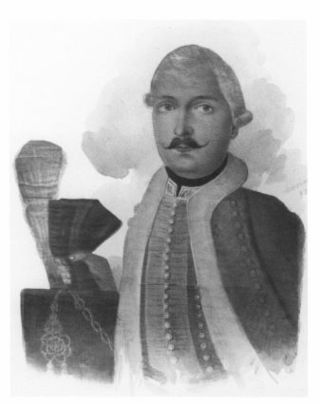
Johann Mészáros von Szoboszló joined the Habsburg army in 1756 and fought the Prussians, Ottoman Turks, and French during a long military career. During the French Revolutionary Wars, he fought in several campaigns. He commanded a division in the 1796-1797 Italian campaign against the army of Napoleon Bonaparte. He was Proprietor (Inhaber) of an Austrian Uhlan regiment from 1792 to 1797 and a Hussar regiment from 1797 to 1801.
In the Battle of Arcole on 15 to 17 November 1796, the French Army of Italy commanded by Napoleon Bonaparte won a victory over the army of Austria led by Jozsef Alvinczi. The battle was part of the third relief of the Siege of Mantua in which Alvinczi's army repulsed Bonaparte at the Second Battle of Bassano on 6 November and at the Battle of Caldiero on 12 November. Meanwhile, Paul Davidovich's Austrian Tyrol Corps clashed with Claude Vaubois' French division at Cembra on 2 November. Davidovich defeated Vaubois at the Battle of Calliano on 6–7 November and Rivoli Veronese on 17 November. After Bonaparte's triumph at Arcola, he turned on the Tyrol Corps, beat it at Rivoli on 21 November, and forced it to retreat north into the mountains.
In the Battle of Castiglione on 5 August 1796, the French Army of Italy under the command of General Napoleon Bonaparte defeated an Austrian army led by Field Marshal Dagobert Sigmund von Wurmser. Castiglione and the Battle of Lonato were the major actions in a campaign which marked the first attempted relief of the Siege of Mantua. While Wurmser advanced east of Lake Garda with three columns, Peter Quasdanovich moved his column into the area west of Lake Garda. The Austrians pushed back the French forces and forced Bonaparte to raise the siege. However, the French commander massed against Quasdanovich and forced him to retreat after a week of see-saw fighting. After disposing of Quasdanovich, Bonaparte turned on Wurmser and defeated the main army also. In the sequel, the French pushed the Mantua garrison back and blockaded the city.
The Battle of Calliano on 6 and 7 November 1796 saw an Austrian corps commanded by Paul Davidovich rout a French division directed by Claude Belgrand de Vaubois. The engagement was part of the third Austrian attempt to relieve the French siege of Mantua during the French Revolutionary Wars. The battle was preceded by a clash at Cembra on 2 November and followed by actions at Rivoli Veronese on 17 and 21 November.
The Second Battle of Bassano on 6 November 1796, saw a Habsburg army commanded by József Alvinczi fight Napoleon Bonaparte's French Army of Italy. The Austrians repulsed persistent French attacks in a struggle in which both sides suffered heavy losses. The engagement, which happened two months after the more famous Battle of Bassano, marked the first tactical defeat of Bonaparte's career and occurred near Bassano del Grappa in Northern Italy during the French Revolutionary Wars. The action was part of the third relief of the siege of Mantua during the War of the First Coalition.
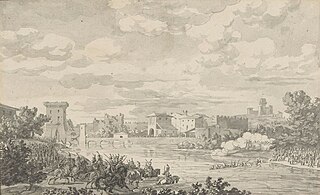
The Battle of Borghetto, near Valeggio sul Mincio in the Veneto of northern Italy, took place during the War of the First Coalition, part of the French Revolutionary Wars. On 30 May 1796, a French army led by General Napoleon Bonaparte forced a crossing of the Mincio River in the face of opposition from an Austrian army commanded by Feldzeugmeister Johann Peter Beaulieu. This action compelled the Austrian army to retreat north up the Adige valley to Trento, leaving the fortress of Mantua to be besieged by the French.

Gerhard Ritter von Rosselmini or Gherardo Rosselmini or Gerhard Roselmini became a general officer in the Austrian army during the French Revolutionary Wars and fought in several actions against Napoleon Bonaparte's French army during the 1796 Italian campaign. From 1789 to 1794 he commanded an Austrian infantry regiment. He led the unit in several battles on the upper Rhine in 1793 before being captured. He was promoted to General Major in early 1794. Rosselmini died in Italy while on campaign.
Karl Philipp Sebottendorf van der Rose enrolled in the Austrian army at the age of 18, became a general officer during the French Revolutionary Wars, and commanded a division against Napoleon Bonaparte in several notable battles during the Italian campaign of 1796.
Anton Schübirz or Anton Schubirz von Chobinin was an Austrian General-major. He fought for Habsburg monarchy against Ottoman Turkey and the French First Republic. He participated in several noteworthy actions during the French Revolutionary Wars. As a newly promoted general officer in Italy, he led a brigade in an all-night action against the French at Codogno, part of the Battle of Fombio in May 1796. In the sparring before the Battle of Castiglione, he showed initiative in bringing his troops to the assistance of a fellow general. He also fought at Fontaniva, Caldiero, and Arcole in the autumn of 1796. This was the theater of war where a young French general named Napoleon Bonaparte earned his fame. Schübirz retired from the army in 1798 and died three years later.

Joseph Franz Canto d'Irles or Canto d'Yrlès was an Austrian general officer who led his troops against Napoleon Bonaparte's French army during the Siege of Mantua in 1796–1797. He joined the Austrian army as a teenager and fought in the Seven Years' War. He was promoted to Colonel (Oberst) during the War of the Bavarian Succession and to Generalmajor during the Austro-Turkish War. He was promoted to Feldmarschall-Leutnant in 1795 and assigned to command the fortress of Mantua in Italy. For successfully defending the fortress for two months, he received the Commander's Cross of the Military Order of Maria Theresa in August 1796. He was superseded in command during the later part of the siege and died two months after the fortress surrendered in February 1797.

Johann Rudolf von Sporck or Spork served as an Austrian general during the French Revolutionary Wars. He fought in the Austro-Turkish War in 1789–1790. He led an infantry regiment in 1792–1793 and was promoted Generalmajor at the beginning of 1794. He fought in the Flanders campaign in 1792–1794 and in the Rhine campaign of 1795. After being transferred to Italy, he led a brigade at Lonato, Rovereto, and Calliano in 1796. He was promoted to Feldmarschall-Leutnant in 1797 and led a division in 1800 at Engen, Messkirch, and the Iller River. In 1801 he became the inhaber (proprietor) of an infantry regiment. He died in 1806.
References
- Boycott-Brown, Martin. The Road to Rivoli. London: Cassell & Co., 2001. ISBN 0-304-35305-1