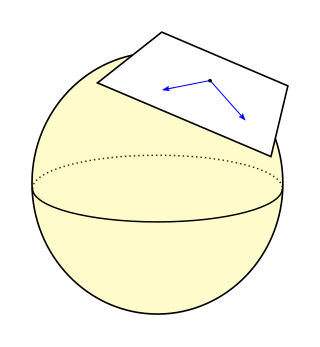
In differential geometry, a Riemannian manifold is a geometric space on which many geometric notions such as distance, angles, length, volume, and curvature are defined. Euclidean space, the -sphere, hyperbolic space, and smooth surfaces in three-dimensional space, such as ellipsoids and paraboloids, are all examples of Riemannian manifolds. Riemannian manifolds are named after German mathematician Bernhard Riemann, who first conceptualized them.
In Riemannian geometry, the sectional curvature is one of the ways to describe the curvature of Riemannian manifolds. The sectional curvature K(σp) depends on a two-dimensional linear subspace σp of the tangent space at a point p of the manifold. It can be defined geometrically as the Gaussian curvature of the surface which has the plane σp as a tangent plane at p, obtained from geodesics which start at p in the directions of σp. The sectional curvature is a real-valued function on the 2-Grassmannian bundle over the manifold.
In the mathematical field of Riemannian geometry, the scalar curvature is a measure of the curvature of a Riemannian manifold. To each point on a Riemannian manifold, it assigns a single real number determined by the geometry of the metric near that point. It is defined by a complicated explicit formula in terms of partial derivatives of the metric components, although it is also characterized by the volume of infinitesimally small geodesic balls. In the context of the differential geometry of surfaces, the scalar curvature is twice the Gaussian curvature, and completely characterizes the curvature of a surface. In higher dimensions, however, the scalar curvature only represents one particular part of the Riemann curvature tensor.

Shing-Tung Yau is a Chinese-American mathematician. He is the director of the Yau Mathematical Sciences Center at Tsinghua University and professor emeritus at Harvard University. Until 2022, Yau was the William Caspar Graustein Professor of Mathematics at Harvard, at which point he moved to Tsinghua.

Eugenio Calabi was an Italian-born American mathematician and the Thomas A. Scott Professor of Mathematics at the University of Pennsylvania, specializing in differential geometry, partial differential equations and their applications.
In the mathematical field of differential geometry, Ricci-flatness is a condition on the curvature of a Riemannian manifold. Ricci-flat manifolds are a special kind of Einstein manifold. In theoretical physics, Ricci-flat Lorentzian manifolds are of fundamental interest, as they are the solutions of Einstein's field equations in a vacuum with vanishing cosmological constant.
Hopf–Rinow theorem is a set of statements about the geodesic completeness of Riemannian manifolds. It is named after Heinz Hopf and his student Willi Rinow, who published it in 1931. Stefan Cohn-Vossen extended part of the Hopf–Rinow theorem to the context of certain types of metric spaces.

Richard Streit Hamilton was an American mathematician who served as the Davies Professor of Mathematics at Columbia University.
In the mathematical field of differential geometry, there are various splitting theorems on when a pseudo-Riemannian manifold can be given as a metric product. The best-known is the Cheeger–Gromoll splitting theorem for Riemannian manifolds, although there has also been research into splitting of Lorentzian manifolds.
In mathematics, the soul theorem is a theorem of Riemannian geometry that largely reduces the study of complete manifolds of non-negative sectional curvature to that of the compact case. Jeff Cheeger and Detlef Gromoll proved the theorem in 1972 by generalizing a 1969 result of Gromoll and Wolfgang Meyer. The related soul conjecture, formulated by Cheeger and Gromoll at that time, was proved twenty years later by Grigori Perelman.
In the mathematical field of metric geometry, Mikhael Gromov proved a fundamental compactness theorem for sequences of metric spaces. In the special case of Riemannian manifolds, the key assumption of his compactness theorem is automatically satisfied under an assumption on Ricci curvature. These theorems have been widely used in the fields of geometric group theory and Riemannian geometry.
In Riemannian geometry, a branch of mathematics, harmonic coordinates are a certain kind of coordinate chart on a smooth manifold, determined by a Riemannian metric on the manifold. They are useful in many problems of geometric analysis due to their regularity properties.
In the mathematical field of Riemannian geometry, the Berger spheres form a special class of examples of Riemannian manifolds diffeomorphic to the 3-sphere. They are named for Marcel Berger who introduced them in 1962.
In mathematics—specifically, in Riemannian geometry—a Wiedersehen pair is a pair of distinct points x and y on a (usually, but not necessarily, two-dimensional) compact Riemannian manifold (M, g) such that every geodesic through x also passes through y, and the same with x and y interchanged.
Arthur Besse is a pseudonym chosen by a group of French differential geometers, led by Marcel Berger, following the model of Nicolas Bourbaki. A number of monographs have appeared under the name.
In mathematics, specifically Riemannian geometry, Synge's theorem is a classical result relating the curvature of a Riemannian manifold to its topology. It is named for John Lighton Synge, who proved it in 1936.
In Riemannian geometry, Cheng's eigenvalue comparison theorem states in general terms that when a domain is large, the first Dirichlet eigenvalue of its Laplace–Beltrami operator is small. This general characterization is not precise, in part because the notion of "size" of the domain must also account for its curvature. The theorem is due to Cheng (1975b) by Shiu-Yuen Cheng. Using geodesic balls, it can be generalized to certain tubular domains.
In Riemannian geometry, a field of mathematics, Preissmann's theorem is a statement that restricts the possible topology of a negatively curved compact Riemannian manifold. It is named for Alexandre Preissmann, who published a proof in 1943.
In mathematics, the Lichnerowicz conjecture is a generalization of a conjecture introduced by Lichnerowicz. Lichnerowicz's original conjecture was that locally harmonic 4-manifolds are locally symmetric, and was proved by Walker (1949). The Lichnerowicz conjecture usually refers to the generalization that locally harmonic manifolds are flat or rank-1 locally symmetric. It has been proven true for compact manifolds with fundamental groups that are finite groups but counterexamples exist in seven or more dimensions in the non-compact case
In the mathematical fields of differential geometry and geometric analysis, the Gauss curvature flow is a geometric flow for oriented hypersurfaces of Riemannian manifolds. In the case of curves in a two-dimensional manifold, it is identical with the curve shortening flow. The mean curvature flow is a different geometric flow which also has the curve shortening flow as a special case.

