Bernhard Fischer | |
|---|---|
 Dwelling of Fischer's parents at Steinweg 43 in Coburg |
Johann Friedrich Bernhard Fischer (19 February 1852 Coburg - 2 August 1915 Dadizele) was a German bacteriologist noted for his classification system for bacteria.
Bernhard Fischer | |
|---|---|
| Dwelling of Fischer's parents at Steinweg 43 in Coburg |
Johann Friedrich Bernhard Fischer (19 February 1852 Coburg - 2 August 1915 Dadizele) was a German bacteriologist noted for his classification system for bacteria.
After attending Casimirianum from 1862 to 1871, he was educated at the University of Berlin, received the degree of M.D. in 1875, and went to Egypt and India as member of the German Cholera Commission. In 1889, he was a member of the Plankton Expedition and 10 years later became professor at the University of Kiel. There he also became head of the Institute of Hygiene. He became generally known for his classification of bacteria. His Structure and Functions of Bacteria (2d ed., 1900), was the standard in its field. [1]

Christoph Wilhelm Friedrich Hufeland was a German physician, naturopath and writer. He is famous as the most eminent practical physician of his time in Germany and as the author of numerous works displaying extensive reading and a cultivated critical faculty.
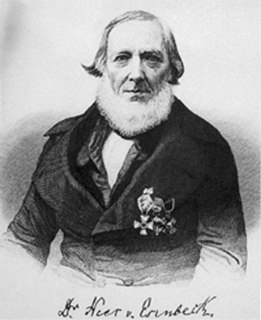
Christian Gottfried Daniel Nees von Esenbeck was a prolific German botanist, physician, zoologist, and natural philosopher. He was a contemporary of Goethe and was born within the lifetime of Linnaeus. He described approximately 7,000 plant species. His last official act as president of the German Academy of Natural Scientists Leopoldina was to admit Charles Darwin as a member. He was the author of numerous monographs on botany and zoology. His best-known works deal with fungi.
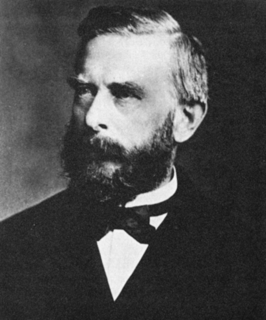
Wilhelm Karl HartwichPeters was a German naturalist and explorer.

Karl Friedrich Mohr (November 4, 1806 – September 28, 1879) was a German chemist famous for his early statement of the principle of the conservation of energy. Ammonium iron(II) sulfate, (NH4)2Fe(SO4)2.6H2O, is named Mohr's salt after him.

Carl Remigius Fresenius, was a German chemist, known for his studies in analytical chemistry.

Julius Theodor Christian Ratzeburg was a German zoologist, botanist, entomologist, and forester.

Julius Leopold Pagel was a German physician and historian of medicine.

Matthias Eugen Oscar Liebreich was a German pharmacologist.

Louis Waldenburg was a German physician.

Eugen Freiherr von Gorup-Besanez was an Austrian-German chemist.

Johann Christian Wiegleb was a notable German apothecary and early innovator of chemistry as a science.

Louis Lewin was a German pharmacologist. In 1887 he received his first sample of the Peyote cactus from Dallas, Texas-based physician John Raleigh Briggs (1851-1907), and later published the first methodical analysis of it, causing a variant to be named Anhalonium lewinii in his honor.

Franz Penzoldt was a German internist and pharmacologist born in Crispendorf, Principality of Reuss-Greiz. He was the father of writer Ernst Penzoldt (1892–1955).

Johann Bartholomew (Bartholomäus) Trommsdorff, was a German chemist and pharmacist noted for his 1805 Systematisches Handbuch der Gesammten Chemie ; a work that was published in eight volumes.
Otto Karl Berg was a German botanist and pharmacist. The official abbreviation of his name, in botany, is O. Berg.

Johann Andreas Buchner was a German pharmacologist working in the area of alkaloids. He was the father of pharmacologist Ludwig Andreas Buchner (1813–1897).

Ludwig Andreas Buchner was a German pharmacologist. His father was pharmacologist Johann Andreas Buchner (1783-1852).

Hans Hermann Julius Hager was a German writer on pharmacy.

Friedrich Gottlob Hayne was a German botanist, taxonomist, pharmacist and professor.

Hermann Bausinger was a German cultural scientist. He was professor and head of the Ludwig Uhland Institute for empirical cultural science at the University of Tübingen from 1960 to 1992. The institute has focused on the culture of everyday life, the history of traditions, and the research of narration patterns and dialects. His history of literature from Swabia from the 18th century to the present was published for his 90th birthday.
| General | |
|---|---|
| National libraries | |
| Other | |
  | This article about a German scientist is a stub. You can help Wikipedia by expanding it. |
