
Colombia, officially the Republic of Colombia, is a country mostly in South America with insular regions in North America. The Colombian mainland is bordered by the Caribbean Sea to the north, Venezuela to the east and northeast, Brazil to the southeast, Ecuador and Peru to the south and southwest, the Pacific Ocean to the west, and Panama to the northwest. Colombia is divided into 32 departments. The Capital District of Bogotá is also the country's largest city hosting the main financial and cultural hub. Other major urbes include Medellín, Cali, Barranquilla, Cartagena, Santa Marta, Cúcuta, Ibagué, Villavicencio and Bucaramanga. It covers an area of 1,141,748 square kilometers, and has a population of around 52 million. Its rich cultural heritage—including language, religion, cuisine, and art—reflects its history as a colony, fusing cultural elements brought by mass immigration from Europe and the Middle East, with those brought by the African diaspora, as well as with those of the various Indigenous civilizations that predate colonization. Spanish is the official language, although English and 64 other languages are recognized regionally.

Magnolia is a large genus of about 210 to 340 flowering plant species in the subfamily Magnolioideae of the family Magnoliaceae. The natural range of Magnolia species is disjunct, with a main center in east and southeast Asia and a secondary center in eastern North America, Central America, the West Indies, and some species in South America.

The Magdalena River is the main river of Colombia, flowing northward about 1,528 kilometres (949 mi) through the western half of the country. It takes its name from the biblical figure Mary Magdalene. It is navigable through much of its lower reaches, in spite of the shifting sand bars at the mouth of its delta, as far as Honda, at the downstream base of its rapids. It flows through the Magdalena River Valley.
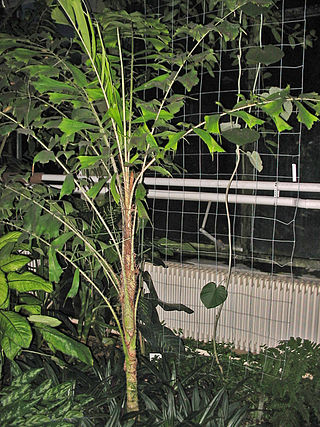
Aiphanes is a genus of spiny palms which is native to tropical regions of South and Central America and the Caribbean. There are about 26 species in the genus, ranging in size from understorey shrubs with subterranean stems to subcanopy trees as tall as 20 metres (66 ft). Most have pinnately compound leaves ; one species has entire leaves. Stems, leaves and sometimes even the fruit are covered with spines. Plants flower repeatedly over the course of their lifespan and have separate male and female flowers, although these are borne together on the same inflorescence. Although records of pollinators are limited, most species appear to be pollinated by insects. The fruit are eaten by several birds and mammals, including at least two species of amazon parrots.

The Colombian weasel, also known as Don Felipe's weasel, is a very rare species of weasel only known with certainty from the departments of Huila and Cauca in Colombia and nearby northern Ecuador. Both its scientific and alternative common name honours the mammalogist Philip "Don Felipe" Hershkovitz.
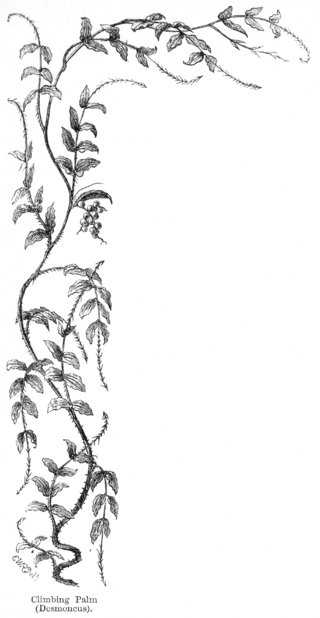
Desmoncus is a genus of mostly climbing, spiny palms native to the Neotropics. The genus extends from Mexico in the north to Brazil and Bolivia in the south, with two species present in the southeastern Caribbean.

The rainbow-bearded thornbill is a species of hummingbird in the "coquettes", tribe Lesbiini of subfamily Lesbiinae. It is found in Colombia, Ecuador, and Peru.

The semiplumbeous hawk is a species of bird of prey in the family Accipitridae. It is found in Colombia, Costa Rica, Ecuador, Honduras, and Panama. Its natural habitat is subtropical or tropical moist lowland forests.

Brunellia is a genus of trees. They are distributed in the mountainous regions of southern Mexico, Central America, West Indies, and South America. Brunellia is the only genus in the family Brunelliaceae. As of 2001 there were about 54 species.

The fauna of Colombia is characterized by a high biodiversity, with the highest rate of species by area unit worldwide.

The Colombian small-eared shrew is a species of mammal in the family Soricidae. It is endemic to Colombia, where it is known from the Cordillera Central in Antioquia Department at elevations from 1,750 to 2,800 m. It is found in montane forest and cultivated areas. It resembles C. brachyonyx.
Buenoa tumaquensis is a species of backswimmer first found in Colombia's Pacific coast.
Buenoa anomala is a species of backswimmer first found in Colombia's Pacific coast.
Buenoa dactylis is a species of backswimmer first found in Colombia's Pacific coast.
Buenoa prosthetus is a species of backswimmer first found in Colombia's Pacific coast.

The biodiversity of Colombia is the variety of indigenous organisms in the country with the second-highest biodiversity in the world. As of 2021, around 63,000 species are registered in Colombia, of which 14% are endemic. The country occupies worldwide the first position in number of orchids, birds and butterflies, second position in plants, amphibians and fresh water fish, third place in species of palm trees and reptiles and globally holds the sixth position in biodiversity of mammals.

Buenoa is a genus of backswimmer. It was created by George Willis Kirkaldy in 1904 to include all species of Anisops from the Western Hemisphere with a two-segmented front tarsus in males, reserving the latter genus for Eastern Hemisphere species with a one-segmented front tarsus in males. It contains 69 described species.
Buenoa confusa is a species of backswimmer in the family Notonectidae. It is found in the Caribbean, Central America, and North America.

Cadena's tailless bat is a species of bat native to Colombia. In 2006 it was described as a separate species from the tailed tailless bat species complex.

