
Hemiptera is an order of insects, commonly called true bugs, comprising over 80,000 species within groups such as the cicadas, aphids, planthoppers, leafhoppers, assassin bugs, bed bugs, and shield bugs. They range in size from 1 mm (0.04 in) to around 15 cm (6 in), and share a common arrangement of piercing-sucking mouthparts. The name "true bugs" is often limited to the suborder Heteroptera.

Corixidae is a family of aquatic insects in the order Hemiptera. They are found worldwide in virtually any freshwater habitat and a few species live in saline water. There are about 500 known species worldwide, in 55 genera, including the genus Sigara.
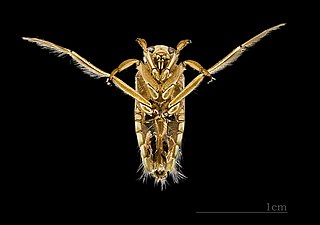
Notonectidae is a cosmopolitan family of aquatic insects in the order Hemiptera, commonly called backswimmers because they swim "upside down" (inverted). They are all predators and typically range from 0.5 to 1.5 cm (0.2–0.6 in) in length. They are similar in appearance to Corixidae, but can be separated by differences in their dorsal-ventral coloration, front legs, and predatory behavior. Their dorsum is convex, lightly colored without cross striations. Their front tarsi are not scoop-shaped and their hind legs are fringed for swimming. There are about 350 species in two subfamilies: Notonectinae with seven genera, and Anisopinae with four genera. Members in the former subfamily are often larger than those in the latter.

Nepomorpha is an infraorder of insects in the "true bug" order (Hemiptera). They belong to the "typical" bugs of the suborder Heteroptera. Due to their aquatic habits, these animals are known as true water bugs. They occur all over the world outside the polar regions, with about 2,000 species altogether. The Nepomorpha can be distinguished from related Heteroptera by their missing or vestigial ocelli. Also, as referred to by the obsolete name Cryptocerata, their antennae are reduced, with weak muscles, and usually carried tucked against the head.

Pleidae, the pygmy backswimmers, is a family of aquatic insects in the order Hemiptera. There are 37 species in three genera, distributed across most of the world, except the polar regions and remote oceanic islands.
Tachygerris is a genus of Water Strider.

Notonecta undulata, also known by the common name grousewinged backswimmer, are from the family Notonectidae and the insect suborder Heteroptera. They are a type of hemipteran or true bug. These aquatic insects typically spend their time at the water's surface, using their abdomen and legs to cling to the underside of the surface tension. The Grousewinged backswimmer can be found in both lotic and lentic environments; however, they typically prefer small ponds and lakes where the water is slow-moving with less current. They swim upside down looking for prey. Once they stop swimming they float back up to the surface. These insects can be distinguished from water boatman or Corixidae by their segmented beak and front legs. Water boatman have highly modified front legs whereas backswimmers do not. Backswimmers are distributed across a broad range throughout North America. However, the species Notonecta undulata has only been documented and studied in southern Manitoba, Saskatchewan, Alberta and the western United States. N. undulata differs from other backswimmers by their antennae and size. They are approximately 10–12 mm long, and their antennae are 4 segmented.
Rhagovelia calceola is a species of aquatic bug first found in Altaquer, Río Ñambí, Nariño, Colombia.
Rhagovelia espriella is a species of aquatic bug first found in La Espriella, Tumaco, Nariño, Colombia.
Rhagovelia rosensis is a species of aquatic bug first found in Vereda Santa Rosa, Consejo Comunitario Río Mejicano, Tumaco, Nariño, Colombia.
Rhagovelia magdalena is a species of aquatic bug first found in Vereda La Vega, Río Magdalena, Oporapa, Huila, Colombia.
Rhagovelia grandis is a species of aquatic bug first found in Quebrada Caparrosa, Oporapa, Huila, Colombia.
Rhagovelia cardia is a species of aquatic bug first found in Altaquer, Río Ñambí, Nariño, Colombia.
Rhagovelia gastrotricha is a species of aquatic bug first found in Altaquer, Río Ñambí, Nariño, Colombia.
Buenoa tumaquensis is a species of backswimmer first found in Colombia's Pacific coast.
Buenoa anomala is a species of backswimmer first found in Colombia's Pacific coast.
Buenoa burtsa is a species of backswimmer first found in Colombia's Pacific coast.
Buenoa prosthetus is a species of backswimmer first found in Colombia's Pacific coast.

Buenoa is a genus of backswimmer. It was created by George Willis Kirkaldy in 1904 to include all species of Anisops from the Western Hemisphere with a two-segmented front tarsus in males, reserving the latter genus for Eastern Hemisphere species with a one-segmented front tarsus in males. It contains 69 described species.
Buenoa confusa is a species of backswimmer in the family Notonectidae. It is found in the Caribbean, Central America, and North America.

