
Fort Zeelandia was a fortress built over ten years from 1624 to 1634 by the Dutch East India Company (VOC), in the town of Anping on the island of Formosa, the former name of Taiwan Island in Taiwan, during their 38-year rule over the western part of the island. The site had been renamed several times as Orange City (奧倫治城), Anping City (安平城), and Taiwan City (臺灣城); the current name of the site in Chinese is 安平古堡(lit. 'Anping Old Fort').

Zhangjiakou also known as Kalgan and several other names, is a prefecture-level city in northwestern Hebei province in Northern China, bordering Beijing to the southeast, Inner Mongolia to the north and west, and Shanxi to the southwest. By 2019, its population was 4,650,000 inhabitants on 36,861.56 square kilometres (14,232.33 sq mi), divided into 17 Counties and Districts. The built-up area made of Qiaoxi, Qiaodong, Chongli, Xuanhua, Xiahuayuan Districts largely being conurbated had 1,500,000 inhabitants in 2019 on 1,412.7 km2 (545.4 sq mi).

Xinzheng is a county-level city of Henan Province, China. It is under the administration of the prefecture-level city of Zhengzhou, the provincial capital. The city has a population of 600,000 people and covers an area of 873 square kilometres (337 sq mi), 15 km2 (5.8 sq mi) of which is urban.

Handan is a prefecture-level city located in the southwest of Hebei province, China. The southernmost prefecture-level city of the province, it borders Xingtai on the north, and the provinces of Shanxi on the west, Henan on the south and Shandong on the east. At the 2010 census, its population was 9,174,683 inhabitants whom 2,845,790 lived in the built-up area made of 5 urban districts. Yongnian District in Handan and Shahe City in Xingtai have largely formed into a single conurbation.

A hill is a landform that extends above the surrounding terrain. It often has a distinct summit.

Xianyang is a prefecture-level city in central Shaanxi province, situated on the Wei River a few kilometers upstream (west) from the provincial capital of Xi'an. Once the capital of the Qin dynasty, it is now integrated into the Xi'an metropolitan area, one of the main urban agglomerations in western China, with more than 7.17 million inhabitants, its built-up area made of 2 urban districts was 945,420 inhabitants at the 2010 census. It has a total area of 10,213 square kilometres (3,943 sq mi). Xianyang is home to the main campus of Northwest A&F University (NWAFU), one of the world's top universities in "Agriculture Science" related-fields and a member of "Project 985" club which is an organization of 39 reputable universities in China.

The Great Wall of China is a series of fortifications that were built across the historical northern borders of ancient Chinese states and Imperial China as protection against various nomadic groups from the Eurasian Steppe. Several walls were built from as early as the 7th century BC, with selective stretches later joined together by Qin Shi Huang (220–206 BC), the first emperor of China. Little of the Qin wall remains. Later on, many successive dynasties have built and maintained multiple stretches of border walls. The most well-known sections of the wall were built by the Ming dynasty (1368–1644).

Chinese city walls refer to defensive systems used to protect towns and cities in China in pre-modern times. In addition to walls, city defenses often included towers and gates.

Zhangpu County is a county of Zhangzhou prefecture-level city in far southern Fujian province, People's Republic of China. The county seat is located in the town of Sui'an (绥安镇).

Yongchang County is a county located in the southern half of the prefecture-level city of Jinchang in north-central Gansu province, China, bordering Qinghai to the south. It has been associated with the historical Liqian and Fanhe counties. The village of Zhelaizhai, located in Jiaojiazhuang township, has been the subject of international academic and media attention for its potential connection to Sino-Roman relations.

The Changdao County simplified Chinese: 长岛县; traditional Chinese: 長島縣; pinyin: Chángdǎo Xiàn; lit. 'long island county') is a county in Yantai, a prefectural area of Shandong in the People's Republic of China. It consists of the Changshan Islands within the Bohai Strait, directly north of Penglai. They are known for their sandy beaches and picturesque limestone cliffs. The total land area is only 56 square kilometers (22 sq mi), but the coastline is 146 km (91 mi) long.
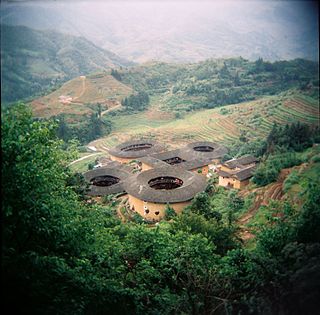
The Fujiantulou are Chinese rural dwellings unique to the Hakka in the mountainous areas in southeastern Fujian, China. They were mostly built between the 12th and the 20th centuries.
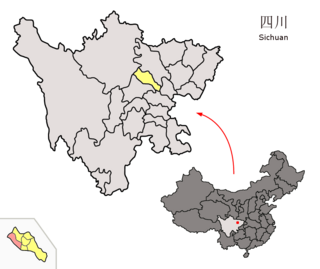
Shifang, formerly Shifang County, is a county-level city in Sichuan, China under the municipal administration of Deyang. It is located directly about 50 kilometers (31 mi) from Chengdu. It had an area of 863 km2 (333 sq mi) and a population of 430,000 in 2004. Shifang has a history stretching back over two thousand years. It suffered heavy damage during the 2008 Sichuan earthquake. The city was also the scene of a large-scale environmental protest against a copper smelting plant in July 2012.

The Hushan or Tiger Mountain Great Wall, is a section of the Ming Great Wall in Kuandian Manchu Autonomous County, Liaoning, China. The wall runs for about 1,200 metres over Hushan.

The history of the Great Wall of China began when fortifications built by various states during the Spring and Autumn and Warring States periods were connected by the first emperor of China, Qin Shi Huang, to protect his newly founded Qin dynasty against incursions by nomads from Inner Asia. The walls were built of rammed earth, constructed using forced labour, and by 212 BC ran from Gansu to the coast of southern Manchuria.

The Mausoleum of the First Qin Emperor is located in Lintong District, Xi'an, Shaanxi province of China. This mausoleum was constructed over 38 years, from 246 to 208 BC, and is situated underneath a 76-meter-tall tomb mound shaped like a truncated pyramid. The layout of the mausoleum is modeled on the Qin capital Xianyang, divided into inner and outer cities. The circumference of the inner city is 2.5 km and the outer is 6.3 km. The tomb is located in the southwest of the inner city and faces east. The main tomb chamber housing the coffin and burial artifacts is the core of the architectural complex of the mausoleum.
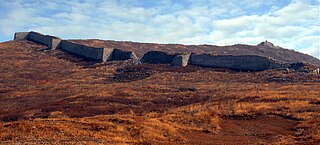
Yanzhou Village is a small settlement in Dengta Prefecture of Liaoyang Prefecture in Liaoning Province in China. The village is the site of the ancient Goguryeo city of Baegam in Korea or Baiyan City in Chinese. The ancient city was the scene a major battle between the Tang dynasty Chinese emperor Taizong and the Goguryeo in 645 AD.
Ji or Jicheng was an ancient city in northern China, which has become the longest continuously inhabited section of modern Beijing. Historical mention of Ji dates to the founding of the Zhou dynasty in about 1045 BC. Archaeological finds in southwestern Beijing where Ji was believed to be located date to the Spring and Autumn period. The city of Ji served as the capital of the ancient states of Ji and Yan until the unification of China by the Qin dynasty in 221 BC. Thereafter, the city was a prefectural capital for Youzhou through the Han dynasty, Three Kingdoms, Western Jin dynasty, Sixteen Kingdoms, Northern Dynasties, and Sui dynasty. With the creation of a Jizhou (蓟州) during the Tang dynasty in what is now Tianjin Municipality, the city of Ji took on the name Youzhou. Youzhou was one of the Sixteen Prefectures ceded to the Khitans during the Five Dynasties. The city then became the southern capital of the Liao dynasty and then main capital of the Jin dynasty (1115–1234). In the 13th century, Kublai Khan built a new capital city for the Yuan dynasty adjacent to Ji to the north. The old city of Ji became a suburb to Dadu. In the Ming dynasty, the old and new cities were merged by Beijing's Ming-era city wall.
Winter Clothes Day, Tomb-sweeping Day and Hungry Ghost Festival are the days for people to offer sacrifice to their ancestors in China. The Winter Clothes Day falls on the first day of Lunar October. October first of the lunar calendar has come into winter, thus people feel cold, which makes them miss the dead. To protect their ancestors against the cold in the netherworld, people send clothes to them, which's why it is called the Winter Clothes Day. On October first, Chinese people burn clothes made of colorful papers in front of graves to their ancestors to keep them warm. At the same time, the day marks the arrival of the dead of winter. Consequently, it's the day for parents and lovers to send clothes to the livings who they care about. As time goes by, the day becomes the festival for people to offer sacrifice to their ancestors.
Duan Qingbo was a Chinese archaeologist. He served as the chief archaeologist of the Mausoleum of the First Qin Emperor and Dean of the School of Cultural Heritage of Northwest University in Xi'an. He discovered the large-scale drainage system of Qin Shi Huang's mausoleum and a high-ranking noble tomb in the mausoleum precinct. He also spent over two years surveying more than 1,900 kilometres (1,200 mi) of the Great Wall on foot.

