Kampong Cham is a province (khaet) of Cambodia located on the central lowlands of the Mekong River. It borders the provinces of Kampong Chhnang to the west, Kampong Thom and Kratié to the north, Tbong Khmum to the east, and Prey Veng and Kandal to the south. Kampong Cham was officially divided into two provinces on 31 December 2013 in what was seen by many as a political move by the ruling party. All land west of the Mekong remained Kampong Cham while land east of the river became Tbong Khmum province. Prior to this division, Kampong Cham extended eastward to the international border with Vietnam, was the eleventh largest province in Cambodia, and with a population of 1,680,694, was the most populous province in Cambodia. Its capital and largest city is Kampong Cham.

The Candlelight Party is a personalist liberal party in Cambodia. The party was a member of the Council of Asian Liberals and Democrats, Liberal International, and the Alliance of Democrats.
The Democratic Senatorial Campaign Committee (DSCC) is the Democratic Hill committee for the United States Senate. It is the only organization solely dedicated to electing Democrats to the United States Senate. The DSCC's current Chair is Senator Catherine Cortez Masto of Nevada, who suceeded Maryland‘s Chris Van Hollen after the 2018 Senate elections. DSCC's current Executive Director is Tom Lopach, who is assisted by Deputy Executive Director Preston Elliott.
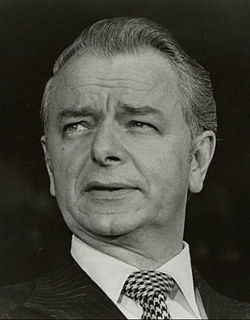
The 1978 United States Senate elections in the middle of Democratic President Jimmy Carter's term. Thirteen seats changed hands between parties. The Democrats at first lost a net of two seats to the Republicans, and then one more in a special election. Democrats nevertheless retained a 58-41 majority.

The 2008 United States Senate elections were held November 4, 2008, with 35 of the 100 seats in the Senate being contested. Thirty-three seats were up for regular elections; the winners were eligible to serve six-year terms from January 3, 2009 to January 3, 2015, as members of Class 2. There were also two special elections, the winners of those seats would finish the terms that ended January 3, 2013.
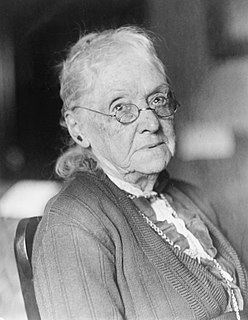
There have been 56 total women in the United States Senate since its establishment in 1789. The first woman who served as a U.S. Senator, Rebecca Latimer Felton, represented Georgia for a single day in 1922. The first woman elected to the Senate was Hattie Caraway from Arkansas in 1932. Seventeen of the women who have served were appointed; seven of those were appointed to succeed their deceased husbands. The 116th Congress has 25 female senators, meaning for the first time in history, one-fourth of the members of the U.S. Senate are female.

The 1968 United States Senate elections were elections for the United States Senate which coincided with the presidential election. Although Richard Nixon won the presidential election narrowly, the Republicans picked up five net seats in the Senate. Republicans would gain another seat after the election when Alaska Republican Ted Stevens was appointed to replace Democrat Bob Bartlett.
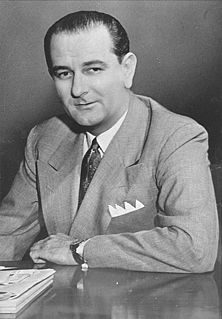
The 1958 United States Senate elections were elections for the United States Senate which occurred in the middle of President Dwight D. Eisenhower's second term. As is common in midterm elections, the party in the White House lost seats, but losses this year were more than usual, perhaps due to the high unemployment of the Recession of 1958. The Eisenhower Administration's position on right-to-work issues galvanized labor unions which supported Democrats. The launch of Sputnik may also have been a factor.
The 1956 United States Senate elections were elections for the United States Senate that coincided with the re-election of President Dwight D. Eisenhower. Although the Democrats gained two seats in regular elections, the Republicans gained back two seats in special elections, leaving the party balance of the chamber remained unchanged.

The United States Senate elections of 1926 were elections for the United States Senate that occurred in the middle of Republican President Calvin Coolidge's second term. The Republican majority was reduced by six seats.

In the United States Senate elections of 1912 and 1913, Democrats gained control of the Senate from the Republicans. This coincided with Democrat Woodrow Wilson's victory in the presidential election amid a divide in the Republican Party. In the Senate, Joseph M. Dixon and Miles Poindexter defected from the Republican Party and joined Theodore Roosevelt's new Progressive Party. Dixon, however, lost his seat during this election.

The Senate is the upper house of the Parliament of Cambodia. It is a legislative body composed of 62 members. Fifty-eight of the Senate seats are elected every six years by the commune councillors from 24 provinces of Cambodia and members of the National Assembly. In addition, the King nominates two Senators, and the National Assembly nominates two, ending with a total of 62 Senators. The Senate performs its duties as determined in the constitution and law in force. The Senate is chaired and presided by the President, currently Say Chhum of the Cambodian People's Party and assisted by two Vice Presidents.
The Nigerian National Assembly delegation from Kano comprises three Senators and fifteen Representatives. They form the legislature of Kano State, Nigeria.

The 2008 United States elections were held on November 4. The result was a significant victory for the Democratic Party on the national level, as they increased majorities in both houses of Congress and won the Presidency. Democratic Senator Barack Obama of Illinois defeated Republican Senator John McCain of Arizona in the presidential election. Riding Obama's coattails, the Democrats also picked up net gains of 8 Senate seats and 21 House seats.
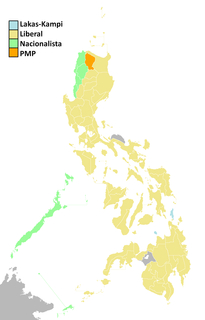
Election to the Senate of the Philippines was held on Monday, May 10, 2010. This is to elect 12 of the 24 seats in the Senate. Together with those elected in 2007, they will comprise the 15th Congress. The senators elected in 2007 will serve until June 30, 2013, while the senators elected in this election will serve up to June 30, 2016. The 2010 presidential election, elections to the House of Representatives as well as local elections will occur on the same date. The Philippines uses plurality-at-large voting for seats in the Senate: the twelve candidates with the highest number of votes wins the twelve seats up for election.
The United States Senate elections of 1852 and 1853 were elections which had the Democratic Party gain two seats in the United States Senate, and which coincided with the 1852 presidential election. Only six of the twenty Senators up for election were re-elected.
The United States Senate elections of 1872 and 1873 were elections which had the Republican Party, while still retaining a commanding majority, lose two seats in the United States Senate. By the beginning of the Congress, however, they'd lost three more: two as defections to the Liberal Republican Party, and one a resignation of Henry Wilson to become U.S. Vice President. These elections also coincided with President Ulysses S. Grant's easy re-election.
The United States Senate elections of 1792 and 1793 were elections of United States Senators that coincided with President George Washington's unanimous re-election. In these elections, terms were up for the ten senators in class 2.

Douglas Ericksen is an American politician of the Republican Party. He is a member of the Washington State Senate, District 42.

The 2018 United States Senate elections were held on November 6, 2018. Thirty-three of the 100 seats were contested in regular elections while two others were contested in special elections due to Senate vacancies in Minnesota and Mississippi. The winners were elected to six-year terms running from January 3, 2019, to January 3, 2025. Senate Democrats had 26 seats up for election while Senate Republicans had nine seats up for election.