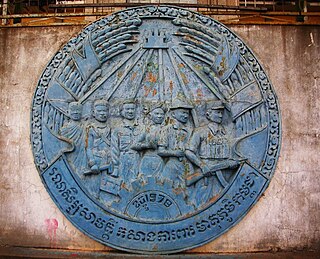
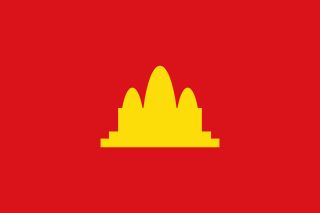
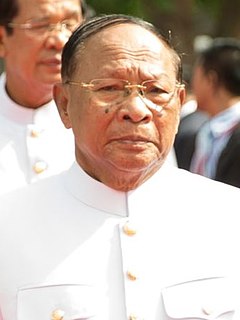
The People's Republic of Kampuchea was founded in Cambodia by the Salvation Front, a group of Cambodian communists dissatisfied with the Khmer Rouge after the overthrow of Democratic Kampuchea, Pol Pot's government. Brought about by an invasion from the Socialist Republic of Vietnam, which routed the Khmer Rouge armies, it had Vietnam and the Soviet Union as its main allies.
The Cambodian People's Party, founded as the Kampuchean People's Revolutionary Party, is the current ruling political party of Cambodia. It was the sole legal party in the country at the time of the People's Republic of Kampuchea (1979–1989) and during the first two years of the State of Cambodia. Its name was changed during the final years of the State of Cambodia, when the single-party system as well as the Marxist–Leninist ideology were abandoned. Having governed Cambodia since 1979, it is one of the longest-ruling parties in the world. The General Secretary of the party from 1979 to 1981 was Pen Sovan. The KPRP was originally a Marxist–Leninist party, although it took on a more reformist outlook in the mid-1980s under Heng Samrin's leadership. In the 1990s, the KPRP officially dropped its commitment to socialist ideology altogether when it renamed itself the Cambodian People's Party. It is also currently the oldest active party in Cambodia. Since 2018, the party commands all 125 seats in the National Assembly, and 58 of 62 seats in the Senate. Hun Sen, the Prime Minister of Cambodia, has served as the party's President since 2015.
Pen Sovan, the General Secretary of the KPRP, became Prime Minister on 27 June 1981 but was removed from office on 5 December and replaced by Chan Sy.
Pen Sovan was a Cambodian politician who served as the Prime Minister of the Hanoi-backed People's Republic of Kampuchea from 27 June to 5 December 1981, and was General Secretary of the Kampuchean People's Revolutionary Party (KPRP) from 1979 to 1981. He was arrested and removed from office in December 1981 by the Vietnamese for irritating Lê Đức Thọ, the chief adviser to the PRK government. He was imprisoned in Vietnam until January 1992.
Chan Sy, also spelt Chan Si, was a Cambodian politician. He became Prime Minister of the People's Republic of Kampuchea from 1982 to 1984.
The Kampuchea United Front for National Salvation, often simply referred to as Salvation Front or by its French acronym FUNSK, was the nucleus of a new Cambodian regime that would topple the Khmer Rouge and later establish the People's Republic of Kampuchea (PRK).
The Vietnamese, also known as the "elder brothers", took over Phnom Penh on 7 January 1979. 10 January 1979 marked the establishment of the People’s Republic of Kampuchea (PRK) government. By the beginning of 1980, the Vietnamese had forced the defeated Democratic Kampuchean Army into their mountain fortifications.
The National Army of Democratic Kampuchea (NADK) was a Cambodian guerrilla force. NADK were the armed forces of the Party of Democratic Kampuchea, operating between 1979 and the late 1990s.
In 1980, the Vietnamese seemed like the lesser evil as Cambodia faced a period of uncertainty. The greater fear lied in the potential revival of a coalition between the Democratic Kampuchea with the Chinese, Thai and Western backing. Furthermore, Cambodians initially perceived the Vietnamese as their liberators, many Khmer now saw them as opportunists who wished to subjugate the country. This was the general drive for many Vietnamese-opposing groups such as the KPNLF. Prior to the political return of Prince Sihanouk, Cambodia’s King who ruled from 1941 to 1955 and had recently been living in exile in Beijing, in January 1981, the leader of the KPNLF Son Sann, met with the Prime Minister of Democratic Kampuchea, Khieu Samphan. Prince Sihanouk returned to the political life on 8 February 1981, with the intention of heading “a government and a United Front against Vietnamese colonialism in Kampuchea.”[3] In March 1981, Sihanouk’s resistance movement called FUNCINPEC joined with the small resistance army known as the Armée Nationale Sihanoukiste (ANS), the Khmer Rouge, and Son Sann's KPNLF to discuss anti-Vietnamese and PAVN prospects. This only unsettled and prompted the Vietnamese to act quickly.
The state of Kampuchea, officially Democratic Kampuchea, existed between 1975 and 1979 in present-day Cambodia. The state was controlled by the Khmer Rouge (KR) and was founded when KR forces defeated the Khmer Republic of Lon Nol in 1975.
The Khmer People's National Liberation Front was a political front organized in 1979 in opposition to the Vietnamese-installed People's Republic of Kampuchea (PRK) regime in Cambodia. The 200,000 Vietnamese troops supporting the PRK, as well as Khmer Rouge defectors, had ousted the brutal Democratic Kampuchea regime of Pol Pot, and were initially welcomed by the majority of Cambodians as liberators. Some Khmer, though, recalled the two countries' historical rivalry and feared that the Vietnamese would attempt to subjugate the country, and began to oppose their military presence. Members of the KPNLF supported this view.
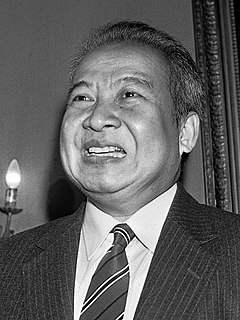
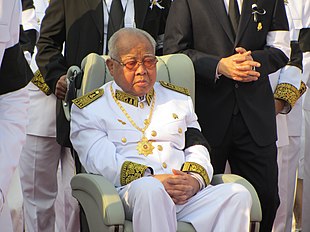
Norodom Sihanouk was a Cambodian royal, politician, composer and filmmaker who was twice the King of Cambodia. He was the son of King Norodom Suramarit and Queen Sisowath Kossamak. In Cambodia, he is also known as Samdech Euv.
The Vietnamese’ effort to start a Khmer state and nation began in Spring 1981. On 10 March 1981, Radio Phnom Penh announced a draft constitution, which caused villagers to elect their local committees in a narrow time frame due to the pressure of growing anti-Vietnamese organizations.
Electoral system
The 1981 elections are known for its close resemblance to the Vietnamese model. They were set up as a plurality system and applied in 20 MMCs. The law stated that for every MMC, there had to be more candidates than seats distributed. The electoral laws were exactly the same except for Article 4 in the new Cambodian constitution. This one explained that “Citizens of the PRK have the obligation to take part in the general elections to elect members of the National Assembly who, loyal to the fatherland, agree to follow the political line of the KNUFNS and work tirelessly in the service of the people.”[4] A law nowhere to be found in the initial constitution.
Plurality voting is an electoral system in which each voter is allowed to vote for only one candidate, and the candidate who polls the most among their counterparts is elected. In a system based on single-member districts, it may be called first-past-the-post (FPTP), single-choice voting, simple plurality or relative/simple majority. In a system based on multi-member districts, it may be referred to as winner-takes-all or bloc voting. The system is often used to elect members of a legislative assembly or executive officers. It is the most common form of the system, and is used in most elections in the United States, the lower house in India, most elections in the United Kingdom, and Canada.
The district magnitude ranged from 2 to 13 seats with an average size of 5.9. There were open lists and multiple votes, with the voting process consisting of voters choosing their candidates by crossing off the names of those they did not wish to vote for.[4]
Candidates would then be nominated jointly by the Front Central Committee, the Central mass organizations, and the Front Committees and mass organizations at the lower levels. The deputies were directly elected for five-year terms, and the Assembly would meet around twice a year.
Campaign
148 candidates, who were all approved by the electoral committee of the National United Front for the Salvation of Kampuchea, contested 117 seats in the National Assembly. No constituency had less than 2 seats to fill in the National Assembly.
Conduct
The elections occurred in a hasty manner due to the growth of anti-Vietnamese forces through Khmer resistance meetings and the Vietnamese’ fear of potential coalescence between them.
Other issues with this election were found in the Constitution. An original draft had been initially printed and distributed 10,000 times in 1980, yet the 1981 Constitution more heavily emphasized Indo-Chinese solidarity and bore the stamp of the 1980 Vietnamese Constitution.
There were several other minor problems with the system, such as the regime’s violation of its own decree of 18 March 1981. Rather than announcing candidates 15 days prior to the election, as was appropriate, the PRK only announced them 10 days in advance.
Another issue was spotted in the official results of 27 June 1981, when it was revealed that Sim Ka, who at the time was the Chairman of the Committee to Control State Affairs, had no seat in the Assembly and therefore no constituency.
Results
The official results were broadcast on 1 May 1981 by Radio Phnom Penh, remaining in conformity with the Communist practice. They announced the proclamation of the People’s Republic of Kampuchea which lead to Kampuchean People’s Revolutionary Party (KPRP) control of power. Considering its sole opponent was the isolated group of Khmer Rouge, the PRK claimed the majority of support.
The results only asserted President Heng Samrin and Vice President Pen Sovan’s leaderships as they secured 99.75% and 99.63% of the Phnom Penh constituency votes.
On 29 May 1981, the Kampuchean People’s Revolutionary Party held a four-day congress in Phnom Peng. Lê Duẩn, the first secretary of the Communist Party of Vietnam, along with ten other foreign representatives attended the meeting. The Fourth Party Congress announced Pen Sovan as General secretary of the elected politburo and Central Committee of the Revolutionary Party of the People of Kampuchea.
However, on 4 December 1981, the Vietnamese replaced Pen Sovan with Heng Samrin as Secretary General, because of Sovan's pro-Moscow sentiments.
A list of foreign communist parties that supported the newly established Cambodian government was released on 16 June 1981. The organizations originated from various communist countries such as Vietnam, Laos (occupied by 60,000 Vietnamese troops), the Soviet Union (Vietnam’s only ally in Asia) along with its provinces, as well as the Indonesian Communist Party PKI.
On 24 June 1981 the first National Assembly meeting was held. On 27 June 1981, Assembly Chairman Chea Sim along with the rest of the leaders of the national assembly, the Council of State, and the Council of Ministers took the oath of office and signed the constitution.
Constitution
The National Assembly’s first session consisted of implementing a new Constitution. This constitution stated that Kampuchea was an “independent and peaceful state, and where power resided in the people’s hands”.[4]
However, the Vietnamese disagreed with many points in the original 1980 Constitutional draft. These changes were then implemented into its official form in June 1981. The Constitution noted that Cambodia would slowly orient itself towards socialism under the leadership of the KPRP. It also claimed that the state’s biggest enemies were China, the US and other imperialist countries. The one country it did express some level of interest towards was Russia considering it was Vietnam’s only ally in Asia at the time.
The new Constitution allowed for new branches to be introduced, such as the National Assembly, the Council of State, and the Council of Ministers. These would only be enacted in 1982.
Analysis
This election proved the overwhelming control the Vietnamese had on Kampuchea. The Vietnamese politburo offices in Phnom Penh determined policy in the Khmer party. In the provinces, civilian advisors from Vietnamese “sister” provinces worked in offices and services. Provincial candidates had to apply to gain approval from the Vietnamese in order to run and would then have to travel to Vietnam to take part in a political training. Advisory teams from the PAVN operated districts below the province level. They were in charge of picking candidates for local elections and also had authority over the Khmer district along with internal security and troop recruitment.
The KPRP refused to work with any non-communist political forces which lead to the establishment of an exiled government in 1982. This government was none other than the offspring issued by the coalition between FUNCINPEC, ANS, the Khmer Rouge and the KPNLF in March 1981. This government was supported by the People’s Republic of China and Thailand.
Seeing it as another form of Vietnamese expansionism, China and the Association of Southeast Asian Nations (ASEAN) failed to recognize the newly backed People’s Republic of Kampuchea (PRK). ASEAN saw Vietnam as a “stalking horse for Soviet expansionism.” From 1979 to 1981, Pol Pot’s exiled government, Democratic Kampuchea, continued to be recognized at the UN, since they saw the Vietnamese’ actions in Cambodia as a violation of the UN Charter. This system allowed ASEAN to avoid using force, especially since they were unable to provide adequate military capacity to change the state of Cambodia.
Related Research Articles
The Khmer Rouge was the name popularly given to the followers of the Communist Party of Kampuchea (CPK) and by extension to the regime through which the CPK ruled in Cambodia between 1975 and 1979. The name had originally been used in the 1950s by Norodom Sihanouk as a blanket term for the Cambodian left.
Pol Pot was a Cambodian revolutionary and politician who served as the general secretary of the Communist Party of Kampuchea from 1963 to 1981. Ideologically a Marxist–Leninist and Khmer nationalist, he led the Khmer Rouge group from 1963 until 1997. From 1976 to 1979, he served as the Prime Minister of Democratic Kampuchea.
The Khmer Rouge period refers to the rule of Pol Pot, Nuon Chea, Ieng Sary, Son Sen, Khieu Samphan and the Communist Party of Kampuchea over Cambodia, which the Khmer Rouge renamed Democratic Kampuchea.
The Kingdom of Cambodia, informally known as the first Kingdom of Cambodia and the Sangkum Reastr Niyum era, referred to Norodom Sihanouk's first administration of Cambodia from 1953 to 1970, an especially significant time in the country's history. Sihanouk continues to be one of the most controversial figures in Southeast Asia's turbulent and often tragic postwar history.
Chea Sim was a Cambodian politician. He was President of the Cambodian People's Party from 1991 to 2015, President of the National Assembly of Cambodia from 1981 to 1998 and President of the Senate from 1999 to 2015. His official title was Samdach Akeak Moha Thomak Pothisal Chea Sim, Protean Protsaphea ney Preah Reacheanachak Kampuchea.
Heng Samrin is a Cambodian politician who was the de facto leader of the Hanoi-backed People's Republic of Kampuchea from 1979 to 1981 and General Secretary of the Kampuchean People's Revolutionary Party from 1981 to 1991. He has been the President of the National Assembly of Cambodia since 2006; he is also Honorary President of the Cambodian People's Party (CPP) and a Member of Parliament for Tboung Khmum Province. Heng Samrin is Cambodia's oldest parliamentarian, at 84 years of age. His honorary title is "Samdech Akeak Moha Ponhea Chakrei Heng Samrin".
The Cambodian–Vietnamese War, otherwise known in Vietnam as the Counter-offensive on the Southwestern border, was an armed conflict between the Socialist Republic of Vietnam and Democratic Kampuchea. The war began with isolated clashes along the land and maritime boundaries of Vietnam and Kampuchea between 1975 and 1978, occasionally involving division-sized military formations. On 25 December 1978, Vietnam launched a full-scale invasion of Kampuchea and subsequently occupied the country and removed the Communist Party of Kampuchea government from power.
The Coalition Government of Democratic Kampuchea, renamed to the National Government of Cambodia from 1990, was a coalition government in exile composed of three Cambodian political factions, namely Prince Norodom Sihanouk's FUNCINPEC party, the Party of Democratic Kampuchea and the Khmer People's National Liberation Front (KPNLF) formed in 1982, broadening the de facto deposed Democratic Kampuchea regime. For most of its existence, it was the internationally recognized government of Cambodia.
Son Sann was a Cambodian politician and anti-communist resistance leader who served as the 22nd Prime Minister of Cambodia (1967–68) and later as President of the National Assembly (1993). A devout Buddhist, he fathered seven children and was married. His full honorary title is "Samdech Borvor Setha Thipadei Son Sann".
General Sak Sutsakhan was a Cambodian politician and soldier who had a long career in the country's politics. He was the last Head of State of the Khmer Republic, the regime overthrown by the Khmer Rouge in 1975. Sak Sutsakhan formed a pro-US force known as the "Khmer Sâ".
General Dien Del directed combat operations in Cambodia, first as a general in the Army of the Khmer Republic (1970–1975) and then as a leader of Khmer People's National Liberation Front (KPNLF) guerrilla forces fighting against the Vietnamese occupation (1979–1992).
The Communist Party of Kampuchea, also known as Khmer Communist Party (KCP), was a communist party in Cambodia. Its leader was Pol Pot and its followers were generally known as Khmer Rouge. The party was underground for most of its existence and took power in the country in 1975 and established the state known as Democratic Kampuchea. The party lost power in 1979 with the establishment of the People's Republic of Kampuchea by leftists who were dissatisfied by the Pol Pot regime and by the intervention of Vietnamese military forces after a period of mass killing. The party was officially dissolved in 1981, with the Party of Democratic Kampuchea claiming its legacy.
↑ Timothy, Carney (January 1982). "Kampuchea in 1981: Fragile Stalemate". University of California Press. 22 (1): 78–87. JSTOR2643712.
1 2 3 KERSHAW, ROGER (1982-01-01). "Lesser Current: The Election Ritual and Party Consolidation in the People's Republic of Kampuchea". Contemporary Southeast Asia. 3 (4): 315–339. JSTOR25797680.
Bibliography
Elections in Asia and the Pacific: A Data Handbook: Volume II: South East Asia, East Asia, and the South Pacific; Volume 2 of Elections in Asia and the Pacific: A Data Handbook, Dieter Nohlen, ISBN9780199249589
Kiernan, Ben, and Chanthou Boua. Peasants and politics in Kampuchea, 1942-81. London: Zed, 1982. Print.
KERSHAW, ROGER (1982-01-01). "Lesser Current: The Election Ritual and Party Consolidation in the People's Republic of Kampuchea". Contemporary Southeast Asia. 3 (4): 315–339.
External links
"Cambodia profile - Timeline." BBC News. BBC, 22 Feb. 2017.
Cambodia.org. "Khmer Rouge Page." Cambodian Information Center. N.p., n.d.
Further reading
“UNITED NATIONS: INTERNATIONAL CONFERENCE ON KAMPUCHEA DECLARATION.” International Legal Materials, vol. 20, no. 6, 1981, pp.1503–1505., www.jstor.org/stable/20692378.
This page is based on this Wikipedia article Text is available under the CC BY-SA 4.0 license; additional terms may apply. Images, videos and audio are available under their respective licenses.