| |||||||||||||||||||||||||||||||||||||
All 123 seats to the National Assembly 62 seats needed for a majority | |||||||||||||||||||||||||||||||||||||
|---|---|---|---|---|---|---|---|---|---|---|---|---|---|---|---|---|---|---|---|---|---|---|---|---|---|---|---|---|---|---|---|---|---|---|---|---|---|
| Registered | 9,675,453 | ||||||||||||||||||||||||||||||||||||
| Turnout | 6,735,244 (69.61%) | ||||||||||||||||||||||||||||||||||||
| |||||||||||||||||||||||||||||||||||||
| |||||||||||||||||||||||||||||||||||||
| This article is part of a series on the politics and government of Cambodia |
|---|
Monarchy |
|
| Foreign relations |
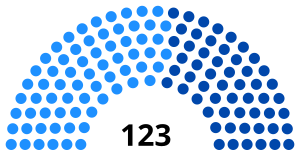
General elections (Khmer : ការបោះឆ្នោតជ្រើសតាំងតំណាងរាស្ត្រ នីតិកាលទី៥ ឆ្នាំ២០១៣) were held in Cambodia on 28 July 2013. [1] The National Election Committee (NEC) announced that some 9.67 million Cambodians were eligible to cast their ballots to elect the 123-seat National Assembly. [2] Voter turnout was reported to be 69.6%, making it the lowest turnout in history. [3] Polling precincts opened 7:00 a.m. and closed at 3:00 p.m. The Cambodian Minister of Information, Khieu Kanharith announced in preliminary results that the Cambodian People's Party won 68 seats and the opposition Cambodia National Rescue Party won all the remaining 55 seats. This election marked the largest seat loss by the Cambodian People's Party to date, and their lowest share of seats since 1998.
Khmer or Cambodian is the language of the Khmer people and the official language of Cambodia. With approximately 16 million speakers, it is the second most widely spoken Austroasiatic language. Khmer has been influenced considerably by Sanskrit and Pali, especially in the royal and religious registers, through Hinduism and Buddhism. The more colloquial registers have influenced, and have been influenced by, Thai, Lao, Vietnamese, and Cham, all of which, due to geographical proximity and long-term cultural contact, form a sprachbund in peninsular Southeast Asia. It is also the earliest recorded and earliest written language of the Mon–Khmer family, predating Mon and by a significant margin Vietnamese, due to Old Khmer being the language of the historical empires of Chenla, Angkor and, presumably, their earlier predecessor state, Funan.
Cambodia, officially the Kingdom of Cambodia, is a country located in the southern portion of the Indochina peninsula in Southeast Asia. It is 181,035 square kilometres in area, bordered by Thailand to the northwest, Laos to the northeast, Vietnam to the east and the Gulf of Thailand to the southwest.

The National Election Committee is an independent agency that supervises the national elections of Cambodia.
The previous parliamentary elections in 2008 were won by the Cambodian People's Party, which managed to secure an absolute majority of the seats: 90 out of 123. Despite winning a parliamentary majority, the CPP chose to form a coalition with the royalist FUNCINPEC, which won 2 seats. The opposition Sam Rainsy Party and Human Rights Party won a combined total of 29 seats. In 2012, the two parties merged to form the Cambodian National Rescue Party. However, party leader Sam Rainsy was barred from running as a candidate because he was not registered to vote. [4] The voter roll was finalised on 31 December 2012, at which time Rainsy was living abroad after being controversially convicted in 2010 of making changes to a map to suggest the country was losing land to neighbouring Vietnam. [5] Rainsy returned to Cambodia in July 2013 after he received a royal pardon from King Norodom Sihamoni, [5] but Rainsy failed to have his name reinstated on the voter roll and was not eligible for candidacy in the election. [4]
The Cambodian People's Party, founded as the Kampuchean People's Revolutionary Party, is the current ruling political party of Cambodia. It was the sole legal party in the country at the time of the People's Republic of Kampuchea (1979–1989) and during the first two years of the State of Cambodia. Its name was changed during the final years of the State of Cambodia, when the single-party system as well as the Marxist–Leninist ideology were abandoned. Having governed Cambodia since 1979, it is one of the longest-ruling parties in the world. The General Secretary of the party from 1979 to 1981 was Pen Sovan. The KPRP was originally a Marxist–Leninist party, although it took on a more reformist outlook in the mid-1980s under Heng Samrin's leadership. In the 1990s, the KPRP officially dropped its commitment to socialist ideology altogether when it renamed itself the Cambodian People's Party. It is also currently the oldest active party in Cambodia. Since 2018, the party commands all 125 seats in the National Assembly, and 58 of 62 seats in the Senate. Hun Sen, the Prime Minister of Cambodia, has served as the party's President since 2015.
FUNCINPEC, National United Front for an Independent, Neutral, Peaceful and Cooperative Cambodia in English, is a royalist political party in Cambodia. Founded in 1981 by Norodom Sihanouk, it started off as a resistance movement against the People's Republic of Kampuchea (PRK) government. In 1982, it formed a resistance pact, the Coalition Government of Democratic Kampuchea (CGDK), together with the Khmer People's National Liberation Front (KPNLF) and the Khmer Rouge. It was one of the signatory parties of the 1991 Paris Peace Accords, which paved the way for the formation of the United Nations Transitional Authority in Cambodia (UNTAC). In 1992, FUNCINPEC became a political party and participated in the 1993 general elections organised by UNTAC. It won the elections, and formed a coalition government with the Cambodian People's Party (CPP), with which it jointly headed. Norodom Ranariddh, Sihanouk's son who had succeeded him as the party president, became First Prime Minister while Hun Sen, who was from the CPP, became Second Prime Minister.

The Human Rights Party or was a Cambodian political party founded on 22 July 2007 led by Kem Sokha. Critics allege that its foundation is meant to weaken opposition parties and is driven by the ruling party. This sentiment, however, seems to be driven by the ruling party themselves as Kem Sokha has long been a very vocal critic of the ruling CPP party.
Cambodia had its first televised debate on 20 and 21 July. The US-funded National Democratic Institute also sponsored nine town hall-style debates with provincial candidates from almost all parties. [6]
The National Democratic Institute (NDI), or National Democratic Institute for International Affairs, is a non-partisan, non-profit organization that works with partners in developing countries to increase the effectiveness of democratic institutions. NDI's core program areas include citizen participation, elections, debates, democratic governance, democracy and technology, political inclusion of marginalized groups, and gender, women and democracy, peace and security, political parties, and youth political participation. The organization's stated mission is to "support and strengthen democratic institutions worldwide through citizen participation, openness and accountability in government."
Since Cambodia had had no official population count for the last five years, the country's population figure is merely guesswork, which has led to incorrect projections of possible voters – making it difficult for the National Election Commission to ascertain the number of actual voters that should be listed in Cambodia's voting rolls. The lack of actual population count could have led to fraudulent voting, such as voters voting in multiple precincts using different names. [7] According to the opposition CNRP, between 1.2 and 1.3 million names were omitted from voting rolls. [8]
Migrant Vietnamese have also allegedly been able to register as voters due to lax identification policies in Cambodia. The opposition Cambodia National Rescue Party played up this anti-Vietnamese rhetoric in campaigning leading up to the election. [9]

The Vietnamese people or the Kinh people, are an ethnic group originating from present-day northern Vietnam. They are the majority ethnic group of Vietnam, comprising 86% of the population at the 1999 census, and are officially known as Kinh to distinguish them from other ethnic groups in Vietnam. The earliest recorded name for the ancient Vietnamese people appears as Lạc.
One of the controversies that beset the Cambodian election before it even began was the use of an ostensibly indelible ink that was used to mark which voters had already voted. [10] The ink had previously been donated by the Indian Embassy in Cambodia. Documentation by poll monitors before the election demonstrated the ink could simply be washed off using bleach or lime juice in minutes upon drying. [9] The ink used could have perhaps allowed voters to vote more than once. [10]
The ruling CPP party received 48.83% of the votes, earned 68 seats, while the CNRP party won 55 seats with 44.46% of the vote. By losing 22 seats from the previous election, the CPP earned the fewest percentage of seats that it has had in the National Assembly since 1998. [8] Other parties, including the Funcinpec Party and League for Democracy Party combined for 0 seats on 6.3% of the vote. [11]
| Party | Votes | % | Seats | +/– | ||||
|---|---|---|---|---|---|---|---|---|
| Cambodian People's Party | 3,235,969 | 48.83 | 68 | –22 | ||||
| Cambodia National Rescue Party | 2,946,176 | 44.46 | 55 | +26 | ||||
| FUNCINPEC | 242,413 | 3.66 | 0 | –2 | ||||
| League for Democracy Party | 68,389 | 1.03 | 0 | 0 | ||||
| Khmer Anti-Poverty Party | 43,222 | 0.65 | 0 | 0 | ||||
| Cambodian Nationality Party | 38,123 | 0.58 | 0 | New | ||||
| Khmer Economic Development Party | 33,715 | 0.51 | 0 | New | ||||
| Democratic Republican Party | 19,152 | 0.29 | 0 | New | ||||
| Invalid/blank votes | 108,085 | – | – | – | ||||
| Total | 6,735,244 | 100 | 123 | 0 | ||||
| Registered voters/turnout | 9,675,453 | 69.61 | – | – | ||||
| Source: COMFREL | ||||||||
| ↓ | ||||
The CPP claimed victory in the election. [12] The E.U. and U.S. expressed concern for the concern about possible irregularities, with the latter's State Department Spokeswoman Jen Psaki saying that "we call for a transparent and full investigation of all credible reports of irregularities. We urge all parties and their supporters to continue to act in an orderly and peaceful manner in the post-election period." [13] Vietnam congratulated Cambodia on the success of its 5th General Elections. [14] French Prime Minister Jean-Marc Ayrault and Australian Prime Minister Tony Abbott sent their letter of endorsement, congratulating Hun Sen on his election win. [15]
Though there were claims that the election would be "worthless" even before voting started, [12] after the election, there were complaints of election fraud. Sam Rainsy, the leader of the CNRP, declared that "We will not accept the result – we cannot accept the result...The party in power cannot ignore us anymore." [8] The international non-governmental organisation Human Rights Watch (HRW) issued a statement that read that "the ruling Cambodian People's Party (CPP) appears to have been involved in electoral fraud" and called for an "independent commission" to investigate "allegations of election fraud and other irregularities, including bias in the election machinery". [7] Brad Adams, HRW's Asia Director, further stated that some of the fraud consisted of "senior ruling party officials appear to have been involved in issuing fake election documents and fraudulently registering voters in multiple provinces." [7] The Cambodian government denied calls by international organisations for an independent election review, [16] while the government rejected calls for a review [13] and the National Election Committee (NEC) denied irregularities. There were also claims of voter intimidation as the ruling party controlled the apparatus of state control. [12]
Thousands of CNRP supporters gathered in Phnom Penh in September to protest the results. [17]
Hun Sen is a Cambodian politician and the Prime Minister of Cambodia, President of the Cambodian People's Party (CPP) and Member of Parliament (MP) for Kandal. He has served as Prime Minister since 1985, making him the world’s longest-serving prime minister, the longest-serving head of government of Cambodia and one of the longest-serving leaders in the world. From 1979 to 1986 and again from 1987 to 1990, Hun Sen also served as Cambodia's foreign minister. His full honorary title is Samdech Akka Moha Sena Padei Techo Hun Sen. Born Hun Bunal, he changed his name to Hun Sen in 1972 two years after joining the Khmer Rouge.
Kampong Cham is a province (khaet) of Cambodia located on the central lowlands of the Mekong River. It borders the provinces of Kampong Chhnang to the west, Kampong Thom and Kratié to the north, Tbong Khmum to the east, and Prey Veng and Kandal to the south. Kampong Cham was officially divided into two provinces on 31 December 2013 in what was seen by many as a political move by the ruling party. All land west of the Mekong remained Kampong Cham while land east of the river became Tbong Khmum province. Prior to this division, Kampong Cham extended eastward to the international border with Vietnam, was the eleventh largest province in Cambodia, and with a population of 1,680,694, was the most populous province in Cambodia. Its capital and largest city is Kampong Cham.

The Candlelight Party is a personalist liberal party in Cambodia. The party was a member of the Council of Asian Liberals and Democrats, Liberal International, and the Alliance of Democrats.
Norodom Ranariddh is a Cambodian royal politician and law academic. He is the second son of Norodom Sihanouk of Cambodia and a half-brother of the current king, Norodom Sihamoni. Ranariddh is the president of FUNCINPEC, a Cambodian royalist party. He was also the First Prime Minister of Cambodia following the restoration of the monarchy, serving between 1993 and 1997, and subsequently as the President of the National Assembly between 1998 and 2006.
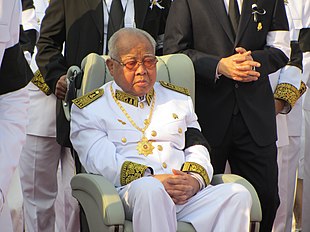
Chea Sim was a Cambodian politician. He was President of the Cambodian People's Party from 1991 to 2015, President of the National Assembly of Cambodia from 1981 to 1998 and President of the Senate from 1999 to 2015. His official title was Samdach Akeak Moha Thomak Pothisal Chea Sim, Protean Protsaphea ney Preah Reacheanachak Kampuchea.
Cambodia is a one party dominant state with the Cambodian People's Party in power. Cambodia's legislature is chosen through a national election. The general election is held every five years in the fourth Sunday of July. The Parliament of Cambodia has two chambers. The National Assembly of Cambodia has 125 members, each elected for a five-year term by proportional representation. The Senate has 62 members, mostly indirectly elected.
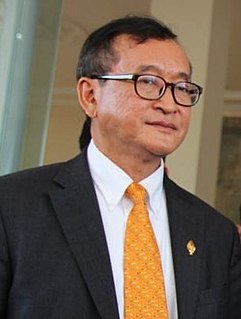
Sam Rainsy is a Cambodian activist and politician who most recently served as the Leader of the Opposition. He is now the president of the Cambodia National Rescue Movement (CNRM), launched in January 2018. He was a Member of Parliament (MP) for Kampong Cham, first from 1998 until 2005, then from 2008 to 2011, and finally from 2014 until 2015; he has been revoked of parliamentary immunity three times. He was previously the MP for Siem Reap from 1993 until 1995 when he was expelled from the Constituent Assembly. A co-founder of the Cambodia National Rescue Party (CNRP), Rainsy was previously a member of the royalist Funcinpec Party and served as the Minister of Economy and Finance during Norodom Ranariddh's administration from 1993 until his sacking in 1994. In June 1995, he was expelled from the National Assembly, and formed the Khmer Nation Party (KNP), which changed its name before the 1998 elections to the Sam Rainsy Party (SRP) to avoid registration issues. From 2000 to 2002 and again from 2012 to 2014, Rainsy was the chairperson of the Council of Asian Liberals and Democrats.
Sar Kheng is a Cambodian politician. One of the highest-ranking members of the ruling Cambodian People's Party, he is the current Minister of the Interior and has served as a Deputy Prime Minister since 1992. He also represents the province of Battambang in the Cambodian Parliament. Kheng has been the Minister of the Interior since 1992. Until March 2006, he shared the position with FUNCINPEC party member You Hockry as co-Ministers of the Interior, but then became sole interior minister in a cabinet reshuffle as FUNCINPEC ended its coalition with the CPP. He is currently the second longest serving government minister of Cambodia after Prime Minister Hun Sen. On June 14, 2015, King Norodom Sihamoni awarded Kheng the honorary title of "Samdech". His official title is "Samdech Kralahom Sar Kheng". Kheng is married to Nhem Sakhan with whom he has three children.
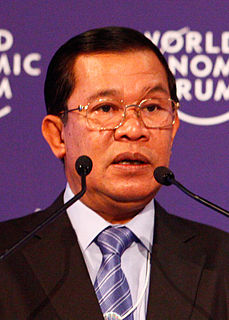
General elections were held in Cambodia on 27 July 2003 to elect members of the National Assembly. The elections were won by the ruling Cambodian People's Party, which won a majority of 73 seats in the 123-seat parliament. However, due to the requirement for a two-thirds majority to elect a Prime Minister, a new government was not formed until July 2004 when a deal was reached with the FUNCINPEC party. Hun Sen was subsequently re-elected the post of Prime Minister.
General elections were held in Cambodia on 27 July 2008. The result was a victory for the ruling Cambodian People's Party, which won 90 of the 123 seats.
The Norodom Ranariddh Party is a Cambodian political party created by Prince Norodom Ranariddh, who has left the Royalist FUNCINPEC party of which he was previously leader/chairman.
The 1997 clashes in Cambodia, also referred to as the 1997 coup in Cambodia, took place in Cambodia in July to September 1997. As a result, co-premier Hun Sen ousted the other co-premier Norodom Ranariddh. Dozens of people were killed during the conflict.
General elections were held in Cambodia on 26 July 1998. The result was a victory for the Cambodian People's Party (CPP), which won 64 of the 122 seats, resulting in its leader Hun Sen becoming Prime Minister. Opposition parties sought a recount and claimed there had been irregularities, claims supported by many international observers. Voter turnout was 93.7%.
Early general elections were held in Jordan on 23 January 2013. Voter turnout was reported to be 56.6%.

The Cambodia National Rescue Party, commonly abbreviated as CNRP, was a major political party in Cambodia. It was founded in 2012 as a merger between the Sam Rainsy Party and Human Rights Party.
Anti-government protests were ongoing in Cambodia from July 2013 to July 2014. Popular demonstrations in Phnom Penh have taken place against the government of Prime Minister Hun Sen, triggered by widespread allegations of electoral fraud during the Cambodian general election of 2013. Demands to raise the minimum wage to $160 a month and resentment at Vietnamese influence in Cambodia have also contributed to the protests. The main opposition party refused to participate in parliament after the elections, and major demonstrations took place throughout December 2013. A government crackdown in January 2014 led to the deaths of 4 people and the clearing of the main protest camp.
Tboung Khmum, officially Tbong Khmum, is a province (khaet) of Cambodia located on the central lowlands of the Mekong River. It borders the provinces of Kampong Cham to the west, Kratié to the north, Prey Veng to the south, and shares an international border with Vietnam to the east. Its capital and largest city is Suong. The province's name consists of two words in Khmer, tboung and khmum (bee), which together mean "amber".
The Community of Royalist People's Party was a Cambodian political party that lasted from March 2014 until January 2015. It was founded and led by Norodom Ranariddh, who had been ousted from FUNCINPEC back in 2006. Ideologically a royalist party, the CRPP drew its inspiration from the political legacy of the former King of Cambodia, Norodom Sihanouk, and competed for its voter base with both FUNCINPEC and the Cambodia National Rescue Party (CNRP). In January 2015, the CRPP was dissolved when Ranariddh returned to FUNCINPEC.
General elections were held in Cambodia on Sunday, 29 July 2018 to elect members of the sixth National Assembly. Polling stations opened at 07:00 and closed at 15:00. The number of registered voters has decreased for the first time since 1993 and was down 13% from the 2013 general elections.
| Wikimedia Commons has media related to Cambodian general election, 2013 . |