Cambodian general election, 1993

Last updated
Cambodian general election, 1993
Flag of Cambodia.svg
  1981 23 & 28 May 1993 1998  

All 120 seats to the Constituent Assembly
61 seats needed for a majority
Registered4,764,618
Turnout4,267,192 (89.6%)
 First partySecond partyThird party
  Ranariddh 1990s.jpg Hun Sen.jpg Camdodian Prime Minister Son Sann.November 1967.jpg
Leader Norodom Ranariddh Hun Sen Son Sann
Party FUNCINPEC CPP BLDP
Leader sinceFebruary 199214 January 1985January 1993
Leader's seat Phnom Penh Kampong Cham Phnom Penh
Seats before000
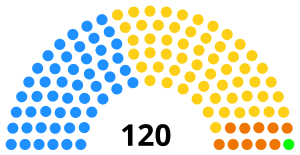
Seats won585110
Seat changeIncrease2.svg 58Increase2.svg 51Increase2.svg 10
Popular vote1,824,1881,533,471152,764
Percentage45.5%38.2%3.8%
SwingIncrease2.svg 45.5%Increase2.svg 38.2%Increase2.svg 3.8%

Cambodia election map 1993.png

Prime Minister before election

Hun Sen
CPP

Elected Prime Minister

Norodom Ranariddh
FUNCINPEC

Royal arms of Cambodia.svg
This article is part of a series on the
politics and government of
Cambodia
Foreign relations

General elections were held in Cambodia between 23 and 28 May 1993. The result was a hung parliament with the FUNCINPEC Party being the largest party with 58 seats. Voter turnout was 89.56%. [1] The elections were conducted by the United Nations Transitional Authority in Cambodia (UNTAC), which also maintained peacekeeping troops in Cambodia throughout the election and the period after it. [2]

Cambodia Southeast Asian sovereign state

Cambodia, officially the Kingdom of Cambodia, is a country located in the southern portion of the Indochina peninsula in Southeast Asia. It is 181,035 square kilometres in area, bordered by Thailand to the northwest, Laos to the northeast, Vietnam to the east and the Gulf of Thailand to the southwest.

A hung parliament is a term used in legislatures under the Westminster system to describe a situation in which no particular political party or pre-existing coalition has an absolute majority of legislators in a parliament or other legislature. This situation is also known, albeit less commonly, as a balanced parliament, or as a legislature under no overall control, and can result in a minority government. The term is not relevant in multi-party systems where it is rare for a single party to hold a majority.

United Nations Transitional Authority in Cambodia UN peacekeeping mission to implement Cambodian-Vietnamese peace

The United Nations Transitional Authority in Cambodia (UNTAC) was a United Nations peacekeeping operation in Cambodia in 1992–93 formed following the 1991 Paris Peace Accords. It was also the first occasion on which the UN had taken over the administration of an independent state, organised and run an election, had its own radio station and jail, and been responsible for promoting and safeguarding human rights at the national level.

Contents

They remain the last elections won by a party other than the Cambodian People's Party, which began to dominate Cambodian politics from 1998.

Cambodian Peoples Party Cambodian political party

The Cambodian People's Party, founded as the Kampuchean People's Revolutionary Party, is the current ruling political party of Cambodia. It was the sole legal party in the country at the time of the People's Republic of Kampuchea (1979–1989) and during the first two years of the State of Cambodia. Its name was changed during the final years of the State of Cambodia, when the single-party system as well as the Marxist–Leninist ideology were abandoned. Having governed Cambodia since 1979, it is one of the longest-ruling parties in the world. The General Secretary of the party from 1979 to 1981 was Pen Sovan. The KPRP was originally a Marxist–Leninist party, although it took on a more reformist outlook in the mid-1980s under Heng Samrin's leadership. In the 1990s, the KPRP officially dropped its commitment to socialist ideology altogether when it renamed itself the Cambodian People's Party. It is also currently the oldest active party in Cambodia. Since 2018, the party commands all 125 seats in the National Assembly, and 58 of 62 seats in the Senate. Hun Sen, the Prime Minister of Cambodia, has served as the party's President since 2015.

Background

The State of Cambodia (SOC) and three warring factions of the Cambodian resistance consisting of FUNCINPEC, Khmer Rouge and Khmer People's National Liberation Front (KPNLF) signed the Paris Peace Accords in October 1991. The accords provides for the establishment of the UNTAC, a United Nations-led interim administration that would supervise the demobilization of troops from the SOC and the three warring factions, and also conduct democratic elections 1993. [3] The UNTAC was formed at the end of February 1992, and Yasushi Akashi was appointed as head of the UNTAC. [4]

FUNCINPEC political party

FUNCINPEC, National United Front for an Independent, Neutral, Peaceful and Cooperative Cambodia in English, is a royalist political party in Cambodia. Founded in 1981 by Norodom Sihanouk, it started off as a resistance movement against the People's Republic of Kampuchea (PRK) government. In 1982, it formed a resistance pact, the Coalition Government of Democratic Kampuchea (CGDK), together with the Khmer People's National Liberation Front (KPNLF) and the Khmer Rouge. It was one of the signatory parties of the 1991 Paris Peace Accords, which paved the way for the formation of the United Nations Transitional Authority in Cambodia (UNTAC). In 1992, FUNCINPEC became a political party and participated in the 1993 general elections organised by UNTAC. It won the elections, and formed a coalition government with the Cambodian People's Party (CPP), with which it jointly headed. Norodom Ranariddh, Sihanouk's son who had succeeded him as the party president, became First Prime Minister while Hun Sen, who was from the CPP, became Second Prime Minister.

Khmer Rouge followers of the Communist Party of Kampuchea in Cambodia

The Khmer Rouge was the name popularly given to the followers of the Communist Party of Kampuchea (CPK) and by extension to the regime through which the CPK ruled in Cambodia between 1975 and 1979. The name had originally been used in the 1950s by Norodom Sihanouk as a blanket term for the Cambodian left.

Khmer Peoples National Liberation Front

The Khmer People's National Liberation Front was a political front organized in 1979 in opposition to the Vietnamese-installed People's Republic of Kampuchea (PRK) regime in Cambodia. The 200,000 Vietnamese troops supporting the PRK, as well as Khmer Rouge defectors, had ousted the brutal Democratic Kampuchea regime of Pol Pot, and were initially welcomed by the majority of Cambodians as liberators. Some Khmer, though, recalled the two countries' historical rivalry and feared that the Vietnamese would attempt to subjugate the country, and began to oppose their military presence. Members of the KPNLF supported this view.

In August 1992, the UNTAC administration promulgated the election law, [5] and conducted the provisional registration of political parties. Political parties that were registered were allowed to open party offices the following month. [6] The following year in January 1993, registration of electorate was carried out, and UNTAC identity cards were issued. [7] The UNTAC conducted a civic education campaign in February 1993, [8] and two months later the UNTAC allowed political parties to hold public meetings and rallies to campaign for votes. [9]

Pre-election challenges

Demobilisation

When UN peacekeepers were sent in to commence on demobilisation in June 1992, the Khmer Rouge set up road blocks in territories under their control to prevent peacekeepers from entering. [10] When the incidents were reported to the then-UN secretary-general Boutros Boutros-Ghali, he sent a personal appeal to Khieu Samphan to let peacekeepers conduct demobilisation. The Khmer Rouge leadership responded by demanding that day-to-day administration should be handed over an administrative body headed by Norodom Sihanouk, and also alleged that continued presence of Vietnamese troops in Cambodia did not warrant demobilisation. As the Khmer Rouge insisted on not participating in demobilisation, Sihanouk called on the UNTAC to isolate the Khmer Rouge from participating in any future peace-making initiatives. [11]

Boutros Boutros-Ghali 6th Secretary-General of the United Nations

Boutros Boutros-Ghali was an Egyptian politician and diplomat who was the sixth Secretary-General of the United Nations (UN) from January 1992 to December 1996. An academic and former Vice Foreign Minister of Egypt, Boutros-Ghali oversaw the UN at a time when it dealt with several world crises, including the breakup of Yugoslavia and the Rwandan genocide. He was then the first Secretary-General of the Organisation internationale de la Francophonie from 16 November 1997 to 31 December 2002.

Khieu Samphan Cambodian war criminal

Khieu Samphan is a former Cambodian communist politician who was the chairman of the state presidium of Democratic Kampuchea (Cambodia) from 1976 until 1979. As such, he served as Cambodia's head of state and was one of the most powerful officials in the Khmer Rouge movement, although Pol Pot remained the General Secretary in the party. Khieu Samphan is the second oldest living former Khmer Rouge leader, alongside Nuon Chea. On 7 August 2014, they were convicted and received life sentences for crimes against humanity during the Cambodian Genocide, and a further trial found him guilty of genocide in 2018.

Norodom Sihanouk Cambodian King

Norodom Sihanouk was a Cambodian royal, politician, composer and filmmaker who was twice the King of Cambodia. He was the son of King Norodom Suramarit and Queen Sisowath Kossamak. In Cambodia, he is also known as Samdech Euv.

The Cambodian People's Armed Forces (CPAF), Armee Nationale Sihanoukiste (ANS, also informally known as the FUNCINPEC army) and Khmer People's National Liberation Front participated in the mobilisation exercises, although young and untrained recruits were sent to participate while non-servicing weapons were presented to the peacekeeping troops. [12] When the Khmer Rouge continued to resist demobilisation efforts, UNTAC decided to suspend the entire mobilisation exercise in September 1992, during which about 50,000 soldiers from the CPAF, ANS and KPNLF have disarmed. [13]

Violent attacks

The Khmer Rouge started to carry out a series of attacks on Vietnamese civilians from April 1992, [14] which they justified by claiming that there were Vietnamese soldiers disguised as civilians. [15] In March 1993, the Khmer Rouge carried out the largest attack on Vietnamese civilians in the floating village of Chong Kneas in Siem Reap Province which claimed the lives of 124 Vietnamese civilians. The Khmer Rouge had provided tacit forewarning prior to the attack, [16] but neither SOC troops not UNTAC peacekeepers were deployed. When the attack was published in the press, it triggered about 20,000 Vietnamese to flee to Vietnam the following month in April 1993. [17]

The CPAF also carried out clandestine attacks on the party offices belonging to FUNCINPEC and BLDP starting in November 1992. The attacks were carried out at night, and soldiers would fire grenades or rockets. The number of incidents were reduced in January 1993, but picked up again in March 1993 until the eve of elections in May 1993. [18] The attacks left about 200 political workers killed or injured by May 1993. [19]

Results

The voting process was carried out between 23 and 28 May 1993. [20] Most of the voting stations were based in school buildings and Buddhist pagodas to reduce costs. The election was staffed by some 50,000 Cambodians and 900 international volunteers as well as an additional 1,400 United Nation officers which served as polling station observers. [21] The counting of votes started on 29 May and lasted until 10 June. The results were declared by Akashi, and five days later the UN security council endorsed the election results with Security Council Resolution 840. [22]

Cambodian National Assembly composition, 1993-1998.svg
PartyVotes%Seats
FUNCINPEC 1,824,18845.558
Cambodian People's Party 1,533,47138.251
Buddhist Liberal Democratic Party 152,7643.810
Liberal Democratic Party 62,6981.60
MOULINAKA 55,1071.41
Khmer Neutral Party 48,1131.20
PD41,7991.00
Free Independent Democracy Party37,4740.90
Free Republican Party31,3480.80
Liberal Reconciliation Party29,7380.70
Cambodge Renaissance Party28,0710.70
Republican Coalition Party27,6800.70
Khmer National Congress Party25,7510.60
Neutral Democratic Party of Cambodia24,3940.60
Khmer Farmer Liberal Democracy20,7760.50
Free Development Republican Party20,4250.50
Rally for National Solidarity14,5690.40
Action for Democracy and Development13,9140.40
Republican Democracy Khmer Party11,5240.30
Nationalist Khmer Party7,8270.20
Invalid/blank votes255,561
Total4,267,192100120
Registered voters/turnout4,764,61889.56
Source: Nohlen et al. [23]

Aftermath

On 31 May 1993, the CPP to file a complaint with Akashi over claims of irregularities in the elections. When Akashi dismissed CPP's complaints, Hun Sen and Chea Sim suggested to Sihanouk to assume full executive powers as the Head of State of the country. [1] Sihanouk accepted the initiative, and issued a declaration on 3 June that he would assume the position as the Head of State of Cambodia. The ministries would be divided between FUNCINPEC and CPP on a fifty-fifty basis. FUNCINPEC president Ranariddh, as well as several countries including the United States, United Kingdom, Australia and China opposed the initiative. The US charged that Sihanouk's initiative would violate the spirit of the election as well as the terms set in the Paris Peace Accords. The following day, Sihanouk abandoned the initiative to assume full executive powers. [24]

One week later on 10 June, Hun Sen announced that seven eastern provinces, all bordering Vietnam had seceded from Cambodia under the leadership of then-Deputy Prime Minister Norodom Chakrapong and then-Interior Minister Sin Song. Hun Sen avoided supporting the secession attempt publicly, but accused the United Nations of creating electoral fraud to precipitate CPP's defeat in the election. Chakrapong and Sin Song attacked political offices belonging to FUNCINPEC and BLDP in the provinces, and also issued orders for UNTAC officials to leave the provinces under their control. An emergency National Assembly meeting was initiated on 14 June where Sihanouk was re-instated as the Head of State, with Ranariddh and Hun Sen appointed as co-prime ministers with equal levels of executive powers. [25] When Hun Sen issued a letter to Akashi to declare his support for continued UNTAC's interim administration, Chakrapong and Sin Song dropped the secessionist threats. [26] For the next three months, Sihanouk presided over an interim administration his resignation on 21 September, and he re-assumed the office of the King of Cambodia two days later on 23 September 1993. [27]

Related Research Articles

Politics of Cambodia

The Kingdom of Cambodia is a unitary state that is governed within the framework of a constitutional monarchy, in which the monarch serves as the head of state, while the prime minister is the head of government. The collapse of the Soviet Union in 1989 had set in motion events that led to withdrawal of the Vietnamese armed forces that had established their presence in the country since the fall of the Khmer Rouge in 1979. The 1993 constitution, which is currently in force, was promulgated as a result of the 1991 Paris Peace Agreements, followed by the elections organized under the aegis of the United Nations Transitional Authority in Cambodia. The constitution proclaims a liberal, multiparty democracy in which powers are devolved to the three arms of the state: the executive, the judiciary and the legislature. Furthermore, the governing charter declares Cambodia to be an "independent, sovereign, peaceful, permanently neutral and non-aligned State."

After the fall of the Pol Pot regime of Democratic Kampuchea, Cambodia was under Vietnamese occupation and a pro-Hanoi government, the People's Republic of Kampuchea was established. A civil war raged during the 1980s opposing the government's Kampuchean People's Revolutionary Armed Forces against the Coalition Government of Democratic Kampuchea, a government in exile composed of three Cambodian political factions: Prince Norodom Sihanouk's Funcinpec party, the Party of Democratic Kampuchea and the Khmer People's National Liberation Front (KPNLF).

Hun Sen Prime Minister of Cambodia

Hun Sen is a Cambodian politician and the Prime Minister of Cambodia, President of the Cambodian People's Party (CPP) and Member of Parliament (MP) for Kandal. He has served as Prime Minister since 1985, making him the world’s longest-serving prime minister, the longest-serving head of government of Cambodia and one of the longest-serving leaders in the world. From 1979 to 1986 and again from 1987 to 1990, Hun Sen also served as Cambodia's foreign minister. His full honorary title is Samdech Akka Moha Sena Padei Techo Hun Sen. Born Hun Bunal, he changed his name to Hun Sen in 1972 two years after joining the Khmer Rouge.

Son Sen Cambodian politician

Son Sen, alias Comrade Khieu (សមមិត្តខៀវ), was a Cambodian Communist politician and soldier. A member of the Central Committee of the Communist Party of Kampuchea/Party of Democratic Kampuchea, the Khmer Rouge, from 1974 to 1992, Sen oversaw the Party's security apparatus, including the Santebal secret police and the notorious security prison S-21 at Tuol Sleng.

Norodom Ranariddh 20th and 21st-century Cambodian politician

Norodom Ranariddh is a Cambodian royal politician and law academic. He is the second son of Norodom Sihanouk of Cambodia and a half-brother of the current king, Norodom Sihamoni. Ranariddh is the president of FUNCINPEC, a Cambodian royalist party. He was also the First Prime Minister of Cambodia following the restoration of the monarchy, serving between 1993 and 1997, and subsequently as the President of the National Assembly between 1998 and 2006.
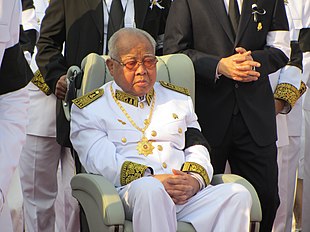
Chea Sim Cambodian politician

Chea Sim was a Cambodian politician. He was President of the Cambodian People's Party from 1991 to 2015, President of the National Assembly of Cambodia from 1981 to 1998 and President of the Senate from 1999 to 2015. His official title was Samdach Akeak Moha Thomak Pothisal Chea Sim, Protean Protsaphea ney Preah Reacheanachak Kampuchea.

Norodom Chakrapong Cambodian prince

Norodom Chakrapong is a Cambodian royal politician, businessman and former major-general of the Royal Cambodian Armed Forces. He is the fourth son of Norodom Sihanouk of Cambodia and also a half-brother of the current king, Norodom Sihamoni. Chakrapong started his career as a military pilot in 1963. After Sihanouk was overthrown in 1970, Chakrapong spent time under house arrest, then in Beijing as the Head of Protocol of then-Prince Sihanouk, afterwards living overseas before he joined the Funcinpec in 1981 and fought against Vietnamese occupation as a commander of the Armée Nationale Sihanoukiste. In 1991, Chakrapong left Funcinpec to join the Cambodian People's Party (CPP) and served as the Deputy Prime Minister of Cambodia between 1992 and 1993. When the CPP lost the 1993 general elections, Chakrapong led a secession attempt in 1993. In 1994, he was accused of joining a failed coup attempt which led him to be sent into exile. After Chakrapong was pardoned in 1998, he founded a private airline company, Royal Phnom Penh Airways. The airlines later stopped all operations in early 2006.
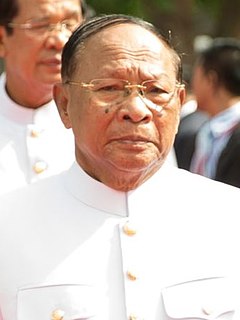
Heng Samrin Cambodian politician

Heng Samrin is a Cambodian politician who was the de facto leader of the Hanoi-backed People's Republic of Kampuchea from 1979 to 1981 and General Secretary of the Kampuchean People's Revolutionary Party from 1981 to 1991. He has been the President of the National Assembly of Cambodia since 2006; he is also Honorary President of the Cambodian People's Party (CPP) and a Member of Parliament for Tboung Khmum Province. Heng Samrin is Cambodia's oldest parliamentarian, at 84 years of age. His honorary title is "Samdech Akeak Moha Ponhea Chakrei Heng Samrin".

Cambodian–Vietnamese War 1977–1991 war between Cambodia and Vietnam

The Cambodian–Vietnamese War, otherwise known in Vietnam as the Counter-offensive on the Southwestern border, was an armed conflict between the Socialist Republic of Vietnam and Democratic Kampuchea. The war began with isolated clashes along the land and maritime boundaries of Vietnam and Kampuchea between 1975 and 1978, occasionally involving division-sized military formations. On 25 December 1978, Vietnam launched a full-scale invasion of Kampuchea and subsequently occupied the country and removed the Communist Party of Kampuchea government from power.

Sar Kheng Cambodian Minister of the Interior

Sar Kheng is a Cambodian politician. One of the highest-ranking members of the ruling Cambodian People's Party, he is the current Minister of the Interior and has served as a Deputy Prime Minister since 1992. He also represents the province of Battambang in the Cambodian Parliament. Kheng has been the Minister of the Interior since 1992. Until March 2006, he shared the position with FUNCINPEC party member You Hockry as co-Ministers of the Interior, but then became sole interior minister in a cabinet reshuffle as FUNCINPEC ended its coalition with the CPP. He is currently the second longest serving government minister of Cambodia after Prime Minister Hun Sen. On June 14, 2015, King Norodom Sihamoni awarded Kheng the honorary title of "Samdech". His official title is "Samdech Kralahom Sar Kheng". Kheng is married to Nhem Sakhan with whom he has three children.

Royal Cambodian Armed Forces combined military forces of Cambodia

The Royal Cambodian Armed Forces (RCAF) is the national military forces of Cambodia. The Supreme Commander-in-Chief is HM King Norodom Sihamoni, Since 2018 General Vong Piseng is the Commander in Chief of the RCAF as head of the Army, Navy, Air Force and the Gendarmerie.

FCU UNTAC

FCU – UNTAC, the Force Communications Unit UNTAC, was the Australian component of the UNTAC mission in Cambodia.

Vietnamese Cambodians Ethnic Kinh people in Cambodia

Vietnamese Cambodians refer to ethnic Vietnamese living in Cambodia. According to the news said in 2013 there are 15,000 Vietnamese people living in Cambodia. They mostly reside in southeastern parts of Cambodia bordering Vietnam or on boathouses in the Tonlé Sap lake and Mekong rivers. The first Vietnamese came to settle modern-day Cambodia from the early 19th century during the era of the Nguyễn lords, and most of the Vietnamese came to Cambodia during the periods of French colonial administration and the People's Republic of Kampuchea administration. During the Khmer Republic and Khmer Rouge governments in the 1970s, the Vietnamese were targets of mass genocides; thousands of Vietnamese were killed and many more sought refuge in Vietnam. Ethnic relations between the Khmers and Vietnamese are poor, and the Vietnamese have been the main target of xenophobic attacks by political parties since the 1990s. Most of the Vietnamese are stateless residents of Cambodia, and as a result they face difficulties in getting access to education, employment and housing.

1997 clashes in Cambodia

The 1997 clashes in Cambodia, also referred to as the 1997 coup in Cambodia, took place in Cambodia in July to September 1997. As a result, co-premier Hun Sen ousted the other co-premier Norodom Ranariddh. Dozens of people were killed during the conflict.

United Nations Security Council resolution 792, adopted on 30 November 1992, after recalling resolutions 668 (1990), 717 (1991), 718 (1991), 728 (1992), 745 (1992), 766 (1992) and 783 (1992) noting a report by the Secretary-General Boutros Boutros-Ghali, the Council concerned itself with preparations for the 1993 elections in Cambodia by the United Nations Transitional Authority in Cambodia (UNTAC) while condemning the refusal of the Party of Democratic Kampuchea to co-operate.

The Cambodian Constituent Assembly was a body elected in 1993 to draft a constitution for Cambodia as provided in the Paris Peace Accord. The writing of the Cambodian Constitution took place between June and September 1993 and it resulted in the transformation of the political situation of Cambodia from civil-war-marred, autocratic oligarchy to a Constitutional Monarchy. Achieved under the guidance, auspices and funding of the United Nations Transitional Authority in Cambodia (UNTAC), the drafting of the constitution was the culmination of a larger, $1.6 billion effort to end the decades-old Cambodian Civil War and bring the warring parties into political, rather than military competition. The result of the process was the creation of a constitution for Cambodia that, at least on paper, guarantees free political competition, regular elections, equal rights and representation and universal suffrage.

References

  1. 1 2 Widyono (2008), p. 124
  2. UN Security Council Practices and Charter Research Branch (1995), p. 598
  3. Widyono (2008), p. 35
  4. Widyono (2008), p. 5
  5. Widyono (2008), p. 95
  6. Widyono (2008), p. 116
  7. Widyono (2008), p. 115
  8. Widyono (2008), p. 117
  9. Widyono (2008), p. 118
  10. Widyono (2008), p. 77
  11. Widyono (2008), pp. 84–5
  12. Widyono (2008), p. 76
  13. Widyono (2008), p. 78
  14. Ben Kiernan (20 November 1992). "COMMENT: U.N.'s Appeasement Policy Falls into Hands of Khmer Rouge Strategists". Phnom Penh Post. Retrieved 8 March 2015.
  15. Heder et al. (1995), p. 98
  16. Widyono (2008), p. 96
  17. Widyono (2008), pp. 97–8
  18. Heder et al. (1995), p. 170
  19. Heder et al. (1995), p. 196
  20. Widyono (2008), p. 119
  21. Widyono (2008), p. 120
  22. Widyono (2008), p. 127
  23. Nohlen et al. (2001), p. 70
  24. Widyono (2008), p. 126
  25. Widyono (2008), pp. 128–9
  26. Ker Munthit (18 June 1993). "Chakrapong-led Secession Collapses". Phnom Penh Post. Retrieved 12 March 2015.
  27. Widyono (2008), p. 130

Bibliography

Books

Reports