Sam Rainsy Party គណបក្ស សម រង្ស៊ី Kanakpak Sam Rainsy | |
|---|---|
| |
| Leader | Kong Korm [1] |
| Founder | Sam Rainsy |
| Founded | June 1995 |
| Headquarters | Phnom Penh, Cambodia |
| Ideology | Khmer nationalism Liberal democracy Populism |
| Political position | Centre |
| Regional affiliation | Council of Asian Liberals and Democrats |
| International affiliation | Liberal International |
| Website | |
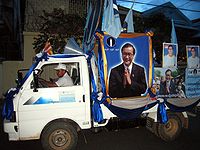
The Sam Rainsy Party (Khmer: គណបក្ស សម រង្ស៊ី; SRP) is a personalist liberal party in Cambodia. The party was a member of the Council of Asian Liberals and Democrats, Liberal International, and the Alliance of Democrats.
Khmer or Cambodian is the language of the Khmer people and the official language of Cambodia. With approximately 16 million speakers, it is the second most widely spoken Austroasiatic language. Khmer has been influenced considerably by Sanskrit and Pali, especially in the royal and religious registers, through Hinduism and Buddhism. The more colloquial registers have influenced, and have been influenced by, Thai, Lao, Vietnamese, and Cham, all of which, due to geographical proximity and long-term cultural contact, form a sprachbund in peninsular Southeast Asia. It is also the earliest recorded and earliest written language of the Mon–Khmer family, predating Mon and by a significant margin Vietnamese, due to Old Khmer being the language of the historical empires of Chenla, Angkor and, presumably, their earlier predecessor state, Funan.
Personalism is a philosophical school of thought searching to describe the uniqueness of 1) God as Supreme Person or 2) a human person in the world of nature, specifically in relation to animals. One of the main points of interest of personalism is human subjectivity or self-consciousness, experienced in a person's own acts and inner happenings—in "everything in the human being that is internal, whereby each human being is an eyewitness of its own self".
Cambodia, officially the Kingdom of Cambodia, is a country located in the southern portion of the Indochina peninsula in Southeast Asia. It is 181,035 square kilometres in area, bordered by Thailand to the northwest, Laos to the northeast, Vietnam to the east and the Gulf of Thailand to the southwest. The sovereign state of Cambodia has a population of over 16 million. The official religion is Theravada Buddhism, practised by approximately 95 percent of the population. The country's minority groups include Vietnamese, Chinese, Chams and 30 hill tribes. The capital and largest city is Phnom Penh, the political, economic and cultural centre of Cambodia. The kingdom is an elective constitutional monarchy with a monarch, currently Norodom Sihamoni, chosen by the Royal Throne Council as head of state. The head of government is the Prime Minister, currently Hun Sen, the longest serving non-royal leader in Southeast Asia, ruling Cambodia since 1985. In 802 AD, Jayavarman II declared himself king, uniting the warring Khmer princes of Chenla under the name "Kambuja". This marked the beginning of the Khmer Empire, which flourished for over 600 years, allowing successive kings to control and exert influence over much of Southeast Asia and accumulate immense power and wealth. The Indianised kingdom facilitated the spread of first Hinduism and then Buddhism to much of Southeast Asia and undertook many religious infrastructural projects throughout the region, including the construction of more than 1,000 temples and monuments in Angkor alone. Angkor Wat is the most famous of these structures and is designated as a World Heritage Site. After the fall of Angkor to Ayutthaya in the 15th century, a reduced and weakened Cambodia was then ruled as a vassal state by its neighbours. In 1863, Cambodia became a protectorate of France, which doubled the size of the country by reclaiming the north and west from Thailand.
The Sam Rainsy Party, founded in 1995 as the Khmer Nation Party and given its current name in 1998, constitutes the official opposition to the ruling Cambodian People's Party. Since the decline of the junior coalition partner, Funcinpec, in the 2008 National Assembly elections, the Sam Rainsy Party is now considered the second largest party in Cambodia. It is the largest opposition party in Cambodia.
The Cambodian People's Party, founded as the Kampuchean People's Revolutionary Party, is the current ruling political party of Cambodia. It was the sole legal party in the country at the time of the People's Republic of Kampuchea (1979–1989) and during the first two years of the State of Cambodia. Its name was changed during the final years of the State of Cambodia, when the single-party system as well as the Marxist–Leninist ideology were abandoned. Having governed Cambodia since 1979, it is one of the longest-ruling parties in the world. The General Secretary of the party from 1979 to 1981 was Pen Sovan. The KPRP was originally a Marxist–Leninist party, although it took on a more reformist outlook in the mid-1980s under Heng Samrin's leadership. In the 1990s, the KPRP officially dropped its commitment to socialist ideology altogether when it renamed itself the Cambodian People's Party. It is also currently the oldest active party in Cambodia. Since 2018, the party commands all 125 seats in the National Assembly, and 58 of 62 seats in the Senate. Hun Sen, the Prime Minister of Cambodia, has served as the party's President since 2015.
The Sam Rainsy Party won 15 of the 123 seats in the National Assembly in the 1998 elections, 24 seats in the 2003 elections, and 26 seats in the 2008 elections with 21% of the vote. The SRP won two seats in the 2006 Senate elections.
In 2009, it formally allied with the Human Rights Party in the Democratic Movement of Change.

The Human Rights Party or was a Cambodian political party founded on 22 July 2007 led by Kem Sokha. Critics allege that its foundation is meant to weaken opposition parties and is driven by the ruling party. This sentiment, however, seems to be driven by the ruling party themselves as Kem Sokha has long been a very vocal critic of the ruling CPP party.
The Democratic Movement of Change is a Cambodian electoral alliance between the two main democratic opposition parties, the Sam Rainsy Party and the Human Rights Party founded in early 2009 to run together in the 2012 local and 2013 general elections.
In 2008, party activist Tuot Saron was arrested on a charge of "being an accomplice to unlawful confinement". [2] International human rights groups including Human Rights Watch and Amnesty International described the charges as a politically motivated attempt to intimidate other SRP activists. [2] [3] Tuot Saron was released on 26 November 2010, following a Royal Pardon decree. [4]
Tuot Saron is a Cambodian activist for the Sam Rainsy Party (SRP). He was imprisoned from 2008 to 2010 on a charge of "being an accomplice to unlawful confinement". Amnesty International called the charges against him politically motivated and named him a prisoner of conscience.
Human Rights Watch (HRW) is an international non-governmental organization, headquartered in New York City, that conducts research and advocacy on human rights. The group pressures some governments, policy makers and human rights abusers to denounce abuse and respect human rights, and the group often works on behalf of refugees, children, migrants and political prisoners.
Amnesty International is a London-based non-governmental organization focused on human rights. The organization says it has more than seven million members and supporters around the world.
In the 2012 Cambodian Senate elections, the Sam Rainsy Party gained nine new seats in the Senate. Although it merged with the Human Rights Party to form the Cambodia National Rescue Party, it still remains active due to still having seats in the Senate, with Kong Korm as its leader. It will fully integrate into the CNRP and officially disband in the next Senate elections. [5]

The Senate is the upper house of the Parliament of Cambodia. It is a legislative body composed of 62 members. Fifty-eight of the Senate seats are elected every six years by the commune councillors from 24 provinces of Cambodia and members of the National Assembly. In addition, the King nominates two Senators, and the National Assembly nominates two, ending with a total of 62 Senators. The Senate performs its duties as determined in the constitution and law in force. The Senate is chaired and presided by the President, currently Say Chhum of the Cambodian People's Party and assisted by two Vice Presidents.

The Cambodia National Rescue Party, commonly abbreviated as CNRP, was a major political party in Cambodia. It was founded in 2012 as a merger between the Sam Rainsy Party and Human Rights Party.
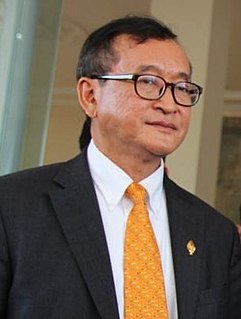
Kong Korm is a Cambodian politician and Senator. He is a member of the Sam Rainsy Party and currently serves as its leader after Sam Rainsy resigned to lead the Cambodia National Rescue Party. He was formerly a member of the Cambodian People's Party and served as foreign minister from 1986 to 1987.
Its motto is "Integrity, Truth, Justice". [6]
| Election | Total seats won | Total votes | Share of votes | Outcome of election | Election leader | |
|---|---|---|---|---|---|---|
| 1998 | 15 / 122 | 699,665 | 14.3% | Opposition | Sam Rainsy | |
| 2003 | 24 / 123 | 1,130,423 | 21.9% | Opposition | Sam Rainsy | |
| 2008 | 26 / 123 | 1,316,714 | 21.9% | Opposition | Sam Rainsy | |
| Election | Total seats won | Total votes | Share of votes | Outcome of election | Election leader |
|---|---|---|---|---|---|
| 2006 | 2 / 57 | 1,165 | 10.3% | Kong Korm | |
| 2012 | 11 / 57 | 2,503 | 21.9% | Kong Korm | |

On 20 December 2008 nine days before the candidate registration deadline ended the DSP was created by its leader president Thorng Sovannara, who says it was a breakaway faction of the Khmer National Party that he changed into a political party.
Liberalism is a political and moral philosophy based on liberty and equality. Liberals espouse a wide array of views depending on their understanding of these principles, but they generally support civil rights, democracy, secularism, gender equality, racial equality, internationalism, freedom of speech, freedom of the press, freedom of religion, and free markets.
Liberal democracy is a liberal political ideology and a form of government in which representative democracy operates under the principles of classical liberalism. Also called Western democracy, it is characterised by elections between multiple distinct political parties, a separation of powers into different branches of government, the rule of law in everyday life as part of an open society, a market economy with private property, and the equal protection of human rights, civil rights, civil liberties and political freedoms for all people. To define the system in practice, liberal democracies often draw upon a constitution, either formally written or uncodified, to delineate the powers of government and enshrine the social contract. After a period of sustained expansion throughout the 20th century, liberal democracy became the predominant political system in the world.
After the fall of the Pol Pot regime of Democratic Kampuchea, Cambodia was under Vietnamese occupation and a pro-Hanoi government, the People's Republic of Kampuchea was established. A civil war raged during the 1980s opposing the government's Kampuchean People's Revolutionary Armed Forces against the Coalition Government of Democratic Kampuchea, a government in exile composed of three Cambodian political factions: Prince Norodom Sihanouk's Funcinpec party, the Party of Democratic Kampuchea and the Khmer People's National Liberation Front (KPNLF).
Kampong Cham is a province (khaet) of Cambodia located on the central lowlands of the Mekong River. It borders the provinces of Kampong Chhnang to the west, Kampong Thom and Kratié to the north, Tbong Khmum to the east, and Prey Veng and Kandal to the south. Kampong Cham was officially divided into two provinces on 31 December 2013 in what was seen by many as a political move by the ruling party. All land west of the Mekong remained Kampong Cham while land east of the river became Tbong Khmum province. Prior to this division, Kampong Cham extended eastward to the international border with Vietnam, was the eleventh largest province in Cambodia, and with a population of 1,680,694, was the most populous province in Cambodia. Its capital and largest city is Kampong Cham.
Chea Sim was a Cambodian politician. He was President of the Cambodian People's Party from 1991 to 2015, President of the National Assembly of Cambodia from 1981 to 1998 and President of the Senate from 1999 to 2015. His official title was Samdach Akeak Moha Thomak Pothisal Chea Sim, Protean Protsaphea ney Preah Reacheanachak Kampuchea.
Sam Rainsy is a Cambodian activist and politician who most recently served as the Leader of the Opposition. He is now the president of the Cambodia National Rescue Movement (CNRM), launched in January 2018. He was a Member of Parliament (MP) for Kampong Cham, first from 1998 until 2005, then from 2008 to 2011, and finally from 2014 until 2015; he has been revoked of parliamentary immunity three times. He was previously the MP for Siem Reap from 1993 until 1995 when he was expelled from the Constituent Assembly. A co-founder of the Cambodia National Rescue Party (CNRP), Rainsy was previously a member of the royalist Funcinpec Party and served as the Minister of Economy and Finance during Norodom Ranariddh's administration from 1993 until his sacking in 1994. In June 1995, he was expelled from the National Assembly, and formed the Khmer Nation Party (KNP), which changed its name before the 1998 elections to the Sam Rainsy Party (SRP) to avoid registration issues. From 2000 to 2002 and again from 2012 to 2014, Rainsy was the chairperson of the Council of Asian Liberals and Democrats.
Cheam Channy was a Cambodian politician and member of parliament for the opposition Sam Rainsy Party (SRP). He was elected as a representative for Battambang Province in the 1998 National Elections, then again for Kompong Cham province in 2003.
The human rights situation in Cambodia is facing growing criticisms both within the country and an increasingly alarmed international community. After a series of flagrant violation against basic human rights a feeling of incertitude regarding the direction the country is emerging, sometimes comparing the situation to a newborn Burma. In its report on Cambodia, Human Rights Watch stated that "Authorities continue to ban or disperse most public demonstrations. Politicians and journalists critical of the government face violence and intimidation and are barred from equal access to the broadcast media. In addition, the judiciary remains weak and subject to political influence. Trafficking of women and children for sexual exploitation through networks protected or backed by police or government officials is rampant. The government continues to turn a blind eye to fraudulent confiscation of farmers’ land, illegal logging, and widespread plundering of natural resources.”
Sar Kheng is a Cambodian politician. One of the highest-ranking members of the ruling Cambodian People's Party, he is the current Minister of the Interior and has served as a Deputy Prime Minister since 1992. He also represents the province of Battambang in the Cambodian Parliament. Kheng has been the Minister of the Interior since 1992. Until March 2006, he shared the position with FUNCINPEC party member You Hockry as co-Ministers of the Interior, but then became sole interior minister in a cabinet reshuffle as FUNCINPEC ended its coalition with the CPP. He is currently the second longest serving government minister of Cambodia after Prime Minister Hun Sen. On June 14, 2015, King Norodom Sihamoni awarded Kheng the honorary title of "Samdech". His official title is "Samdech Kralahom Sar Kheng". Kheng is married to Nhem Sakhan with whom he has three children.
Kem Sokha is a Cambodian politician and activist who most recently served as the President of the Cambodia National Rescue Party (CNRP). He served as the Minority Leader, the highest ranking opposition parliamentarian, of the National Assembly from December 2016 to January 2017, and previously as the First Vice President of the National Assembly from August 2014 to October 2015. He represented Kampong Cham as its Member of Parliament (MP) from 2008 to 2017. From 2007 to 2012, Sokha was the leader of the Human Rights Party, which he founded.
General elections were held in Cambodia on 27 July 2008. The result was a victory for the ruling Cambodian People's Party, which won 90 of the 123 seats.
Yim Sovann is a Cambodian politician, who was the Spokesperson and President of the Executive Committee of the Cambodia National Rescue Party. He was an elected member of the Cambodian parliament representing Phnom Penh until 2017, when the Cambodia National Rescue Party was dissolved. He is also a successful businessman, and a father of two children. He also served as Deputy Leader of the Opposition.
The Union of Cambodian Democrats was a political alliance in Cambodia, which was formed by three political parties, one of them being the Khmer Nation Party of Sam Rainsy, Prince Norodom Ranariddh was involved as well. These three political parties called their umbrella group the "Union of Cambodian Democrats". It was created in exile in 1997 after a coup d'etat. The leaders of three political parties which united their leadership and political parties together to create the Union of Cambodian Democrats were Sam Rainsy's Sam Rainsy Party, Son Sann's Buddhist Liberal Democratic Party and also prince Norodom Ranariddh's FUNCINPEC party. However, from the late 90's onwards a new political party,the Bou Hel and Ty Chhin's Khmer Neutral Party, became part of the alliance .
Mu Sochua is a Cambodian politician and rights activist. She was a Member of Parliament (MP) for Battambang from 2013 to 2017, a seat which she previously held from 1998 to 2003. She was a member and Vice President of the Cambodia National Rescue Party (CNRP) until its dissolve, and previously a member of the Sam Rainsy Party (SRP) prior to its merger with the Human Rights Party. As a member of FUNCINPEC, she also served as Minister of Women and Veterans' Affairs in Hun Sen's coalition government from 1998 to 2004. She is currently one of 118 senior opposition figures serving a five-year ban from politics following a court ruling on 16 November 2017.
The 1997 clashes in Cambodia, also referred to as the 1997 coup in Cambodia, took place in Cambodia in July to September 1997. As a result, co-premier Hun Sen ousted the other co-premier Norodom Ranariddh. Dozens of people were killed during the conflict.
General elections were held in Cambodia on 28 July 2013. The National Election Committee (NEC) announced that some 9.67 million Cambodians were eligible to cast their ballots to elect the 123-seat National Assembly. Voter turnout was reported to be 69.6%, making it the lowest turnout in history. Polling precincts opened 7:00 a.m. and closed at 3:00 p.m. The Cambodian Minister of Information, Khieu Kanharith announced in preliminary results that the Cambodian People's Party won 68 seats and the opposition Cambodia National Rescue Party won all the remaining 55 seats. This election marked the largest seat loss by the Cambodian People's Party to date, and their lowest share of seats since 1998.
Anti-government protests were ongoing in Cambodia from July 2013 to July 2014. Popular demonstrations in Phnom Penh have taken place against the government of Prime Minister Hun Sen, triggered by widespread allegations of electoral fraud during the Cambodian general election of 2013. Demands to raise the minimum wage to $160 a month and resentment at Vietnamese influence in Cambodia have also contributed to the protests. The main opposition party refused to participate in parliament after the elections, and major demonstrations took place throughout December 2013. A government crackdown in January 2014 led to the deaths of 4 people and the clearing of the main protest camp.

Tep Sothy is a Cambodian politician and Member of Parliament for Takeo province. She has represented the Takeo province since the Cambodia National Rescue Party won 55 seats in Cambodian general election, 2013. Before coming to Cambodia, Sothy was a high school teacher in Chicago. In 2010, she decided to join Cambodia's Human Rights Party established and led by Kem Sokha who previously led the Cambodian Center for Human Rights in Phnom Penh for several years. Tep decided to move to Cambodia shortly before the 2013 National Elections. She told Voice of America Khmer Service in 2010 that she joined the political party because Kem Sokha was really "a great, moral, freedom-seeking leader." In 2012, the Sam Rainsy Party and the Human Rights Party, Cambodia's two major political parties merged to form the Cambodia National Rescue Party. Her work in Cambodia includes campaigns with women to improve gender awareness, introduction of gender sensitive laws, and policies to address issues on health, children's welfare, domestic violence, reproduction, and migrant workers rights.
| This article about a Cambodian political party is a stub. You can help Wikipedia by expanding it. |
| This political party– and liberalism-related article is a stub. You can help Wikipedia by expanding it. |