Related Research Articles

Lillie Glacier is a large glacier in Antarctica, about 100 nautical miles (190 km) long and 10 nautical miles (19 km) wide. It lies between the Bowers Mountains on the west and the Concord Mountains and Anare Mountains on the east, flowing to Ob' Bay on the coast and forming the Lillie Glacier Tongue.

James Ross Island is a large island off the southeast side and near the northeastern extremity of the Antarctic Peninsula, from which it is separated by Prince Gustav Channel. Rising to 1,630 metres (5,350 ft), it is irregularly shaped and extends 64 km in a north–south direction. It was charted in October 1903 by the Swedish Antarctic Expedition under Otto Nordenskiöld, who named it for Sir James Clark Ross, the leader of a British expedition to this area in 1842 that discovered and roughly charted a number of points along the eastern side of the island. The style, "James" Ross Island is used to avoid confusion with the more widely known Ross Island in McMurdo Sound.
Kohler Glacier is a distributary of the Smith Glacier in Marie Byrd Land, Antarctica, flowing northward through the middle of the Kohler Range into Dotson Ice Shelf. It was mapped by the U.S. Geological Survey from surveys and U.S. Navy air photos, 1959–65, and was named by the Advisory Committee on Antarctic Names in association with the Kohler Range.
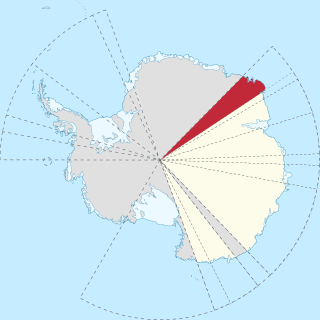
Enderby Land is a projecting landmass of Antarctica. Its shore extends from Shinnan Glacier at about 67°55′S44°38′E to William Scoresby Bay at 67°24′S59°34′E, approximately 1⁄24 of the earth's longitude. It was first documented in western and eastern literature in February 1831 by John Biscoe aboard the whaling brig Tula, and named after the Enderby Brothers of London, the ship's owners who encouraged their captains to combine exploration with sealing.
Explorers Range is a large mountain range in the Bowers Mountains of Victoria Land, Antarctica, extending from Mount Bruce in the north to Carryer Glacier and McLin Glacier in the south. Named by the New Zealand Antarctic Place-Names Committee (NZ-APC) for the northern party of New Zealand Geological Survey Antarctic Expedition (NZGSAE), 1963–64, whose members carried out a topographical and geological survey of the area. The names of several party members are assigned to features in and about this range. All of the geographical features listed below lie situated on the Pennell Coast, a portion of Antarctica lying between Cape Williams and Cape Adare.

Posadowsky Glacier is a glacier about 9 nautical miles long, flowing north to Posadowsky Bay immediately east of Gaussberg. Posadowsky Bay is an open embayment, located just east of the West Ice Shelf and fronting on the Davis Sea in Kaiser Wilhelm II Land. Kaiser Wilhelm II Land is the part of East Antarctica lying between Cape Penck, at 87°43'E, and Cape Filchner, at 91°54'E, and is claimed by Australia as part of the Australian Antarctic Territory. Other notable geographic features in this area include Drygalski Island, located 45 mi NNE of Cape Filchner in the Davis Sea, and Mirny Station, a Russian scientific research station.

Bachstrom Point is a headland on the northeast side of Beascochea Bay, 8 nautical miles (15 km) southeast of Cape Perez on the southwest coast of Kyiv Peninsula in Graham Land, Antarctica. It was first charted by the British Graham Land Expedition, 1934–37, under John Rymill, and named by the UK Antarctic Place-Names Committee in 1959 for Johann Bachstrom, the author in 1734 of a classic pamphlet recognizing scurvy as a nutritional deficiency disease and prescribing the necessary measures for its prevention and cure.

Barilari Bay is a bay 12 nautical miles (22 km) long and 6 nautical miles (11 km) wide, between Cape Garcia and Loqui Point on the west coast of Graham Land. The glaciers Birley, Lawrie, Weir and Bilgeri feed the bay.
Mount Bitgood is a mountain between Mount Lockhart and Mount Colombo on the north side of the Fosdick Mountains, in the Ford Ranges of Marie Byrd Land. Mapped by United States Antarctic Service (USAS) (1939–41) and by United States Geological Survey (USGS) from surveys and U.S. Navy air photos (1959–65). Named by Advisory Committee on Antarctic Names (US-ACAN) for Charles D. Bitgood, geologist with the United States Antarctic Research Program (USARP) party to the Fosdick Mountains, 1967–68.
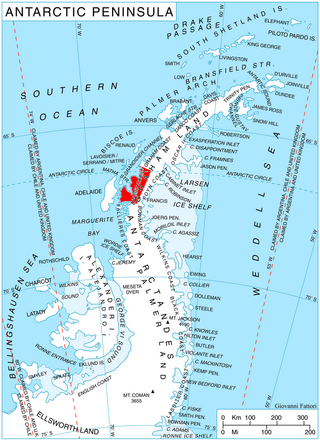
Darbel Bay is a bay 25 nautical miles (50 km) wide, indenting the west coast of Graham Land between Stresher Peninsula and Pernik Peninsula. Entered southwest of Cape Bellue and northeast of Cape Rey. The glaciers Widmark Ice Piedmont, Cardell, Erskine, Hopkins, Drummond, Widdowson, McCance, Solun, and Škorpil feed the bay.

Cape Jules is a rocky cape with a small cove along its northern end, 3 nautical miles (6 km) west of Zelee Glacier Tongue, Antarctica. It was discovered and named by the French expedition under Dumont d'Urville, 1837–40. Jules is the given name of the discoverer, Captain Jules Dumont d'Urville, as well as his son. The area was charted by the Australasian Antarctic Expedition in 1912–13, and again by the British Australian and New Zealand Antarctic Research Expedition in 1931, both under Mawson. The French Antarctic Expedition under Michel Barre established astronomical control at this locality in 1951.
Detour Island is an island lying 2.5 nautical miles (5 km) west of False Cape Renard, on the west side of Lemaire Channel in the Wilhelm Archipelago. It was first charted by the French Antarctic Expedition, 1903–05, under Jean-Baptiste Charcot, and was so named by the UK Antarctic Place-Names Committee in 1959 because the island lies near the entrance to the ships' passage west of Booth Island which provides an alternative route to Lemaire Channel when the latter is blocked by ice.
Cape Douglas is an ice-covered cape marking the south side of the entrance to Matterson Inlet, on the west side of the Ross Ice Shelf. It was discovered by the British National Antarctic Expedition (1901–04) and named for Admiral Sir Archibald Lucius Douglas, Lord of the Admiralty, who persuaded the Admiralty to assign naval seamen to the expedition.

Duyvis Point is the point forming the southeast side of the entrance to Urovene Cove situated 11 nautical miles (20 km) south-southeast of Cape Garcia and 2.65 km southeast of Laskar Point, on the southwest coast of Felipe Solo (Obligado) Peninsula, Graham Land in Antarctica. It was first roughly charted by the British Graham Land Expedition under John Rymill, 1934–37. It was mapped more accurately by the Falkland Islands Dependencies Survey from photos taken by Hunting Aerosurveys Ltd in 1956–57, and was named by the UK Antarctic Place-Names Committee for F. Donker Duyvis, a Dutch documentalist who was Secretary of the International Federation for Documentation.
Erskine Glacier is a glacier 16 nautical miles (30 km) long on the west coast of Graham Land, flowing west into Darbel Bay to the north of Hopkins Glacier. It was first surveyed by the Falkland Islands Dependencies Survey (FIDS) in 1946–47, and named "West Gould Glacier". With East Gould Glacier it was reported to fill a transverse depression across Graham Land, but further survey in 1957 showed no close topographical alignment between the two. The name Gould has been limited to the east glacier and an entirely new name, for Angus B. Erskine, leader of the first FIDS party to travel down the glacier and to survey it in detail, has been approved for the west glacier.

The Géologie Archipelago, also known as the Pointe Géologie Archipelago, Geology Archipelago or Cape Geology Archipelago, is a small archipelago of rocky islands and rocks close to the north of Cape Géodésie and Astrolabe Glacier Tongue, extending from Helene Island on the west to the Dumoulin Islands on the east, in Adélie Land, Antarctica.

Loqui Point is a point at the northern extremity of Velingrad Peninsula on the west coast of Graham Land, Antarctica. It marks the south side of the entrance to Barilari Bay. This feature was discovered and named "Cap Garcia" by the French Antarctic Expedition, 1903–05, under Jean-Baptiste Charcot. At the same time Charcot gave the name "Cap Loqui" to the north cape of Barilari Bay, after a Captain Loqui of the Argentine Navy. The maps of Charcot's French Antarctic Expedition of 1908–10, showed "Cap Garcia" as the north cape of Barilari Bay, and the name Cape Garcia has since become established in that position. Charcot did not use the name "Cap Loqui" on the maps of the 1908–10 expedition, and with his shifting of the name Cape Garcia, this south entrance point to Barilari Bay had remained unnamed. For the sake of historical continuity, the name Loqui Point was accepted for this feature in the 1950s.
The McDonald Heights are broad, mainly snow-covered heights about 35 nautical miles (65 km) long and rising over 1,000 metres (3,300 ft) between Cape Burks and Morris Head on the coast of Marie Byrd Land, Antarctica. The heights are bounded southward by Hull Glacier, Kirkpatrick Glacier and Johnson Glacier. The feature was photographed from aircraft of the United States Antarctic Service, 1939–1941, was observed and partially mapped from USS Glacier during February 1962, and was mapped in detail by the United States Geological Survey in 1965. The heights were named by the Advisory Committee on Antarctic Names after Captain Edwin A. McDonald, U.S. Navy, Deputy Commander of the U.S. Naval Support Force, Antarctica, in 1962, and Commander of the Task Unit that explored this coast aboard Glacier in February 1962.
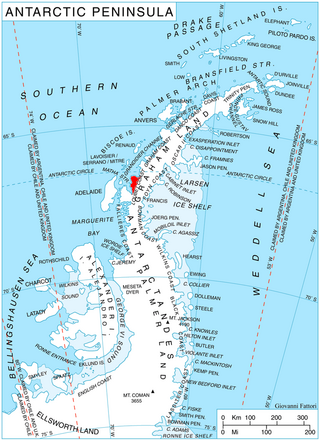
McCance Glacier is the 30-km long and 5 km wide glacier draining the Hutchison Hill area on the west slopes of Avery Plateau on Loubet Coast in Graham Land, Antarctica. It flows north-northwestwards along the west side of Osikovo Ridge, Kladnitsa Peak and Rubner Peak and enters Darbel Bay.
Ryvingen Peak is a rock peak 3 nautical miles (6 km) west-southwest of Brapiggen Peak, on the southern side of Borg Massif in Queen Maud Land. Mapped by Norwegian cartographers from surveys and air photos by Norwegian-British-Swedish Antarctic Expedition (NBSAE) (1949–52) and named Ryvingen.
References
- ↑ "Close, Cape". Geographic Names Information System . United States Geological Survey, United States Department of the Interior . Retrieved 15 November 2011.
 This article incorporates public domain material from "Close, Cape". Geographic Names Information System . United States Geological Survey.
 | This Enderby Land location article is a stub. You can help Wikipedia by expanding it. |