
Physical security describes security measures that are designed to deny unauthorized access to facilities, equipment, and resources and to protect personnel and property from damage or harm. Physical security involves the use of multiple layers of interdependent systems that can include CCTV surveillance, security guards, protective barriers, locks, access control, perimeter intrusion detection, deterrent systems, fire protection, and other systems designed to protect persons and property.

A smoke detector is a device that senses smoke, typically as an indicator of fire. Smoke detectors/Alarms are usually housed in plastic enclosures, typically shaped like a disk about 150 millimetres (6 in) in diameter and 25 millimetres (1 in) thick, but shape and size vary. Smoke can be detected either optically (photoelectric) or by physical process (ionization). Detectors may use one or both sensing methods. Sensitive alarms can be used to detect and deter smoking in banned areas. Smoke detectors in large commercial and industrial buildings are usually connected to a central fire alarm system.

Fire safety is the set of practices intended to reduce destruction caused by fire. Fire safety measures include those that are intended to prevent the ignition of an uncontrolled fire and those that are used to limit the spread and impact of a fire.

A security alarm is a system designed to detect intrusions, such as unauthorized entry, into a building or other areas, such as a home or school. Security alarms protect against burglary (theft) or property damage, as well as against intruders. Examples include personal systems, neighborhood security alerts, car alarms, and prison alarms.

UTC Climate, Controls & Security was a global provider of building technologies offering fire safety, security, building automation, heating, ventilating, air-conditioning, and refrigeration systems and services. A wholly owned subsidiary of United Technologies Corporation, UTC Climate, Controls & Security was a $16.7 billion company with 55,000 employees serving customers in more than 180 countries.
SimplexGrinnell, a subsidiary of Johnson Controls, is an American company specializing in active fire protection systems, communication systems and testing, inspection and maintenance services. The company headquarters is in Boca Raton, Florida; corporate sales and marketing offices are in Westminster, Massachusetts, and the company has about 160 district offices throughout North America. It is currently the largest fire protection company in the world.
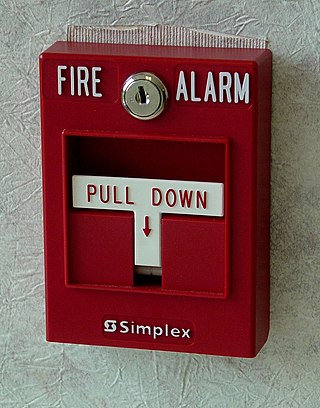
Manual fire alarm activation is the process of triggering a fire alarm through a call point, pull station, or other device. This usually causes the alarm to sound the evacuation signal for the relevant building or zone. Manual fire alarm activation requires human intervention, as distinct from automatic fire alarm activation such as that provided through the use of heat detectors and smoke detectors. It is, however, possible for call points/pull stations to be used in conjunction with automatic detection as part of the overall fire detection and alarm system. Systems in completed buildings tend to be wired in and include a control panel. Wireless activators are common during construction.

A carbon monoxide detector or CO detector is a device that detects the presence of the carbon monoxide (CO) gas to prevent carbon monoxide poisoning. In the late 1990s Underwriters Laboratories changed the definition of a single station CO detector with a sound device to carbon monoxide (CO) alarm. This applies to all CO safety alarms that meet UL 2034 standard; however for passive indicators and system devices that meet UL 2075, UL refers to these as carbon monoxide detectors. Most CO detectors use a sensor with a defined, limited lifespan, and will not work indefinitely.

An aspirating smoke detector (ASD) is a system used in active fire protection, consisting of a central detection unit which draws air through a network of pipes to detect smoke. The sampling chamber is based on a nephelometer that detects the presence of smoke particles suspended in air by detecting the light scattered by them in the chamber. ASDs can typically detect smoke before it is visible to the naked eye.

A heat detector is a fire alarm device designed to respond when the convected thermal energy of a fire increases the temperature of a heat sensitive element. The thermal mass and conductivity of the element regulate the rate flow of heat into the element. All heat detectors have this thermal lag. Heat detectors have two main classifications of operation, "rate-of-rise" and "fixed temperature". The heat detector is used to help in the reduction of property damage.

A fire alarm system is a building system designed to detect, alert occupants, and alert emergency forces of the presence of fire, smoke, carbon monoxide, or other fire-related emergencies. Fire alarm systems are required in most commercial buildings. They may include smoke detectors, heat detectors, and manual fire alarm activation devices. All components of a fire alarm system are connected to a fire alarm control panel. Fire alarm control panels are usually found in an electrical or panel room. Fire alarm systems generally use visual and audio signalization to warn the occupants of the building. Some fire alarm systems may also disable elevators, which are unsafe to use during a fire under most circumstances.
Kidde is a brand subsidiary of Carrier Global that manufactures and distributes fire detection and suppression equipment, as well as smoke and CO alarm units. Kidde is one of America's largest manufacturers of smoke alarms and fire safety products. Kidde is headquartered in Mebane, North Carolina.
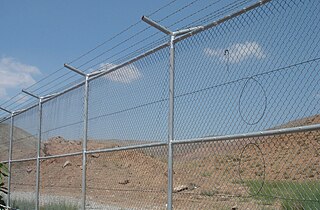
Demarcation of a perimeter, when the protection of assets, personnel or buildings is required, is normally affected by the building of a perimeter fence system. The level of protection offered varies according to the threat level to the perimeter. Different types of perimeter fencing include:
A gas detector is a device that detects the presence of gases in an area, often as part of a safety system. A gas detector can sound an alarm to operators in the area where the leak is occurring, giving them the opportunity to leave. This type of device is important because there are many gases that can be harmful to organic life, such as humans or animals.
A flame detector is a sensor designed to detect and respond to the presence of a flame or fire, allowing flame detection. Responses to a detected flame depend on the installation, but can include sounding an alarm, deactivating a fuel line, and activating a fire suppression system. When used in applications such as industrial furnaces, their role is to provide confirmation that the furnace is working properly; it can be used to turn off the ignition system though in many cases they take no direct action beyond notifying the operator or control system. A flame detector can often respond faster and more accurately than a smoke or heat detector due to the mechanisms it uses to detect the flame.
The EN 54 Fire detection and fire alarm systems is a series of European standards that includes product standards and application guidelines for fire detection and fire alarm systems as well as voice alarm systems.
Home safety is the awareness of risks and potential dangers in and around a home that may cause bodily harm, injury, or even death to those living there.
Xtralis, now part of Honeywell, was a privately held firm. It manufactures smoke detection, gas detection and video surveillance security products for the early detection, visual verification, and prevention of fire and intrusion threats.
RAE Systems, Inc., or RAE System by Honeywell, is a provider of wireless, gas and radiation detection instruments and systems that enable real-time safety and security threat detection to help mitigate risk, and protect workers, contractors, the public, and assets. RAE Systems is located in San Jose, California. The company was founded in 1991 by Robert I. Chen and Peter Hsi.

