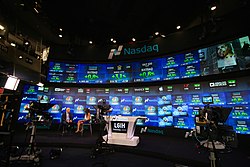
This article is about the stock exchange. For the stock market index, see Nasdaq Composite. For the corporation that owns Nasdaq exchanges, see Nasdaq, Inc. For the corporation's physical headquarters, see Nasdaq MarketSite.
Nasdaq Stock Market[a] (National Association of Securities Dealers Automated Quotations) is an American stock exchange, the second-largest by market cap on the list of stock exchanges, and the first fully electronic stock market. The exchange is based in Manhattan, New York City, and is among the most active stock trading venue by volume in the United States.[3][4]
The exchange platform is owned by Nasdaq, Inc., which also owns the Nasdaq Nordic stock market network and several U.S.-based stock and options exchanges. The exchange is the primary listing for many technology companies and also trades stock in many foreign firms, with China and Israel being the largest foreign sources.[5][6]
As of December 31, 2024, 4,075 companies listed securities on Nasdaq, including 1,383 listings on The Nasdaq Global Select Market, 1,366 on The Nasdaq Global Market, and 1,326 on The Nasdaq Capital Market.[6]
Nasdaq, Inc. was founded in 1971 by the National Association of Securities Dealers (NASD), now known as the Financial Industry Regulatory Authority (FINRA).[7] "Nasdaq" (originally and still commonly spelled with all-capital letters as "NASDAQ") is an acronym for "National Association of Securities Dealers Automated Quotations".[8] On February 8, 1971, the Nasdaq Stock Market commenced operations as the world's first fully electronic stock market.[7] Initially, Nasdaq served as a "quotation system" rather than a platform for electronic trading.[9]Intel Corporation was one of the first major corporations to list its shares on Nasdaq; other major companies that have been listed on Nasdaq since its early years include Comcast and Applied Materials.[10]
Market Growth
Since the launch of Nasdaq, many major companies trading on the over-the-counter (OTC) market began switching to Nasdaq. As late as 1987, the Nasdaq exchange was still commonly referred to as "OTC" in media reports[11] and also in the monthly Stock Guides issued by Standard & Poor's Corporation.[12] Over the years, it became more of a stock market with the addition of trade and volume reporting and automated trading systems. In 1981, Nasdaq traded 37% of the U.S. securities markets' total of 21billion shares. By 1991, Nasdaq accounted for approximately 46% of U.S. securities trading volume.[13] In 1992, the Nasdaq Stock Market joined with the London Stock Exchange to form the first intercontinental linkage of capital markets.[14]
In 1996, the SEC issued a report alleging that Nasdaq market makers fixed prices by avoiding "odd-eighths" quotes (at the time, stock prices were quoted in increments of an eighth of a dollar) to artificially widen spreads. The report was followed by a new set of rules for how Nasdaq handled orders.[15]:102,126
Online Trading
In 1998, it became the first stock market in the United States to trade online, using the slogan "the stock market for the next hundred years".[16] The Nasdaq Stock Market attracted many companies during the dot-com bubble.
2000–2020
Public listing and market change
In a series of sales in 2000 and 2001, FINRA sold its stake in the Nasdaq. On July 2, 2002, Nasdaq, Inc. became a public company via an initial public offering, listing its own shares on the exchange (traded under the ticker symbol NDAQ).[17] In 2006, the status of the Nasdaq Stock Market was changed from a stock market to a licensed national securities exchange.[18] In 2007, it merged with OMX, a leading exchange operator in the Nordic countries, expanded its global footprint, and changed its name to the Nasdaq OMX Group.[19]
To qualify for listing on the exchange, a company must be registered with the United States Securities and Exchange Commission (SEC), must have at least three market makers (financial firms that act as brokers or dealers for specific securities) and must meet minimum requirements for assets, capital, public shares, and shareholders.
In December 2005, Nasdaq acquired Instinet for $1.9billion, retaining the Inet ECN and subsequently selling the agency brokerage business to Silver Lake Partners and Instinet management.[21][22][23]
The European Association of Securities Dealers Automatic Quotation System (EASDAQ) was founded as a European equivalent to the Nasdaq Stock Market. It was purchased by Nasdaq in 2001 and became Nasdaq Europe.[24] In 2003, operations were shut down as a result of the burst of the dot-com bubble.[25] In 2007, Nasdaq Europe was revived first as Equiduct and was acquired by Börse Berlin later that year.[26]
In November 2016, chief operating officer Adena Friedman was promoted to chief executive officer, becoming the first woman to serve as chief executive officer of a major U.S. exchange in the U.S.[30]
In 2016, listings-related acticities accounted for $272million in Nasdaq's revenue.[31]
In October 2018, the SEC blocked the New York Stock Exchange (NYSE) and Nasdaq from raising certain market-data prices. This was the first time the commission rejected increases for the exchanges' stock market data feeds.[32][33][34]
In December 2020, Nasdaq announced that it would remove shares of four Chinese companies from indexes it maintains in accordance with Executive Order 13959.[35]
In October 2024, Nasdaq announced updates to its Calypso platform, including the introduction of XVA Accelerator, a tool for portfolio risk calculations.[37]
In March 2025, pending approval by the U.S. Securities and Exchange Commission, Nasdaq announced plans to introduce 24-hour 5-day a week trading on its United States exchange during the second half of 2026 in response to increased global demand for U.S. equities.[38]
In May 2025, Nasdaq and Amazon Web Services (AWS) announced the launch of Nasdaq Eqlipse Trading, a cloud-based platform. Exchanges that have adopted the platform include Johannesburg Stock Exchange, Mexico's Grupo BMV, and the Philippine Stock Exchange.[39][40]
Quote availability
A quote is the price of a stock as listed on an exchange. Quotes consist of bids, the price buyers are willing to pay, and offers, the price sellers will accept.[41] Nasdaq quotes are available at three levels:
Level 1 shows the highest bid and lowest ask—inside quote.
Level 2 shows all public quotes of market makers together with information of market dealers wishing to buy or sell stock and recently executed orders.[42]
Level 3 is used by the market makers and allows them to enter their quotes and execute orders.[43]
4:00p.m. to 8:00p.m.: extended-hours trading session (postmarket)[45]
The Nasdaq Stock Market averages about 253 trading days per year.[46]
Market tiers
Within the Nasdaq Composite Index, the Nasdaq exchange has three different market tiers for listed companies:[47]
Capital Market (NASDAQ-CM small cap) is an equity market for companies that have relatively small levels of market capitalization.[47] Listing requirements for such "small cap" companies are less stringent than for other Nasdaq markets that list larger companies with significantly higher market capitalization.[48]
Global Market (NASDAQ-GM mid cap) is made up of stocks that represent the Nasdaq Global Market. The Global Market consists of 1,450 stocks that meet Nasdaq's strict financial and liquidity requirements, and corporate governance standards. The Global Market is less exclusive than the Global Select Market.[49][50]
Global Select Market (NASDAQ-GS large cap) is a market capitalization-weighted index made up of US-based and international stocks that represent the Nasdaq Global Select Market Composite (NQGS). This includes companies with the largest market capitalization within the Nasdaq Composite.[51] The Global Select Market consists of 1,200 stocks that meet Nasdaq's strict financial and liquidity requirements and corporate governance standards. The Global Select Market is more exclusive than the Global Market. Every October, the Nasdaq Listing Qualifications Department reviews the Global Market Composite to determine if any of its stocks have become eligible for listing on the Global Select Market.[52][53]
Difference between NYSE and Nasdaq
Bunker-Ramo Data Center in 1971
Nasdaq is the second largest stock exchange in the United States. In addition to age and market capitalization, there are other key differences between the two exchanges:[54][55][56]
Trading Volume. Nasdaq has a greater trading volume than the NYSE with approximately 1.8 billion trades per day.[57]
Exchange systems. Before the COVID-19 pandemic, the NYSE maintained both an electronic trading system and a trading floor system staffed by live professionals who help conduct auctions.[58][59] Nasdaq has been an all-electronic exchange since its inception.[7]
Market structure. The NYSE traces its origins to the Buttonwood Agreement of 1792, when brokers met in person to trade securities using open outcry.[60] Nasdaq began in 1971 as the first exclusively electronic quotation system for over-the-counter securities, displaying bid and ask prices from competing market makers on cathode-ray terminals, however trades were still executed by telephone until electronic execution was introduced in 1984.[61][62] In 2002–2003, Nasdaq launched Supermontage, integrating a public limit order book with market maker quotations and allowing any participant to post orders.[63][64] The NYSE adopted a similar electronic central limit order book system in 2006,[65] which today handles the majority of their trading volume; however, the NYSE retains its physical trading floor where designated market makers facilitate opening, closing, and reopening auctions and are obligated to provide liquidity for the public (institutions, hedge funds, broker/dealers) during periods of volatility.[66]
Listing fees. Listing fees on the Nasdaq vary based on market. For the Capital Market, the fee range is $53,000-$86,000; the Global and Global Select Markets range is $56,000-$193,000; and there is an $81,000-$85,000 listing fee for acquisition companies.[67]
Sectors. Investors typically view the NYSE as an exchange for older, more established companies.[68] Nasdaq tends to be home to newer companies focused on technology and innovation.[69]
↑Patterson, Scott (2012). Dark Pools: High-Speed Traders, A.I. Bandits, and the Threat to the Global Financial System. Crown Publishing. ISBN978-0307887177.
↑Pinto, Jerald E.; Henry, Elaine; Robinson, Thomas R.; Stowe, John D. (2010). Equity Asset Valuation. CFA Institute Investment Series. Vol.27 (2ed.). John Wiley & Sons. p.6. ISBN9780470579657. Archived from the original on May 10, 2013. [...] NASDAQ-GS stands for 'Nasdaq Global Select Market,' [...]
This page is based on this Wikipedia article Text is available under the CC BY-SA 4.0 license; additional terms may apply. Images, videos and audio are available under their respective licenses.