Cockney Alphabet

Last updated

The Cockney Alphabet is a recital of the English alphabet intended to parody the way the alphabet is taught to small working class children. The ostensible humour comes from forming unexpected words and phrases from the names of the various letters of the alphabet, mocking the way people from East London speak. Cockney is a name given to the working class of East London by the middle and upper classes. [1] [2]

Contents

Clapham and Dwyer version

"A Surrealist Alphabet"
Surrealist alphabet clapham dwyer.jpg
Song by Clapham and Dwyer
A-side "A Spot of Fishing"
Released1936
Genre Comedy
Label Columbia
Songwriter(s) Clapham and Dwyer

In 1936, the comedy double act Clapham and Dwyer recorded the following version, entitled "A Surrealist Alphabet":

A for 'orses (hay for horses)
B for mutton (beef or mutton)
C for 'th highlanders (Seaforth Highlanders)
D for 'ential (deferential)
E for Adam (Eve or Adam)
F for 'vescence (effervescence)
G for police (chief of police)
H for respect (age for respect)
I for Novello (Ivor Novello)
J for oranges (Jaffa oranges)
K for 'ancis, (Kay Francis), or K for undressing
L for leather (Hell for leather)
M for 'sis (emphasis)
N for 'adig (in for a dig, or infra dig.)
O for the garden wall (over the garden wall)
P for a penny (pee for a penny)
Q for a song (cue for a song), or Q for billiards (cue for billiards)
R for mo' (half a mo')
S for you (it's for you)
T for two (tea for two)
U for films (UFA films)
V for La France (vive la France)
W for a bob (double you for a bob?, as in gambling)
X for breakfast (eggs for breakfast)
Y for Gawd's sake (why, for God's sake?)
Z for breezes (zephyr breezes, see West wind)

Alternative versions

There are many alternative 'definitions' offered for each letter, some of which include:

A for effort (school report comment to encourage a student who is never going to excel but tries hard)
A for gardner (Ava Gardner)
Bs for honey (bees for honey)
B for stew (beef or stew)
B for you go (before you go)
B for eaters (Beefeaters)
C for fish (sea for fish)
C for miles (see for miles)
C for ships (sea for ships)
C for yourself (see for yourself)
D for dumb (deaf or dumb)
D for 'cate (defecate)
D for 'mation (deformation)
D for 'ential (differential, as part of a vehicle)
E for brick (heave a brick)
E for castle (Hever Castle)
E for 'ning Standard (Evening Standard)
E for 'or (either or)
E for Le Gallienne (Eva Le Gallienne)
E for Gabor (Eva Gabor)
E for Peron (Eva Peron)
F for after (forever after)
F for body (everybody)
F for lump (elephant)
F for but don't get her pregnant (f*** her but don't get her pregnant)
F for I'll kill you (f*** her, I'll kill you)
F for one (everyone)
F for ready (ever ready)
G for crying out loud (gee, for crying out loud)
G for get it (gee, forget it)
H for bless you (aitchfa/atishoo, bless you) [3]
H for go (have a go)
H for beauty (age before beauty)
H for consent (age for consent)
H for a film (age for a film)
H for scratch (itch for scratch)
H for it (hate ye for it)
I for lootin (high-falutin')
I for an eye (eye for an eye)
I for the Engine (Ivor the Engine)
I for the ladies (eye for the ladies)
I for or (either / or)
I for knack for nickin' off (I've a knack for nicking off)
J for cakes (Jaffa Cakes – similar sentiment to Jaffa Oranges)
J for good time (did ya have a good time)
K for 'teria (cafeteria)
K for toway (gave it away)
K for restaurant (cafe or restaurant, mispronouncing the word café)
K for Sutherland (Kiefer Sutherland)
K for a cuppa (care for a cuppa)
L for 'bet (alphabet)
L for 'Romeo (Alfa Romeo)
M for sema (emphysema)
M for cream (Emva Cream, a brand of Cypriot wine)
N for a profit (in for a profit)
N for 'lope (envelope)
N for 'lade (enfilade)
N for 'lid (invalid)
N for mation (information)
N for a penny (in for a penny, mind the conflict with P above)
N for eggs (hen for eggs)
N for En (end for end)
N for Hoxha (Enver Hoxha)
N for Pasha (Enver Pasha)
O for crying out loud (oh, for crying out loud)
O for Gawd's sake (oh, for God's sake)
O for the garden wall (over the garden)
O for the wings of a dove (oh, for the wings of a dove)
O for the rainbow (over the rainbow)
O for my dead body (over my dead body)
O for a life of endless bliss
O for draft (overdraft)
P for relief (pee for relief)
P for 'ming seals (performing seals)
P for nanny (pee for nanny)
P for pleasure (pee for pleasure)
P for a whistle (pea for a whistle)
Q for chips (queue for chips)
Q for a theatre (queue for a theatre)
Q for tickets (queue for tickets)
Q for hours (queue for hours)
Q for almost everything (queue for almost everything)
Q for a pee (queue for a pee)
Q for a bus (queue for a bus)
Q for snooker (cue for snooker)
Q for the loo (queue for the loo)
R for Askey (Arthur Askey)
R for dozen (half a dozen)
R for Lowe (Arthur Lowe)
R for Mullard (Arthur Mullard)
R for pint (half a pint)
S for Costello (The Story of Esther Costello)
S for instance (as for instance)
S for Rantzen (Esther Rantzen)
S for Williams (Esther Williams)
S for zando (sforzando [in music])
T for hurtin (teeth are hurting)
T for chewin (teeth for chewing)
U for 'mism (euphemism)
U for me (you for me)
U for Joyce (Yootha Joyce)
W for quits (double you for quits)
W for a quid (double you for a quid [in gambling])
W for a match? (trouble you for a match?)
W for a tenner (double you for a tenner)
Y for girlfriend (wife, or girlfriend?)
Y for Heaven's sake (why, for Heaven's sake)
Y for crying out loud (why, for crying out loud)
Y for biscuit (wafer biscuit)
Y for (a) husband (wife for [a] husband)
Y for mistress (wife or mistress)
Y for mother (wife or mother)
Y for runts ('Y' fronts [underwear])
Z for his hat (his head for his hat)
Z for a joke (said for a joke)
Z for Zodiac (Zephyr Zodiac Ford Zephyr)

Naming a dog "Deefer" (as was common in the '50s[ citation needed ]) is an example of the reverse of this phenomenon, based on interpreting the line D for dog in an everyday alphabet verse as "deefer dog". "Ceefer" as a name for a cat also appeared in Australia after the Second World War (C for cat) influenced by returning servicemen from England who had been exposed to the humour of the Cockney Alphabet.

Notes

  1. "The definitive Cockney Alphabet". The Sydney Morning Herald. 15 January 2005.
  2. "Verbal frolics". Times Higher Education. 13 November 1998.
  3. "Cockney Alphabet going around the net". 1991.

Related Research Articles

<span class="mw-page-title-main">The ABC Song</span> Song that teaches an alphabet

"The ABC Song" is the best-known song used to recite the English alphabet in alphabetical order. It is commonly used to teach the alphabet to children in English-speaking countries. "The ABC Song" was first copyrighted in 1835 by Boston music publisher Charles Bradlee. The melody is from a 1761 French music book and is also used in other nursery rhymes like "Twinkle, Twinkle, Little Star". It is not known who first set the alphabet to this tune. Songs set to the same melody are also used to teach the alphabets of other languages.

<span class="mw-page-title-main">Diacritic</span> Modifier mark added to a letter

A diacritic is a glyph added to a letter or to a basic glyph. The term derives from the Ancient Greek διακριτικός, from διακρίνω. The word diacritic is a noun, though it is sometimes used in an attributive sense, whereas diacritical is only an adjective. Some diacritics, such as the acute ⟨á⟩, grave ⟨à⟩, and circumflex ⟨â⟩, are often called accents. Diacritics may appear above or below a letter or in some other position such as within the letter or between two letters.

Standard ML (SML) is a general-purpose, modular, functional programming language with compile-time type checking and type inference. It is popular for writing compilers, for programming language research, and for developing theorem provers.
<span class="mw-page-title-main">Slovene alphabet</span>

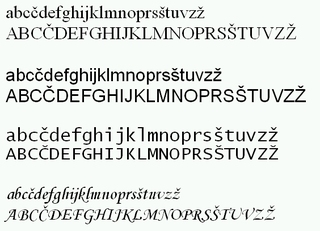
The Slovene alphabet is an extension of the Latin script used to write Slovene. The standard language uses a Latin alphabet which is a slight modification of the Croatian Gaj's Latin alphabet, consisting of 25 lower- and upper-case letters:

This gallery of sovereign state flags shows the national or state flags of sovereign states that appear on the list of sovereign states. For flags of other entities, please see gallery of flags of dependent territories. Each flag is depicted as if the flagpole is positioned on the left of the flag, except for those of Iran, Iraq and Saudi Arabia which are depicted with the hoist to the right.
<span class="mw-page-title-main">English alphabet</span> Latin-script alphabet consisting of 26 letters

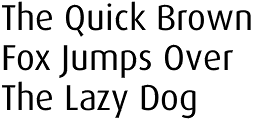
The alphabet for Modern English is a Latin-script alphabet consisting of 26 letters, each having an upper- and lower-case form. The word alphabet is a compound of the first two letters of the Greek alphabet, alpha and beta. The alphabet originated around the 7th century to write Old English from Latin script. Since then, letters have been added or removed to give the current letters:

<span class="mw-page-title-main">Digraph (orthography)</span> Pair of characters used to write one phoneme

A digraph or digram is a pair of characters used in the orthography of a language to write either a single phoneme, or a sequence of phonemes that does not correspond to the normal values of the two characters combined.

When used as a diacritic mark, the term dot refers to the glyphs "combining dot above", and "combining dot below" which may be combined with some letters of the extended Latin alphabets in use in a variety of languages. Similar marks are used with other scripts.

Lewis Carroll published "The Alphabet-Cipher" in 1868, possibly in a children's magazine. It describes what is known as a Vigenère cipher, a well-known scheme in cryptography. While Carroll calls this cipher "unbreakable", Friedrich Kasiski had already published in 1863 a volume describing how to break such ciphers and Charles Babbage had secretly found ways to break polyalphabetic ciphers in the previous decade during the Crimean War.

In cryptography, a classical cipher is a type of cipher that was used historically but for the most part, has fallen into disuse. In contrast to modern cryptographic algorithms, most classical ciphers can be practically computed and solved by hand. However, they are also usually very simple to break with modern technology. The term includes the simple systems used since Greek and Roman times, the elaborate Renaissance ciphers, World War II cryptography such as the Enigma machine and beyond.

Several manual alphabets in use around the world employ two hands to represent some or all of the letters of an alphabet, usually as a part of a deaf sign language. Two-handed alphabets are less widespread than one-handed manual alphabets. They may be used to represent the Latin alphabet or the Cyrillic alphabet.

The four-square cipher is a manual symmetric encryption technique. It was invented by the French cryptographer Felix Delastelle.

The Two-square cipher, also called double Playfair, is a manual symmetric encryption technique. It was developed to ease the cumbersome nature of the large encryption/decryption matrix used in the four-square cipher while still being slightly stronger than the single-square Playfair cipher.

The Romic Alphabet, sometimes known as the Romic Reform, is a phonetic alphabet proposed by Henry Sweet. It descends from Ellis's Palaeotype alphabet and English Phonotypic Alphabet, and is the direct ancestor of the International Phonetic Alphabet. In Romic every sound had a dedicated symbol, and every symbol represented a single sound. There were no capital letters; there were letters derived from small capitals, though these were distinct letters.
<span class="mw-page-title-main">French manual alphabet</span> Manual alphabet

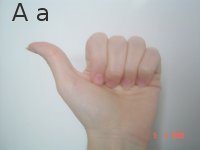
The French manual alphabet is an alphabet used for French Sign Language (LSF), both to distinguish LSF words and to sign French words in LSF.

The Fula language is written primarily in the Latin script, but in some areas is still written in an older Arabic script called the Ajami script or in the recently invented Adlam script.
<span class="mw-page-title-main">Irish manual alphabet</span> Manual alphabet used in Irish Sign Language

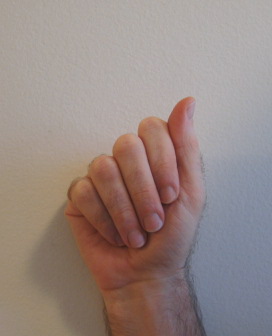
The Irish manual alphabet is the manual alphabet used in Irish Sign Language. Compared with other manual alphabets based on the Latin alphabet, it has unusual forms for the letters G, K, L, P, and Q.

<span class="mw-page-title-main">Portuguese manual alphabet</span>

The Portuguese manual alphabet is the manual alphabet used in Portuguese Sign Language. Compared to other manual alphabets based on the Latin alphabet, it has unusual forms for many of its letters.

The Phonetic Symbol Guide is a book by Geoffrey Pullum and William Ladusaw that explains the histories and uses of the symbols of various phonetic transcription conventions. It was published in 1986, with a second edition in 1996, by the University of Chicago Press. Symbols include letters and diacritics of the International Phonetic Alphabet and Americanist phonetic notation, though not of the Uralic Phonetic Alphabet. The Guide was consulted by the International Phonetic Association when they established names and numerical codes for the International Phonetic Alphabet and was the basis for the characters of the TIPA set of phonetic fonts.