| Comotechna corculata | |
|---|---|
| Scientific classification | |
| Kingdom: | |
| Phylum: | |
| Class: | |
| Order: | |
| Family: | |
| Genus: | |
| Species: | C. corculata |
| Binomial name | |
| Comotechna corculata Meyrick, 1921 | |
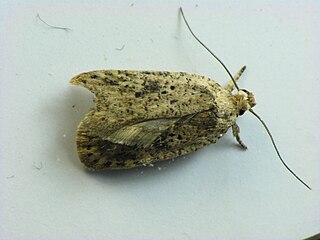
Comotechna corculata is a moth in the family Depressariidae. It was described by Meyrick in 1921. It is found in Brazil (Para) and Peru. [1]

Moths comprise a group of insects related to butterflies, belonging to the order Lepidoptera. Most lepidopterans are moths, and there are thought to be approximately 160,000 species of moth, many of which have yet to be described. Most species of moth are nocturnal, but there are also crepuscular and diurnal species.
Depressariidae is a family of moths. It has formerly been treated as a subfamily of Gelechiidae, but is now recognised as a separate family, comprising about 2300 species worldwide.

Brazil, officially the Federative Republic of Brazil, is the largest country in both South America and Latin America. At 8.5 million square kilometers and with over 208 million people, Brazil is the world's fifth-largest country by area and the fifth most populous. Its capital is Brasília, and its most populated city is São Paulo. The federation is composed of the union of the 26 states, the Federal District, and the 5,570 municipalities. It is the largest country to have Portuguese as an official language and the only one in the Americas; it is also one of the most multicultural and ethnically diverse nations, due to over a century of mass immigration from around the world.
The wingspan is 9–10 mm. The forewings are fuscous with the basal third of the costa dark fuscous, cut by an oblique whitish mark at one-fourth, beneath this a yellow-ochreous streak. There is an obliquely curved suffused dark fuscous fasciate streak from one-fourth of the dorsum to this, enclosed by two whitish-ochreous streaks and with an oblique-oval medio-dorsal blotch reaching three-fourths across the wing, formed of yellow-ochreous suffusion edged with dark fuscous suffusion and then with whitish. Beyond this is a parallel whitish streak, confluent with an ochreous-whitish ring surrounding an elongate ochreous-whitish mark and a very oblique orange-ochreous striga from the costa in the middle, preceded and followed by fine white strigae edged dark fuscous. Beyond this is a whitish-ochreous elongate mark and there is a transverse silvery line at three-fourths, followed by an ochreous-whitish costal dot, as well as an oblique whitish-ochreous streak hooked beneath from the lower part of this to a silvery oblique streak crossing the wing near the apex, above this some whitish-ochreous scattered scales. There is a whitish-ochreous terminal line. The hindwings are dark grey. [2]
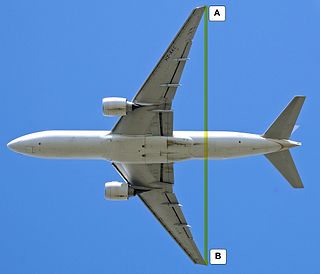
The wingspan of a bird or an airplane is the distance from one wingtip to the other wingtip. For example, the Boeing 777-200 has a wingspan of 60.93 metres, and a wandering albatross caught in 1965 had a wingspan of 3.63 metres, the official record for a living bird. The term wingspan, more technically extent, is also used for other winged animals such as pterosaurs, bats, insects, etc., and other fixed-wing aircraft such as ornithopters. In humans, the term wingspan also refers to the arm span, which is distance between the length from one end of an individual's arms to the other when raised parallel to the ground at shoulder height at a 90º angle. Former professional basketball player Manute Bol stands at 7 ft 7 in (2.31 m) and owns one of the largest wingspans at 8 ft 6 in (2.59 m).